AI-103
Developing AI Apps and Agents on Azure
A free, card-by-card guide to the AI-103 exam. Every card is a single page: the card itself, then a write-up that assumes you know nothing and explains every term it uses. Mapped bullet-by-bullet against the official skills outline, with the corrections I found along the way.
38 cards · 38 written up so far · free, no sign-up · leads to Microsoft Certified: Azure AI Engineer Associate
Domain 1 · Plan and manage
 Card 01
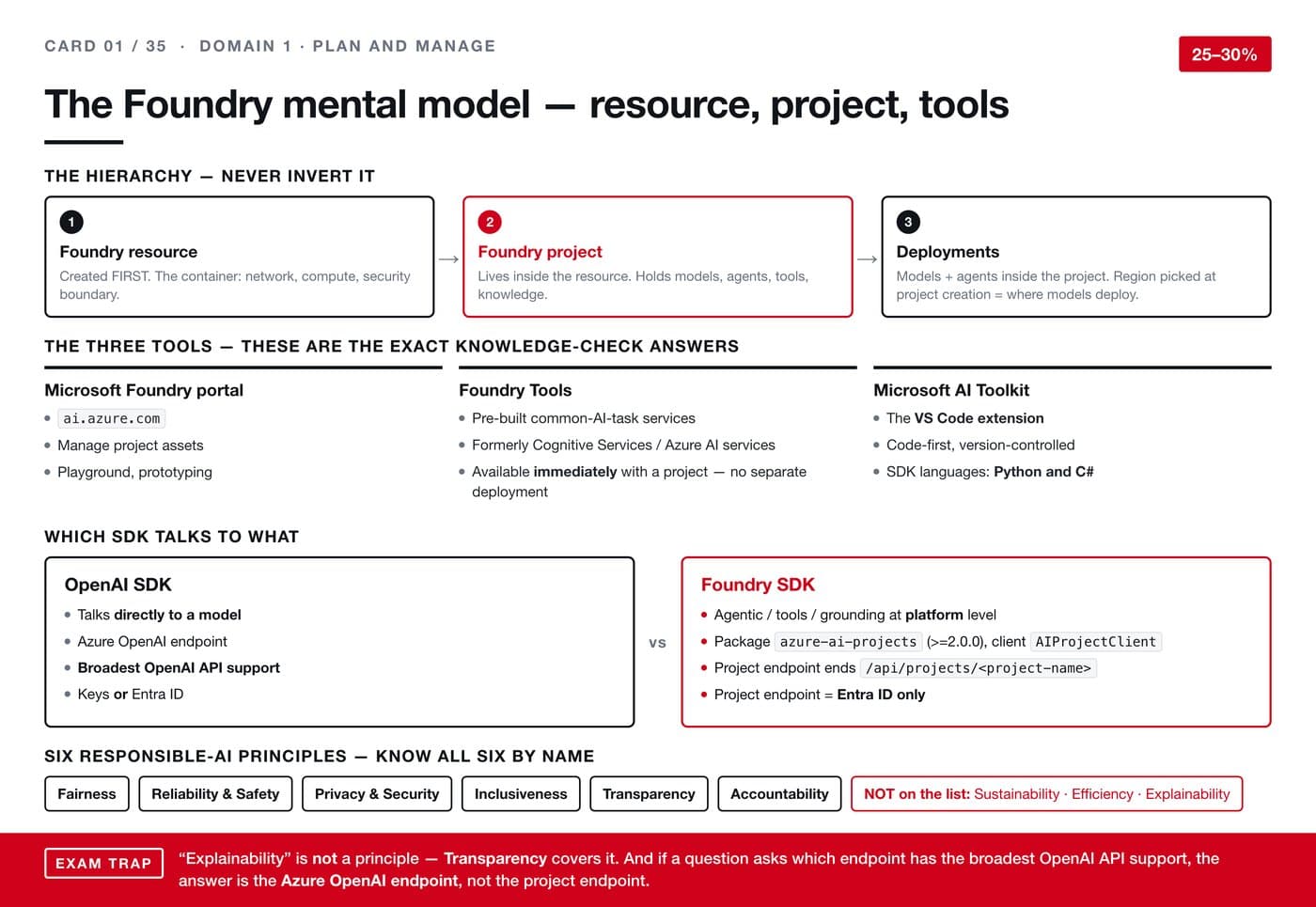
The Foundry mental model — resource, project, tools
The hierarchy you must never invert, which of the three tools does what, when to reach for each SDK, and the six responsible-AI principles by name.
 Card 02
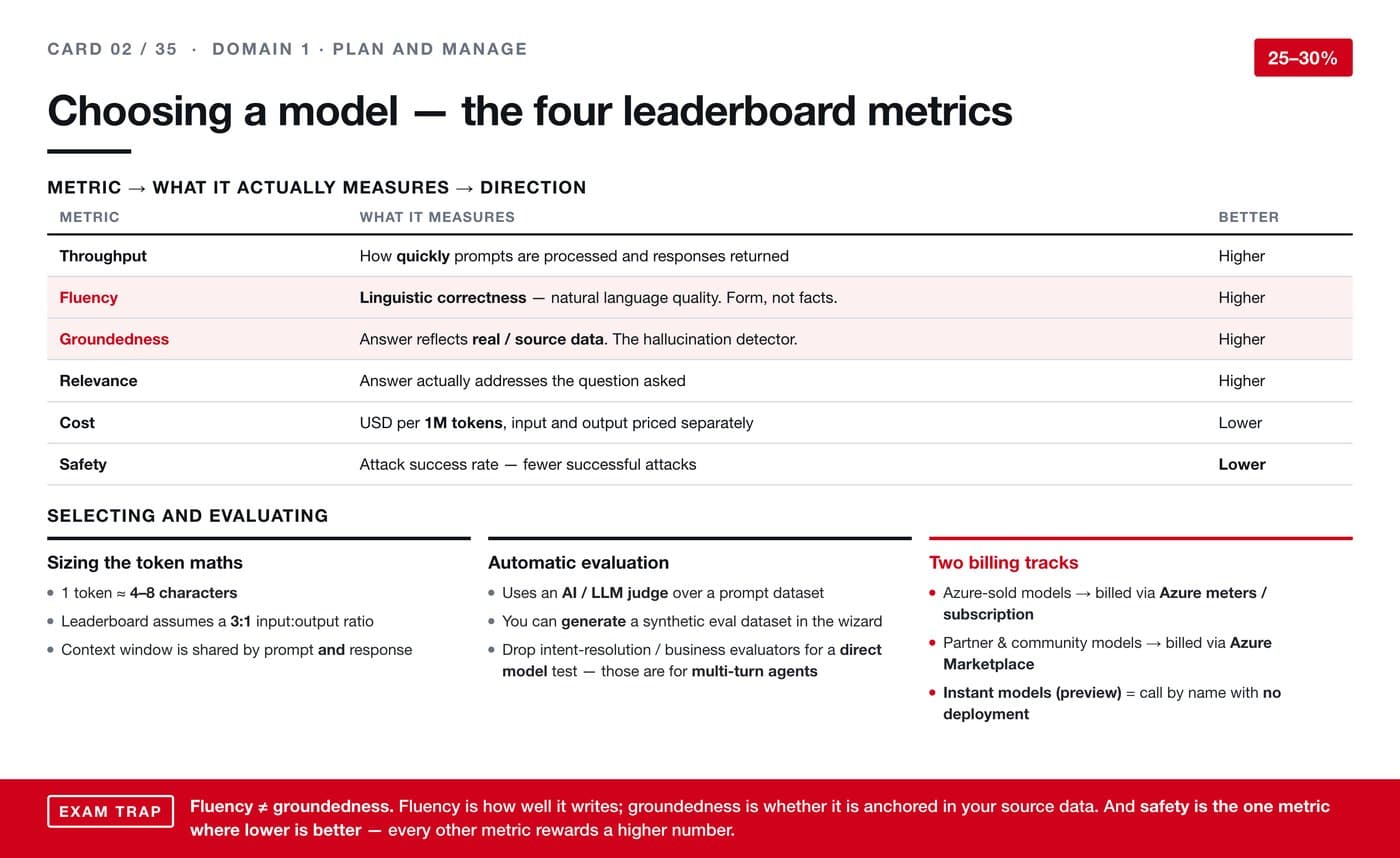
Choosing a model — the four leaderboard metrics
What each leaderboard metric actually measures and which direction is good, the token maths behind sizing, and why fluency and groundedness are not the same thing.
 Card 03
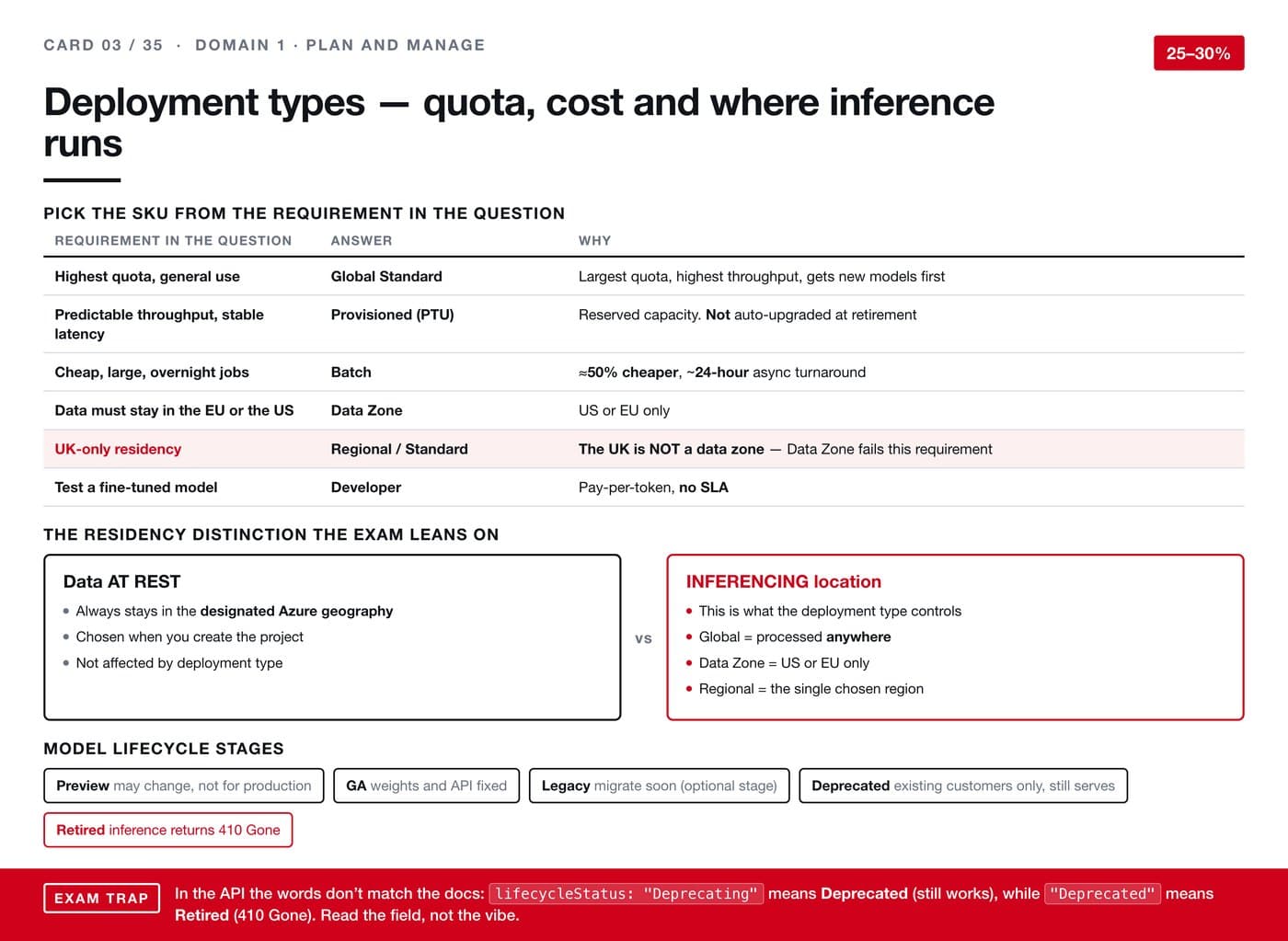
Deployment types — quota, cost and where inference runs
Reading a requirement and naming the deployment, why the UK is not a data zone, the difference between where data rests and where it is processed, and the lifecycle naming trap.
 Card 04
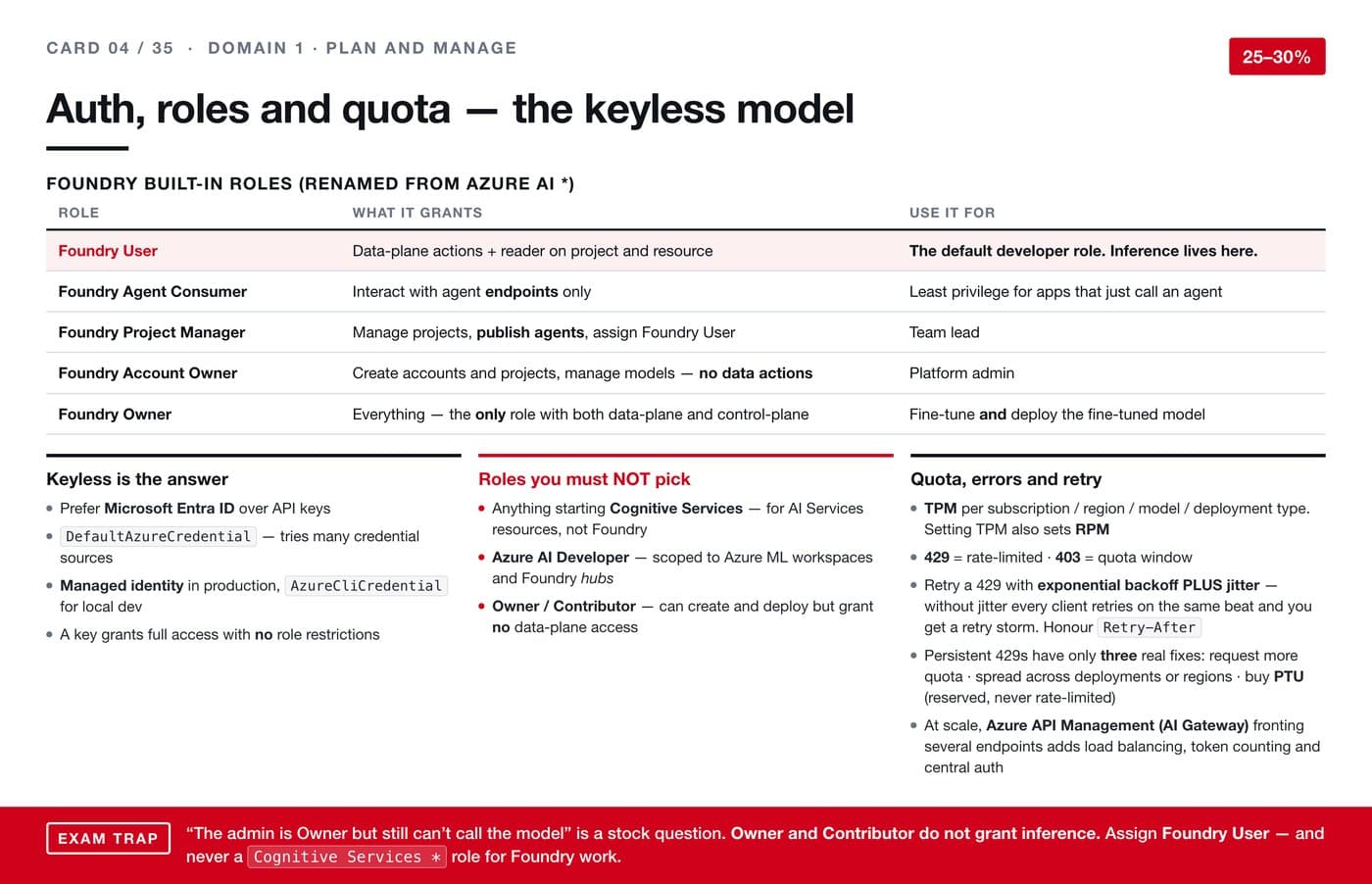
Auth, roles and quota — the keyless model
Identity over keys, the five built-in roles and the three wrong answers, and why the administrator who is Owner still cannot call the model.
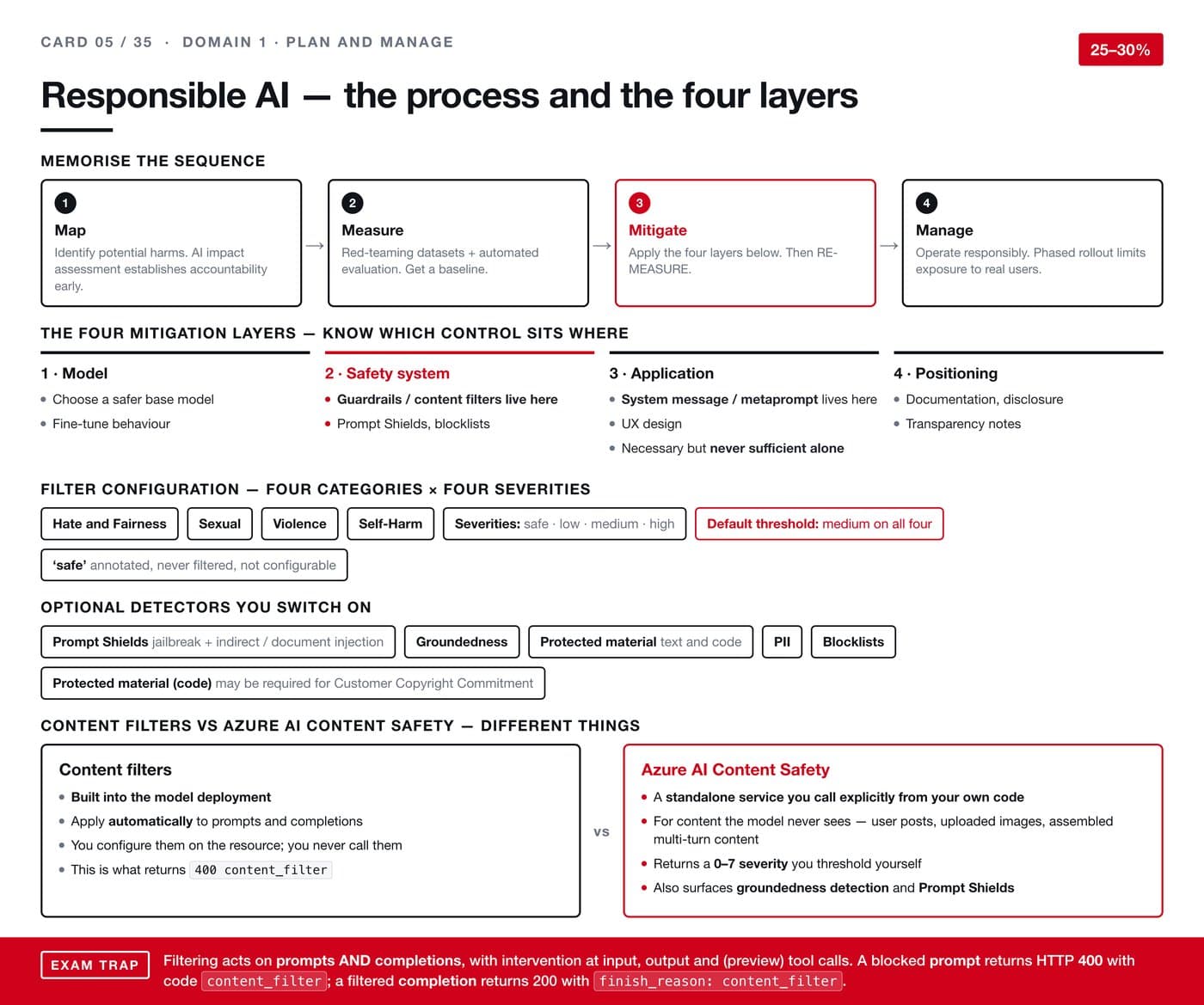 Card 05
Responsible AI — the process and the four layers
Map, measure, mitigate, manage — plus which control sits at which layer, content filters against Content Safety, and what a block actually returns on the wire.
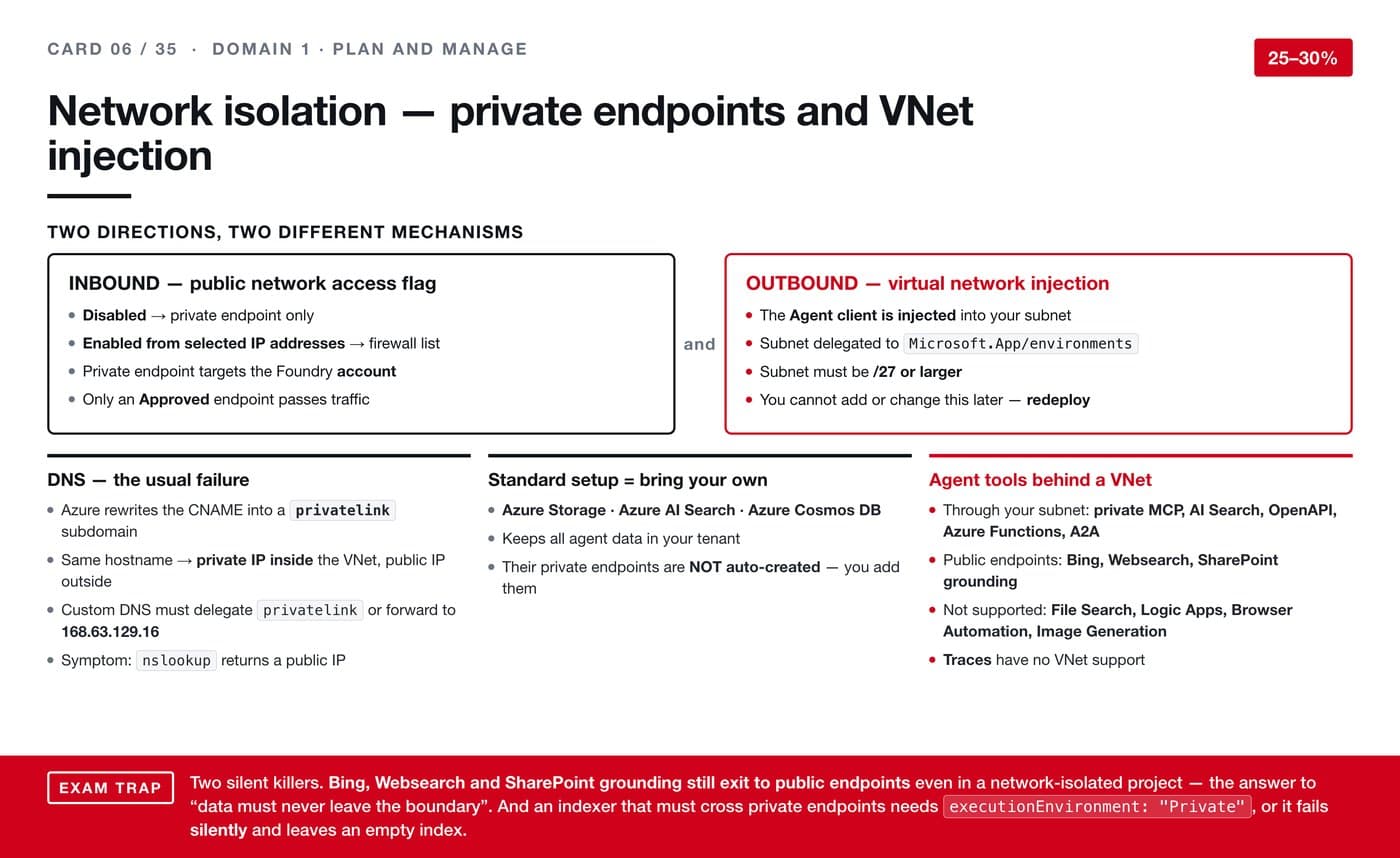 Card 06
Network isolation — private endpoints and VNet injection
Two directions, two mechanisms: inbound private endpoints and outbound VNet injection. Why DNS is where it usually breaks, and the two groundings that leave the boundary silently.
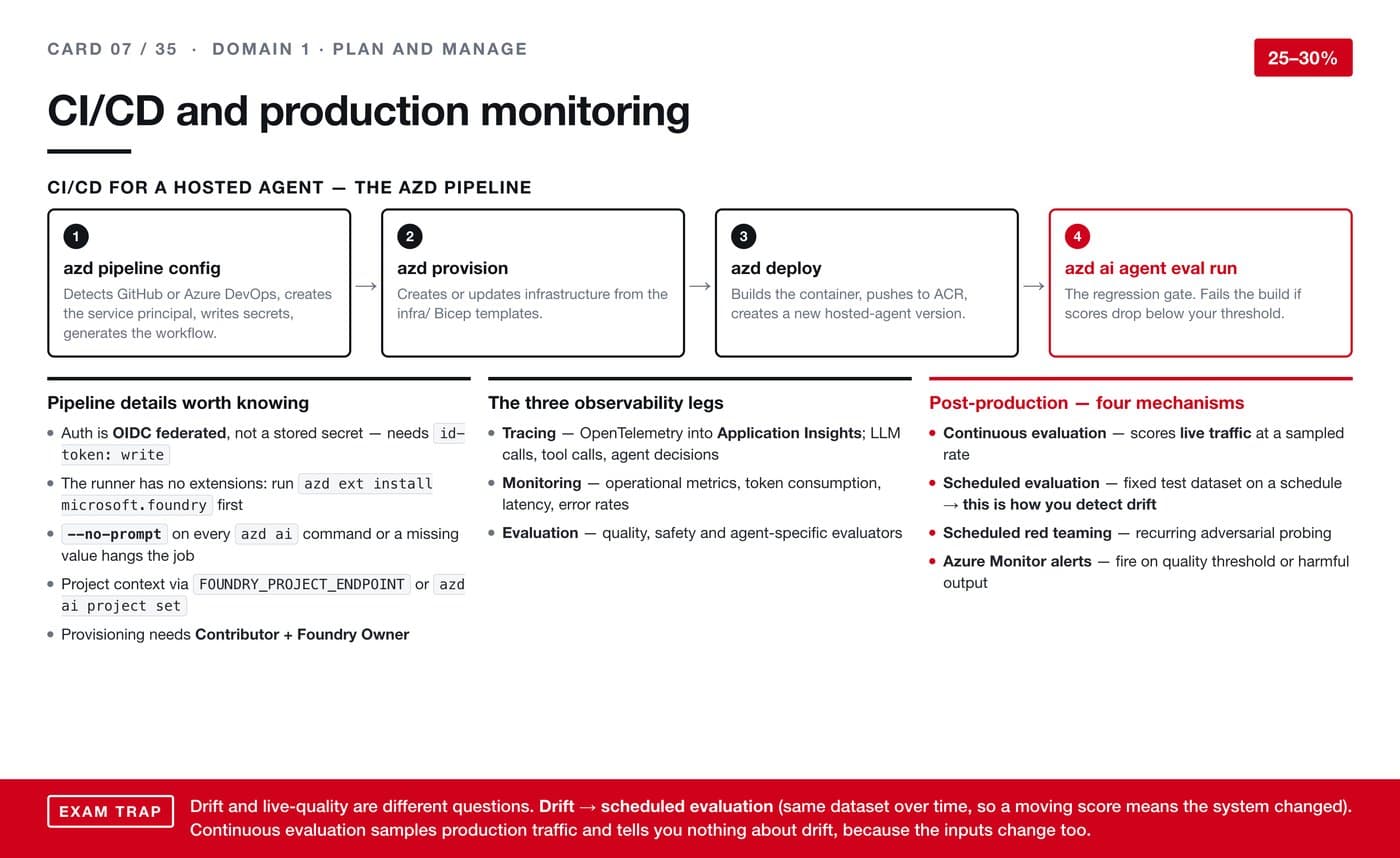 Card 07
CI/CD and production monitoring
The four-step azd pipeline with an evaluation gate, the three legs of observability, and why drift needs a fixed dataset while continuous evaluation cannot detect it.
Domain 2 · Generative AI and agents
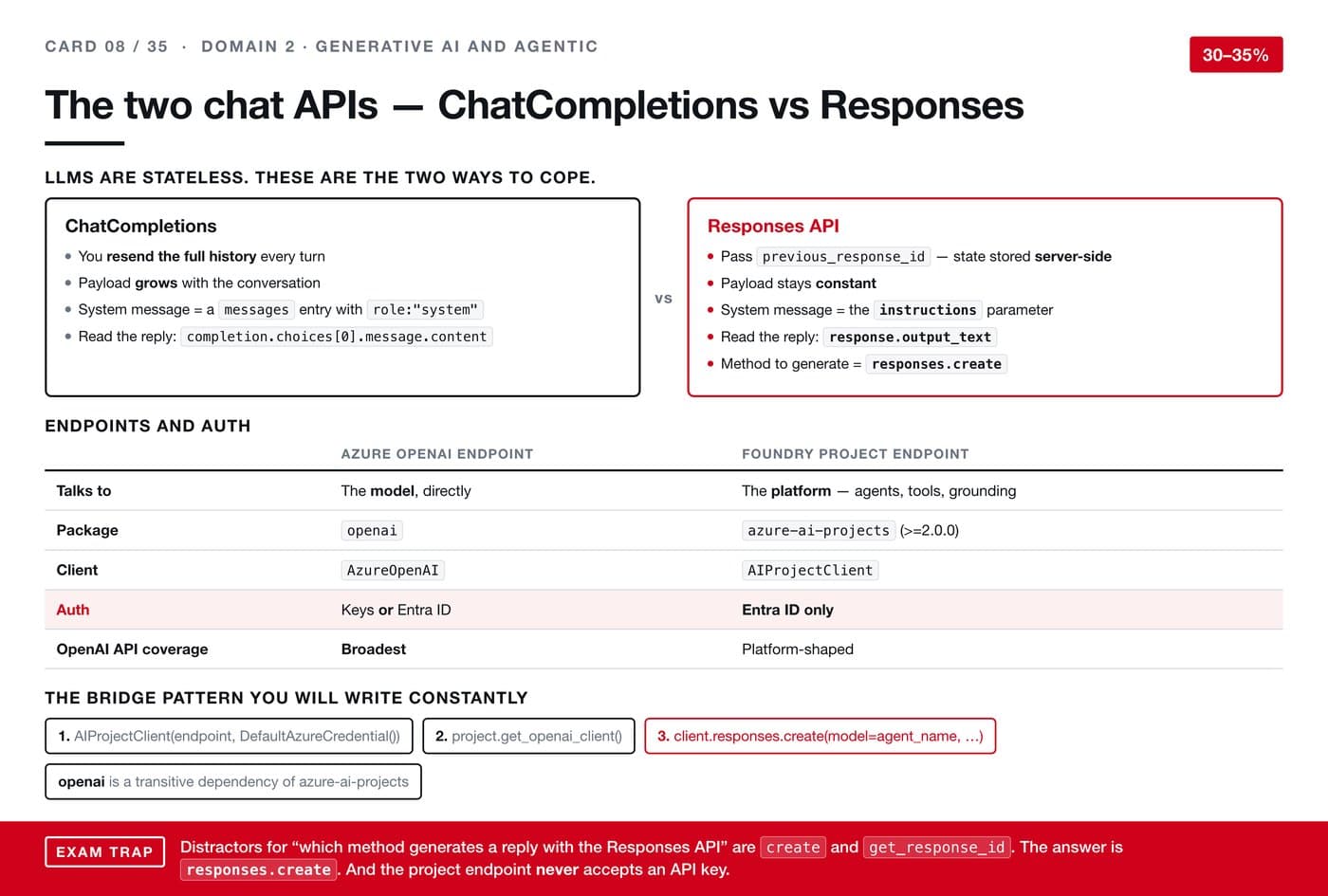 Card 08
The two chat APIs — ChatCompletions vs Responses
Models are stateless, and these are the two ways to cope. Which endpoint talks to what, the one hard rule about keys, and the bridge pattern you will write constantly.
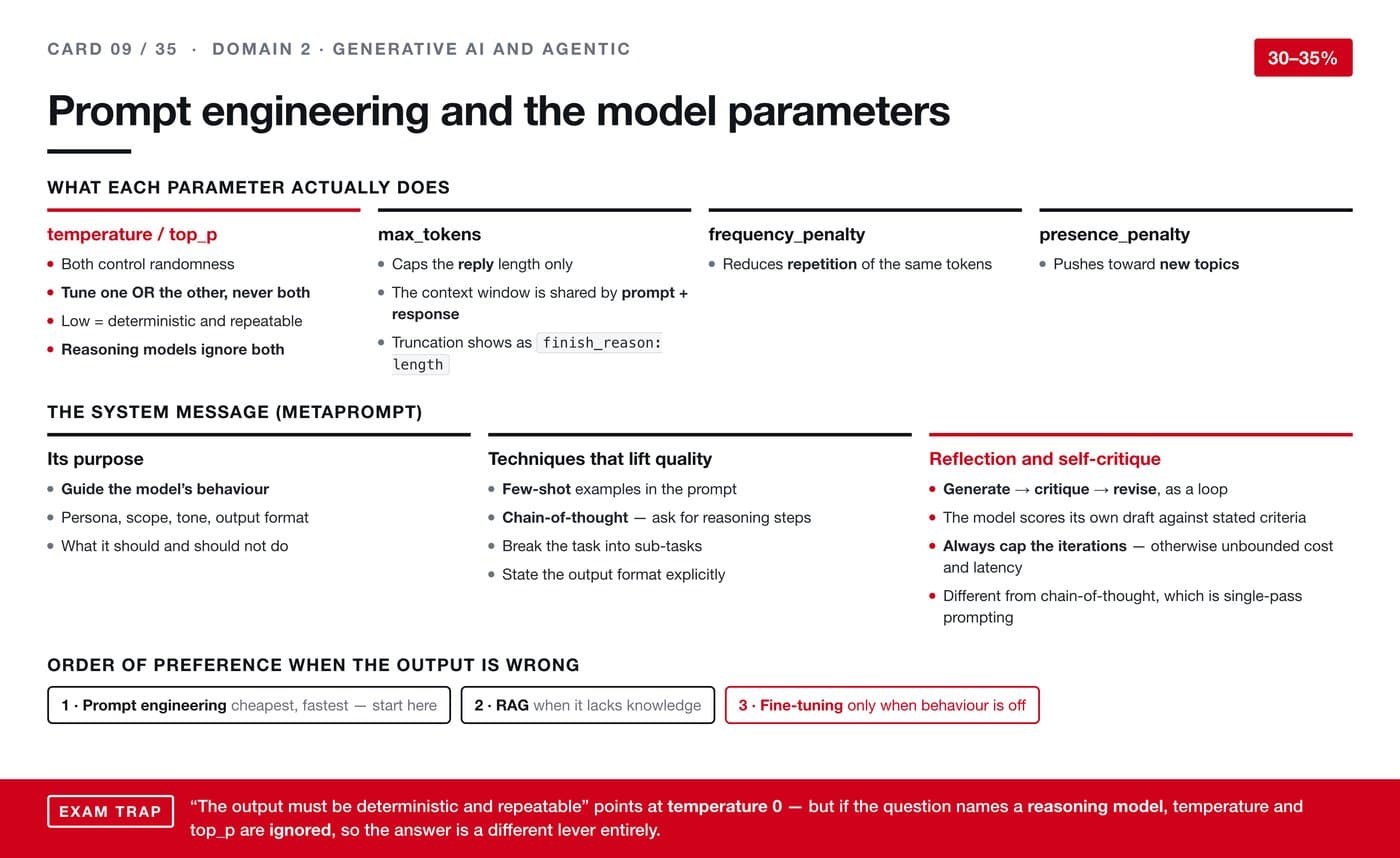 Card 09
Prompt engineering and the model parameters
What each parameter actually controls, why reflection is not chain-of-thought, the order to reach for levers in, and the reasoning-model exception to temperature 0.
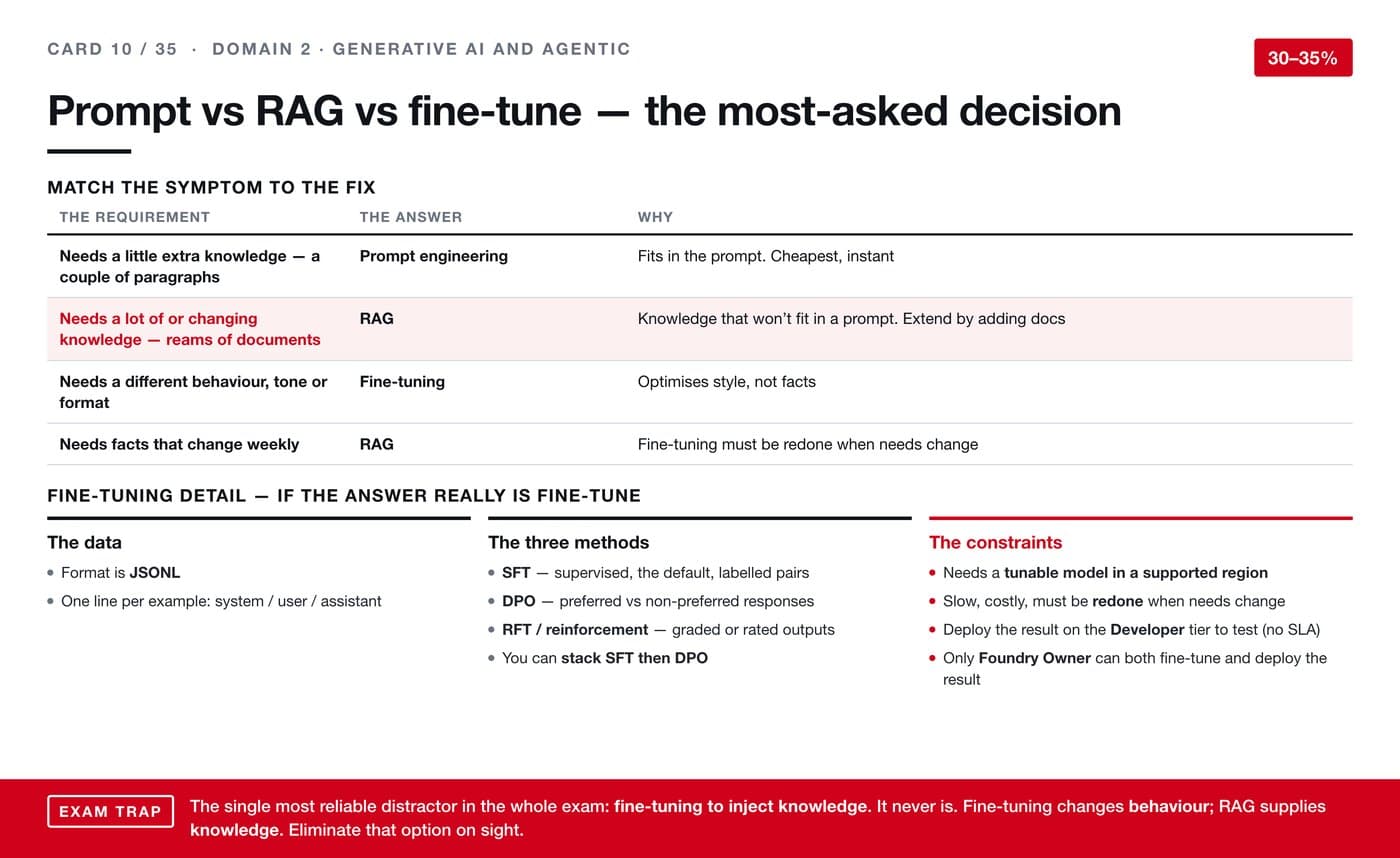 Card 10
Prompt vs RAG vs fine-tune — the most-asked decision
Matching the symptom to the fix, what fine-tuning actually involves if the answer really is fine-tuning, and the single most reliable distractor on the paper.
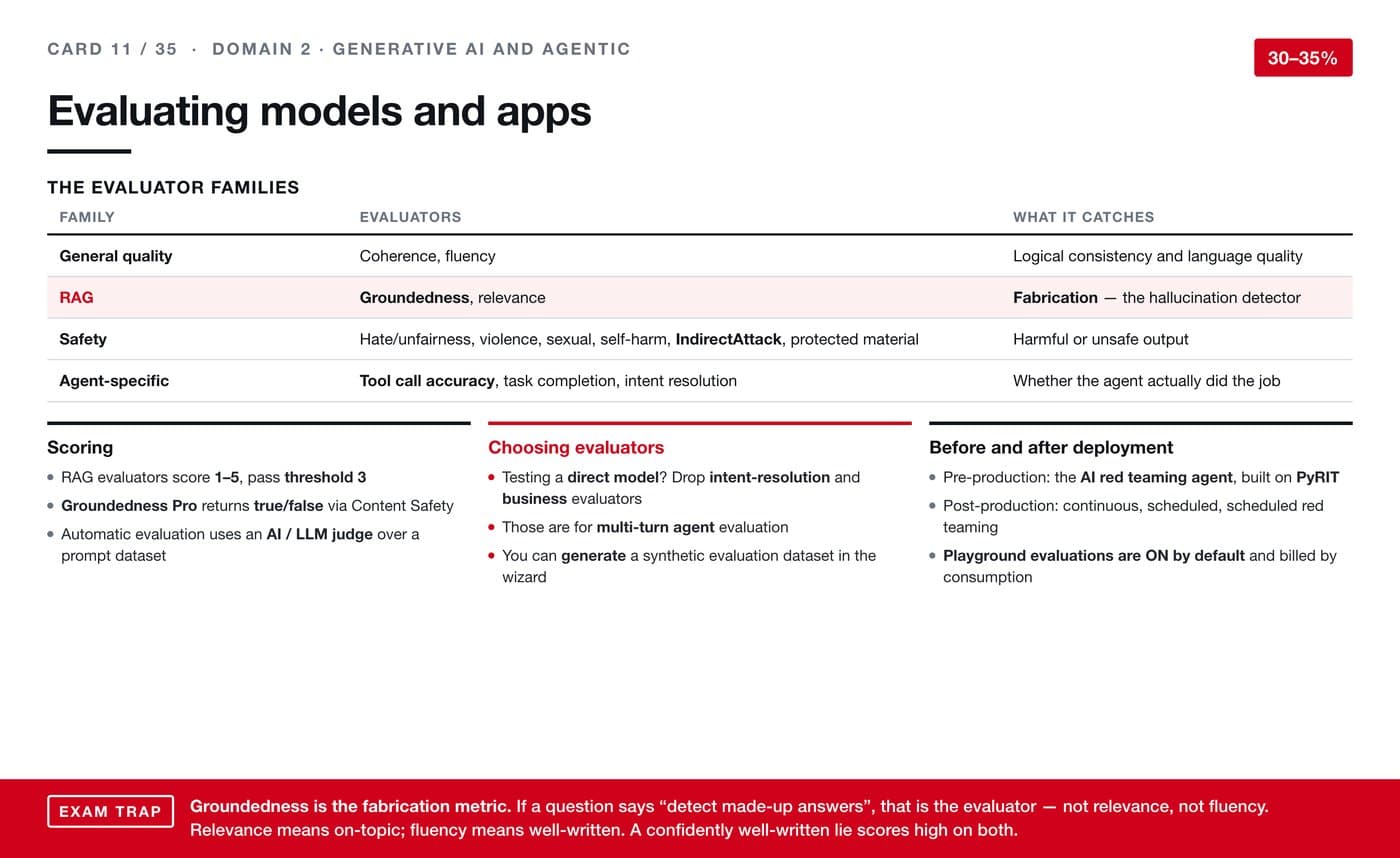 Card 11
Evaluating models and apps
The four evaluator families and what each catches, scoring and thresholds, and why groundedness — not relevance or fluency — is the metric that catches a confident lie.
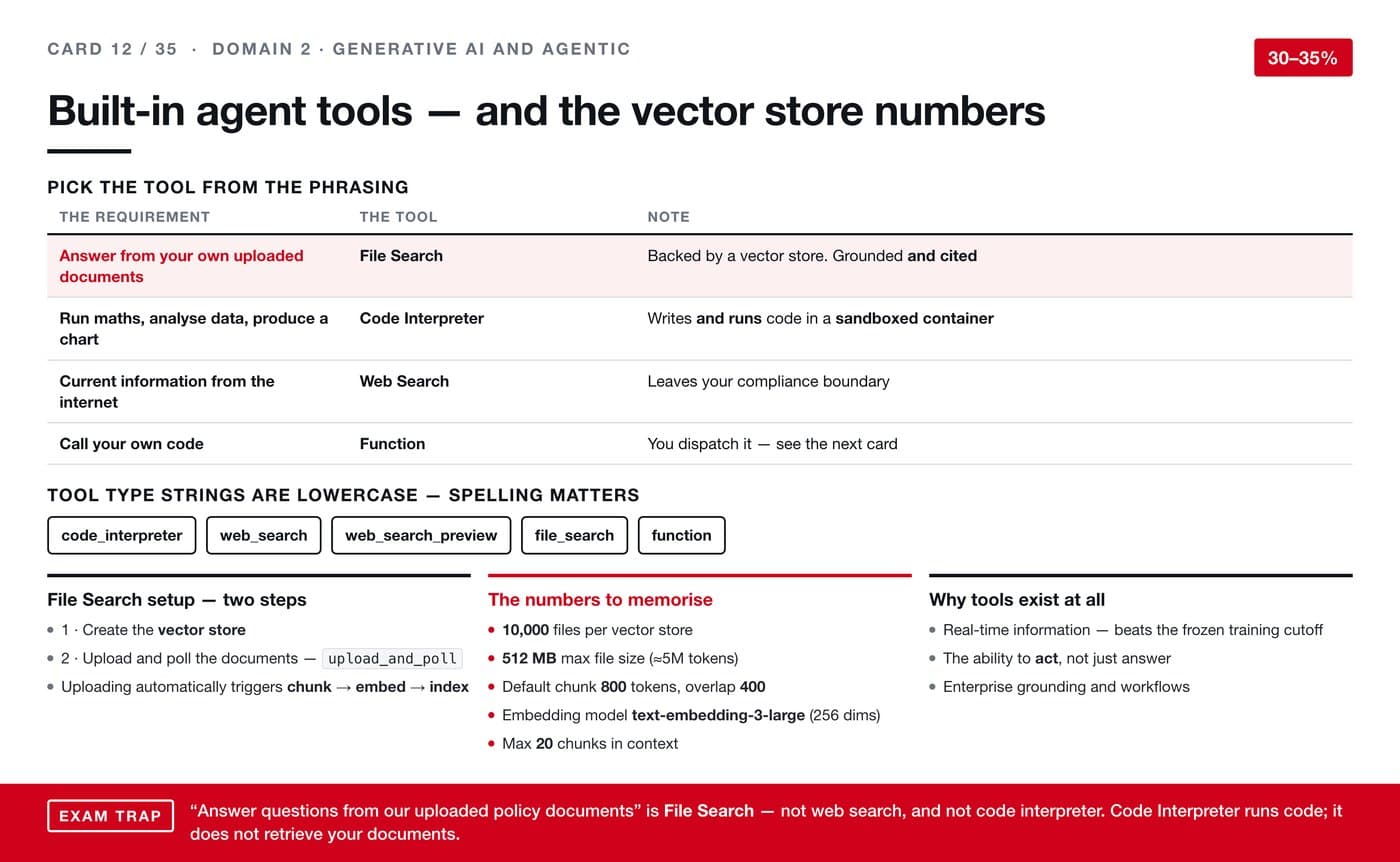 Card 12
Built-in agent tools — and the vector store numbers
Picking the tool from the phrasing, the exact lowercase type strings, the File Search setup and the vector store constants worth memorising.
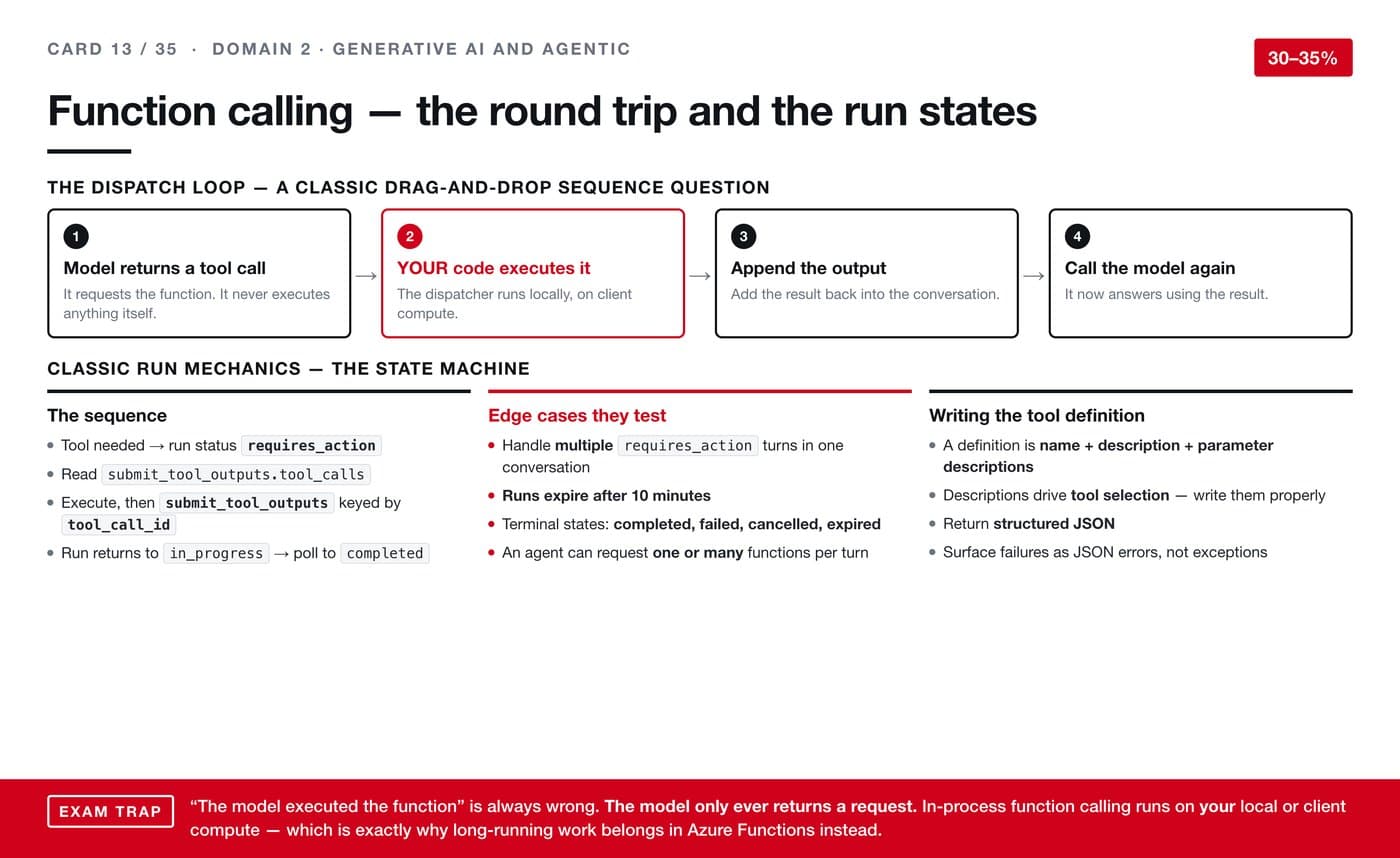 Card 13
Function calling — the round trip and the run states
The four-step dispatch loop, the run state machine and its edge cases, and the thing that is always wrong: the model never executes your function.
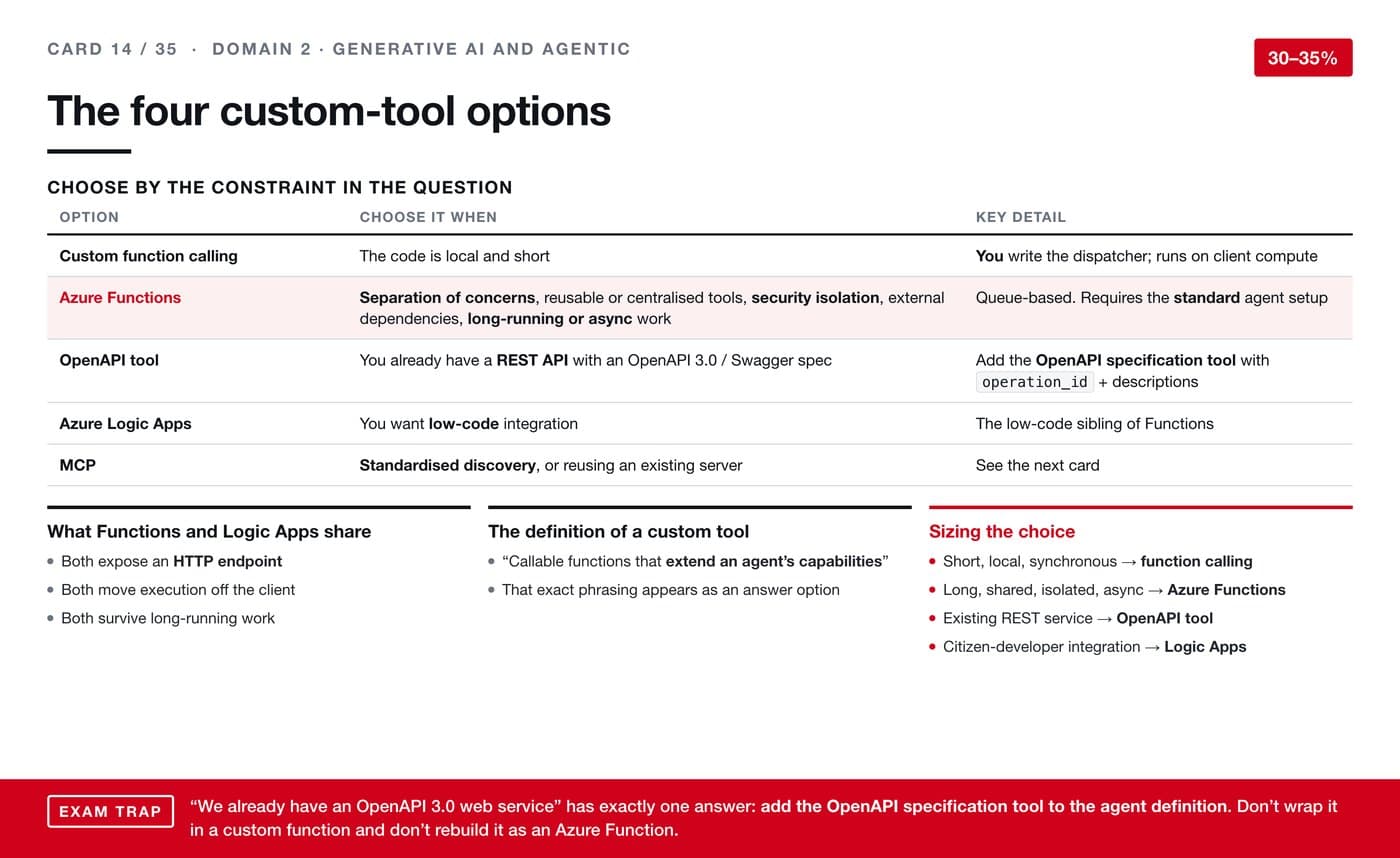 Card 14
The four custom-tool options
Choosing by the constraint in the question, what Functions and Logic Apps share, and the one answer when an OpenAPI service already exists.
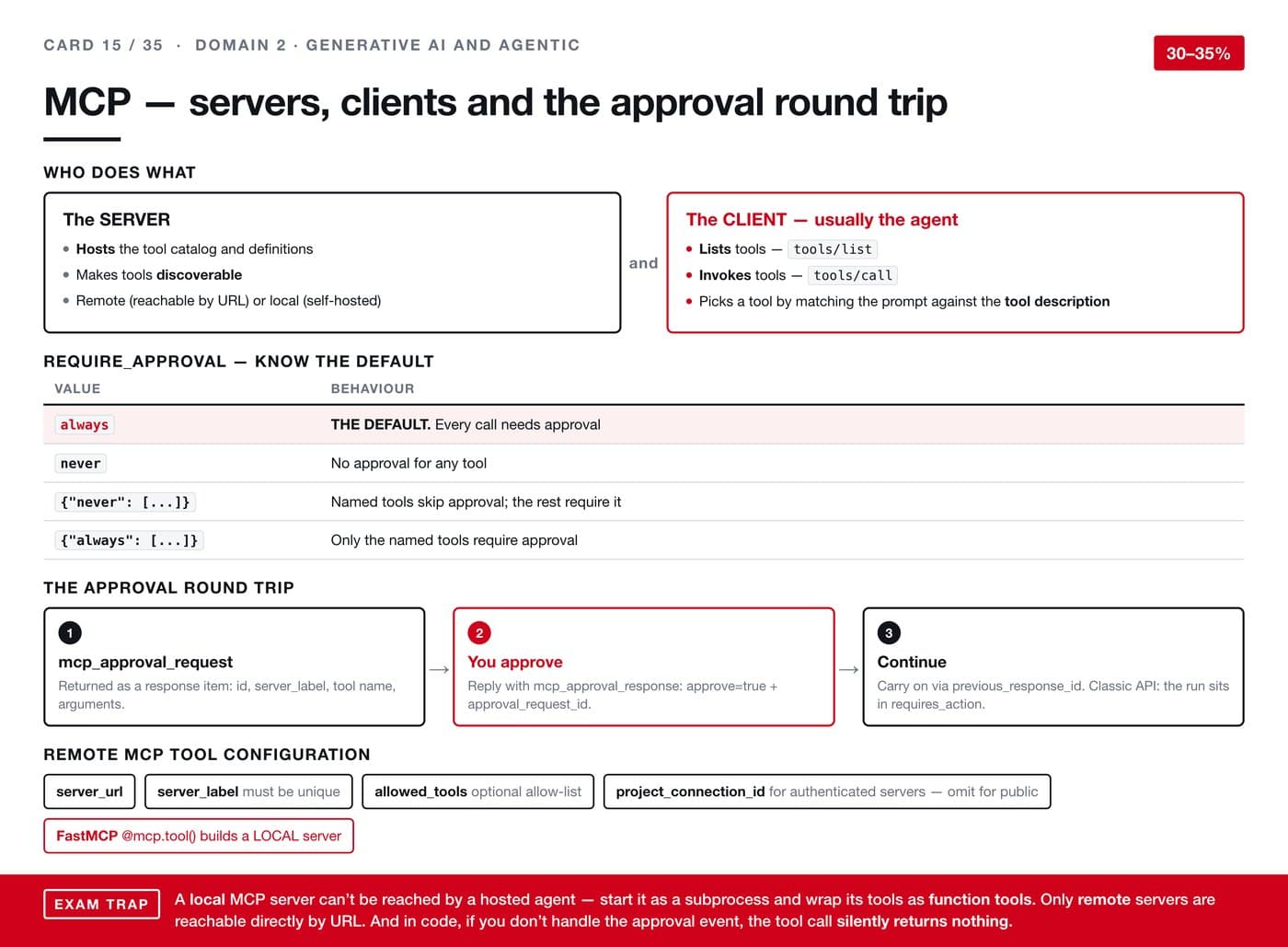 Card 15
MCP — servers, clients and the approval round trip
Who does what, why the approval default explains most "it does nothing" reports, and the two silent failures — unreachable local servers and unhandled approval events.
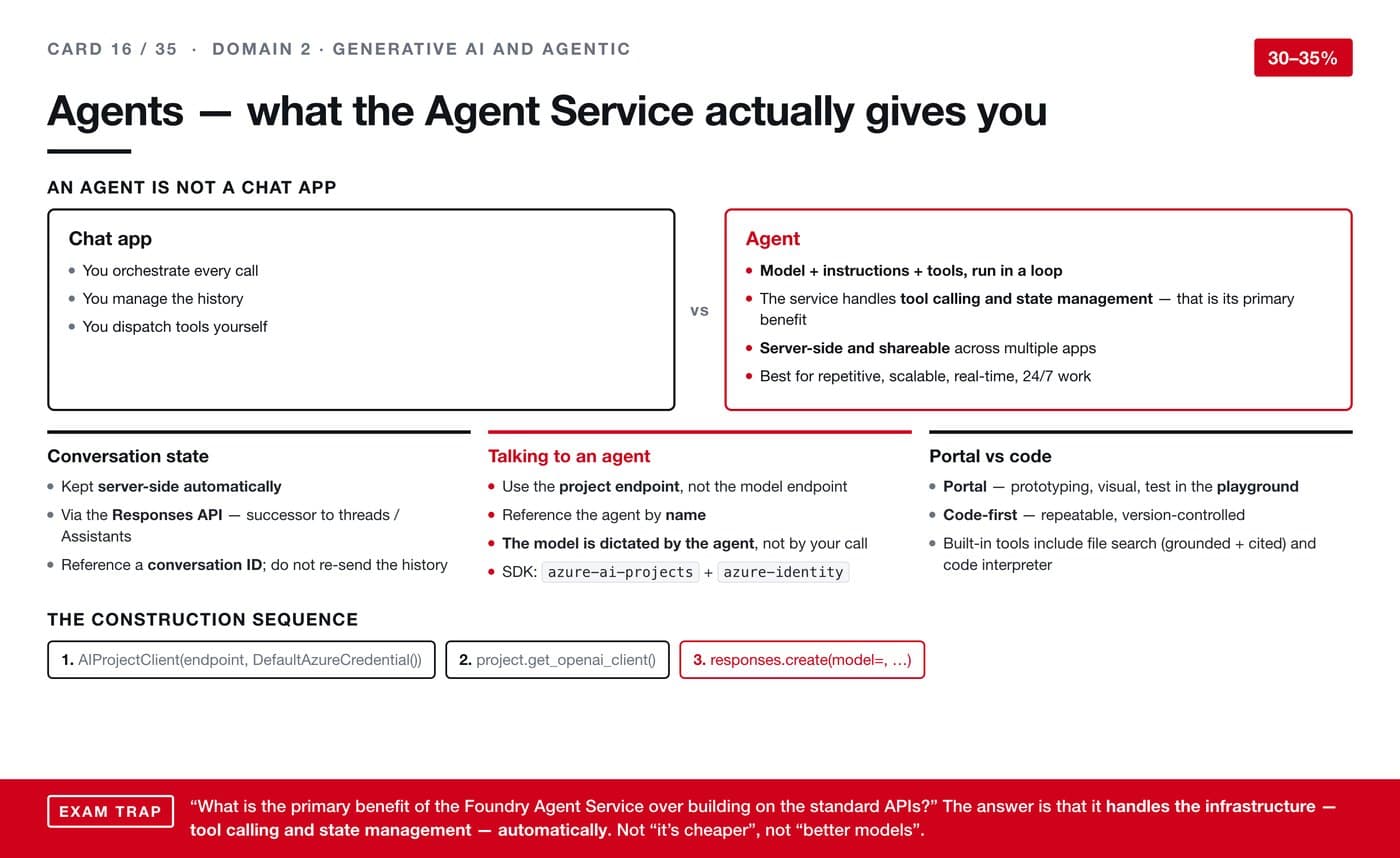 Card 16
Agents — what the Agent Service actually gives you
Why an agent is not a chat app, how conversation state is held, why the agent dictates the model, and the real answer to what the service buys you.
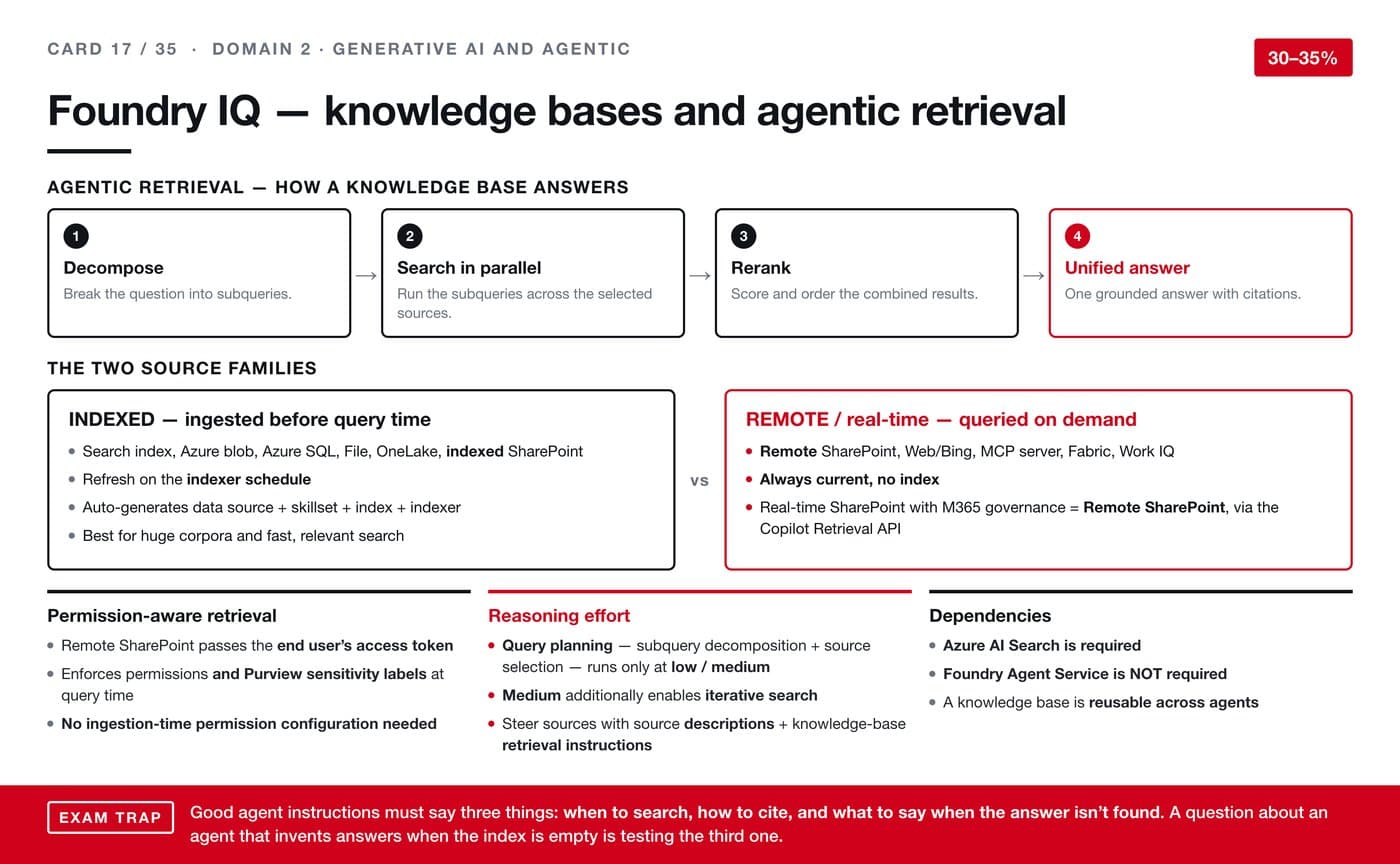 Card 17
Foundry IQ — knowledge bases and agentic retrieval
Decompose, search in parallel, rerank, answer. Indexed against remote sources, permission-aware retrieval with the user’s own token, and the instruction people forget.
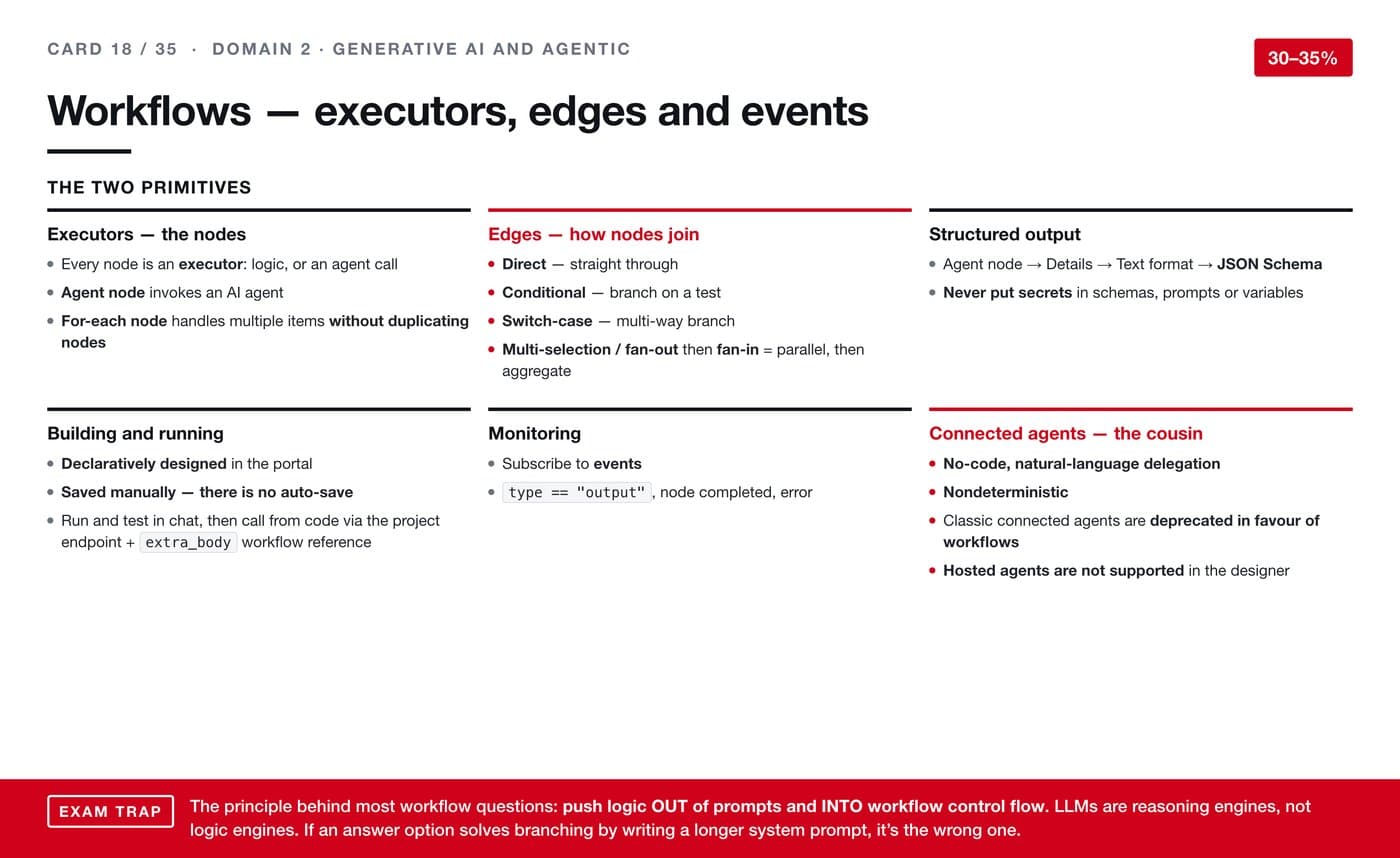 Card 18
Workflows — executors, edges and events
The two primitives and the four edge types, plus the principle behind most workflow questions — push logic out of prompts and into control flow.
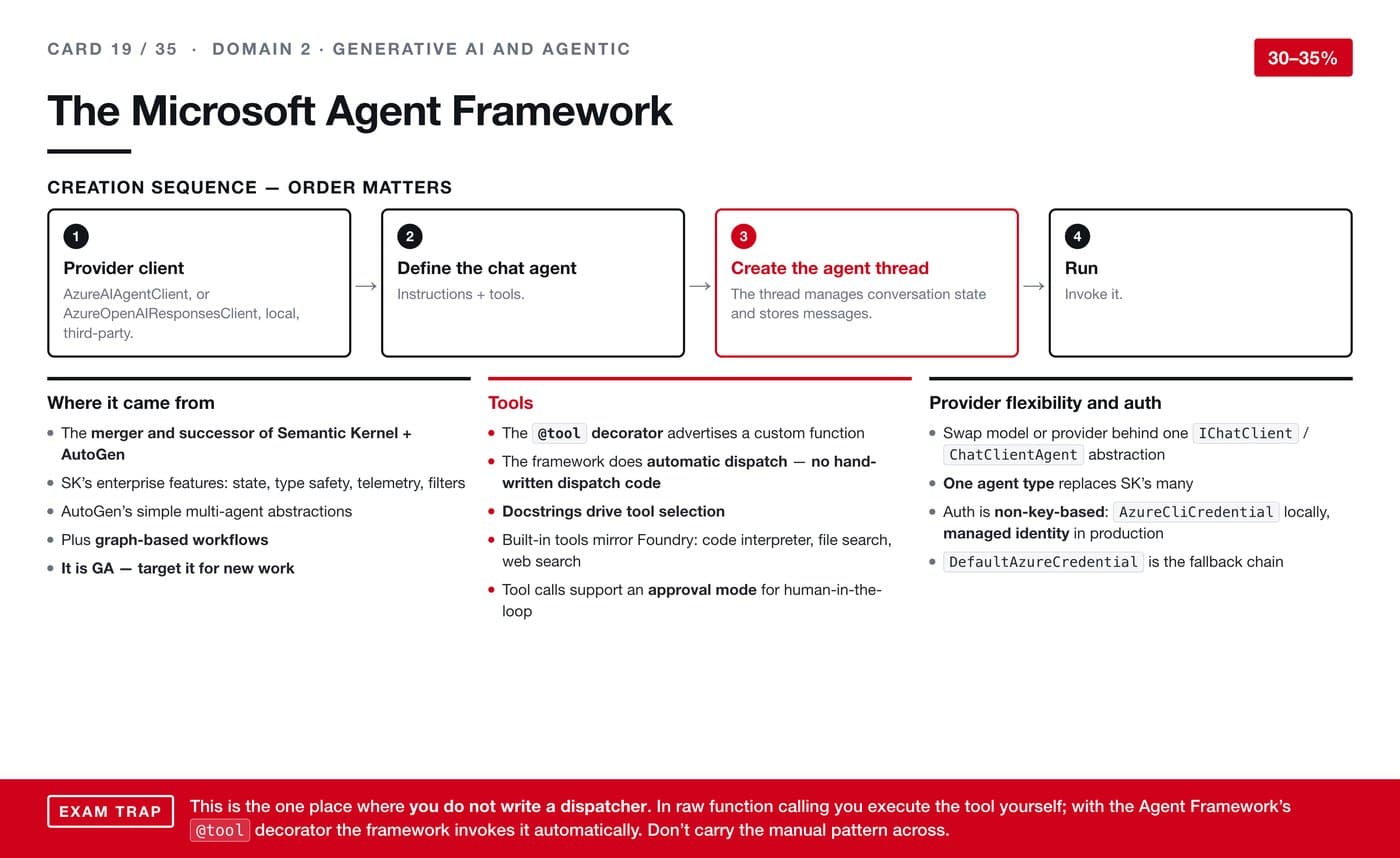 Card 19
The Microsoft Agent Framework
What it inherited from Semantic Kernel and AutoGen, the creation sequence, and the one place where you do not write a dispatcher.
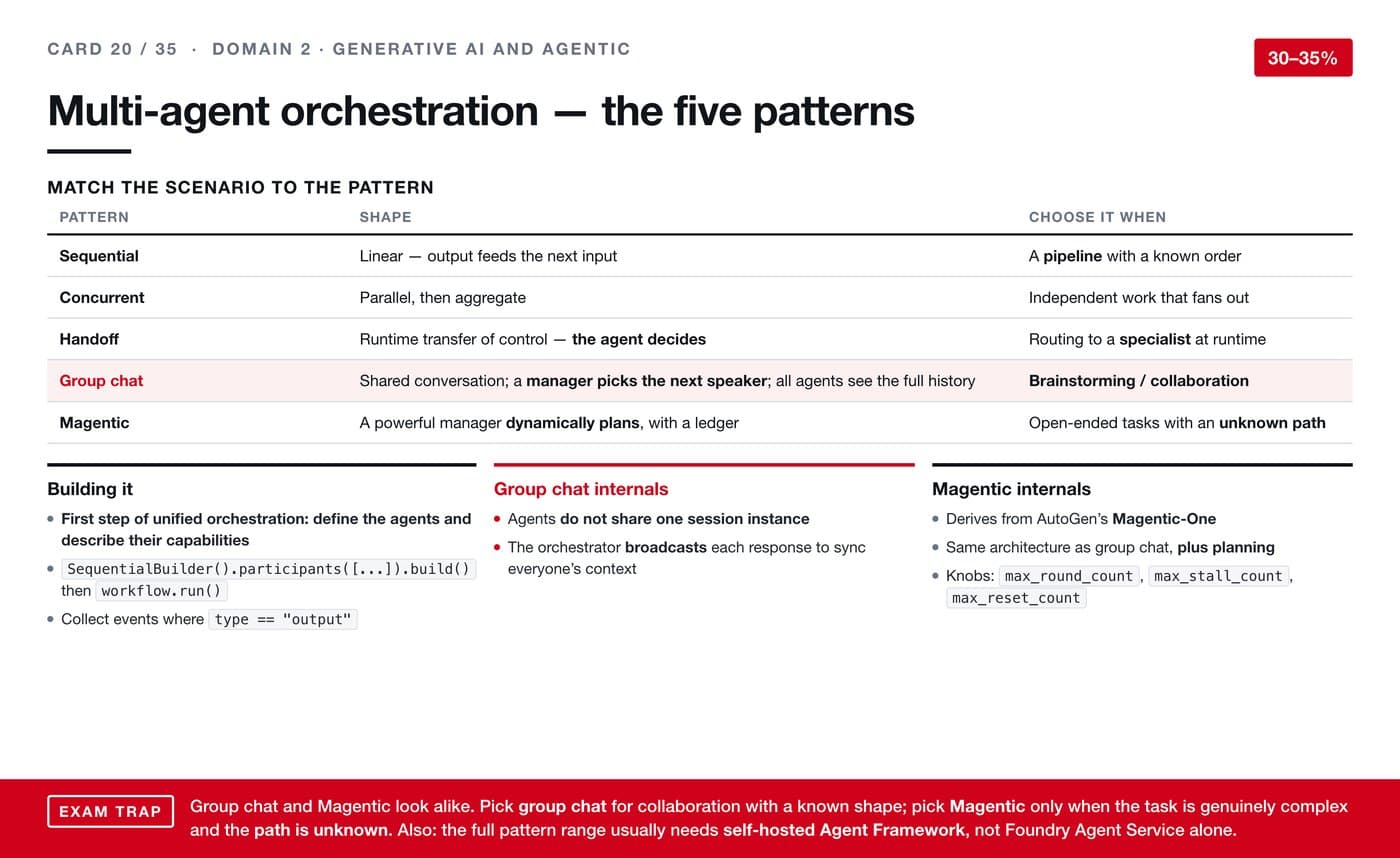 Card 20
Multi-agent orchestration — the five patterns
Matching the scenario to the pattern by asking who decides what happens next, and how to tell group chat from Magentic when they look alike.
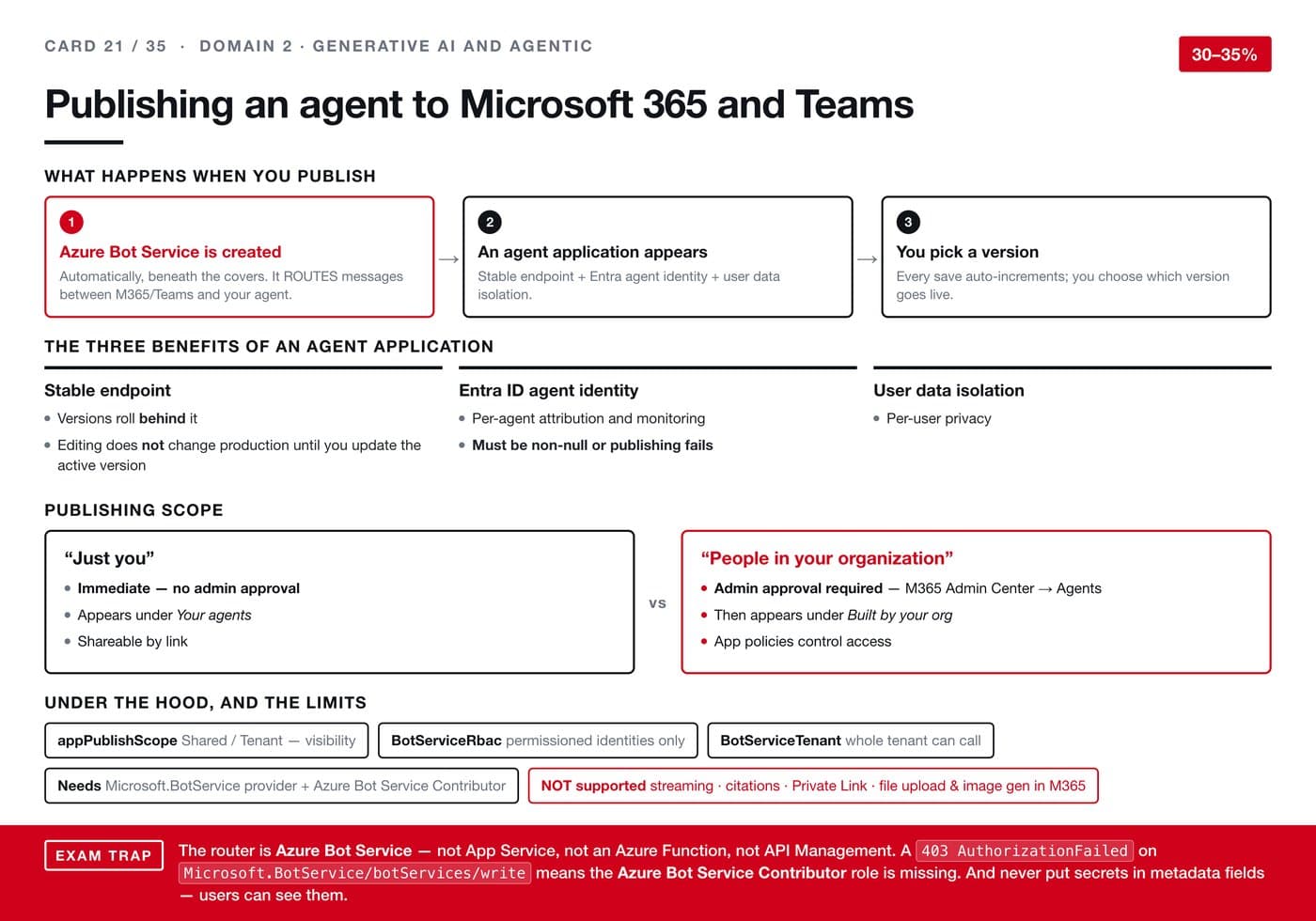 Card 21
Publishing an agent to Microsoft 365 and Teams
What is created beneath the covers, the two publishing scopes and the governance gate between them, and the error code mapped to a missing role.
Domain 3 · Computer vision
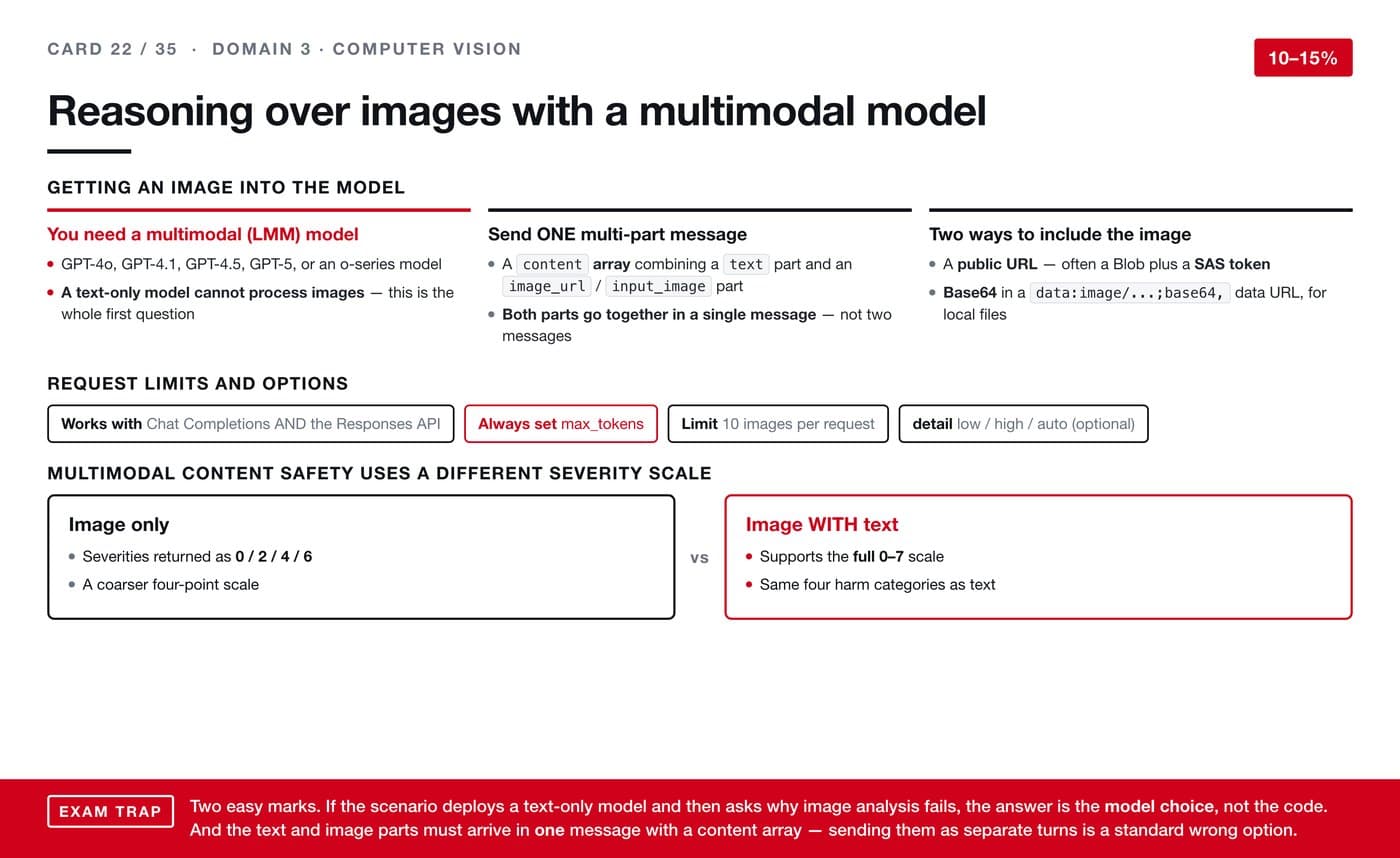 Card 22
Reasoning over images with a multimodal model
Two easy marks — a text-only model cannot see, and the text and image parts must arrive in one message. Plus the coarser severity scale image-only content returns.
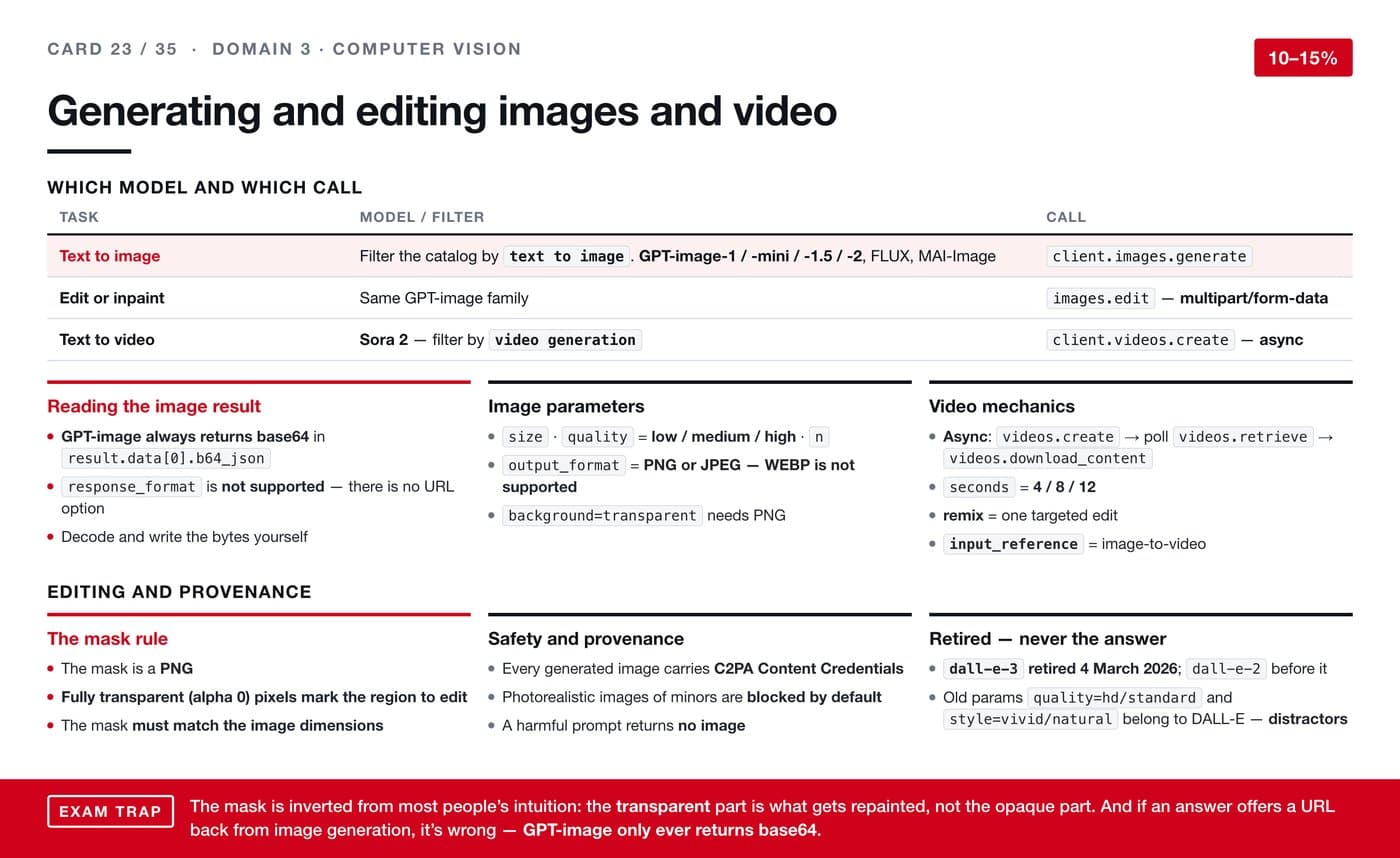 Card 23
Generating and editing images and video
Which model and which call, why there is never a URL to read back, and the mask rule that is inverted from most people’s intuition.
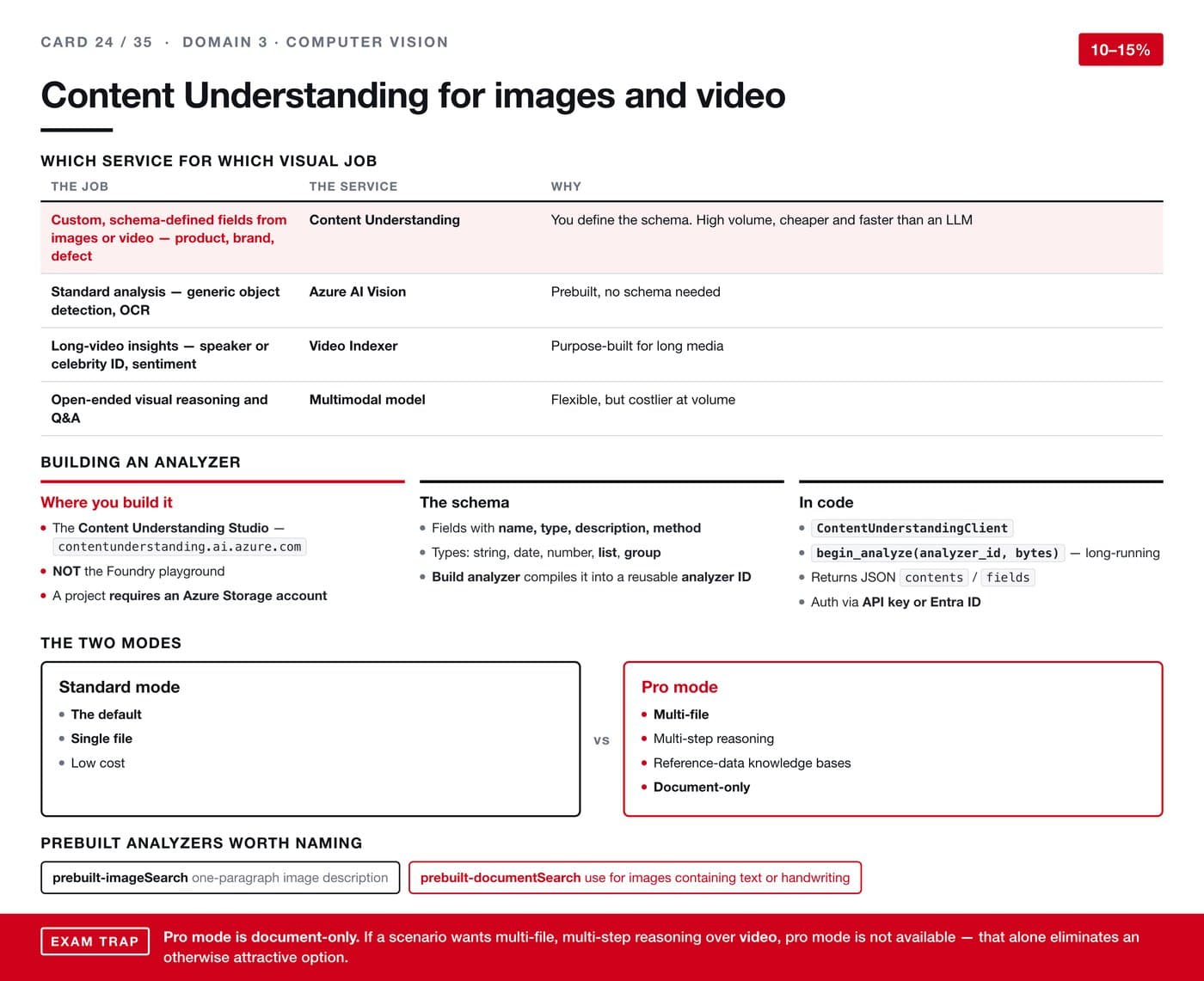 Card 24
Content Understanding for images and video
Picking the service from the job, building an analyzer against your own schema, and the single constraint that eliminates Pro mode from video scenarios.
Domain 4 · Text analysis and speech
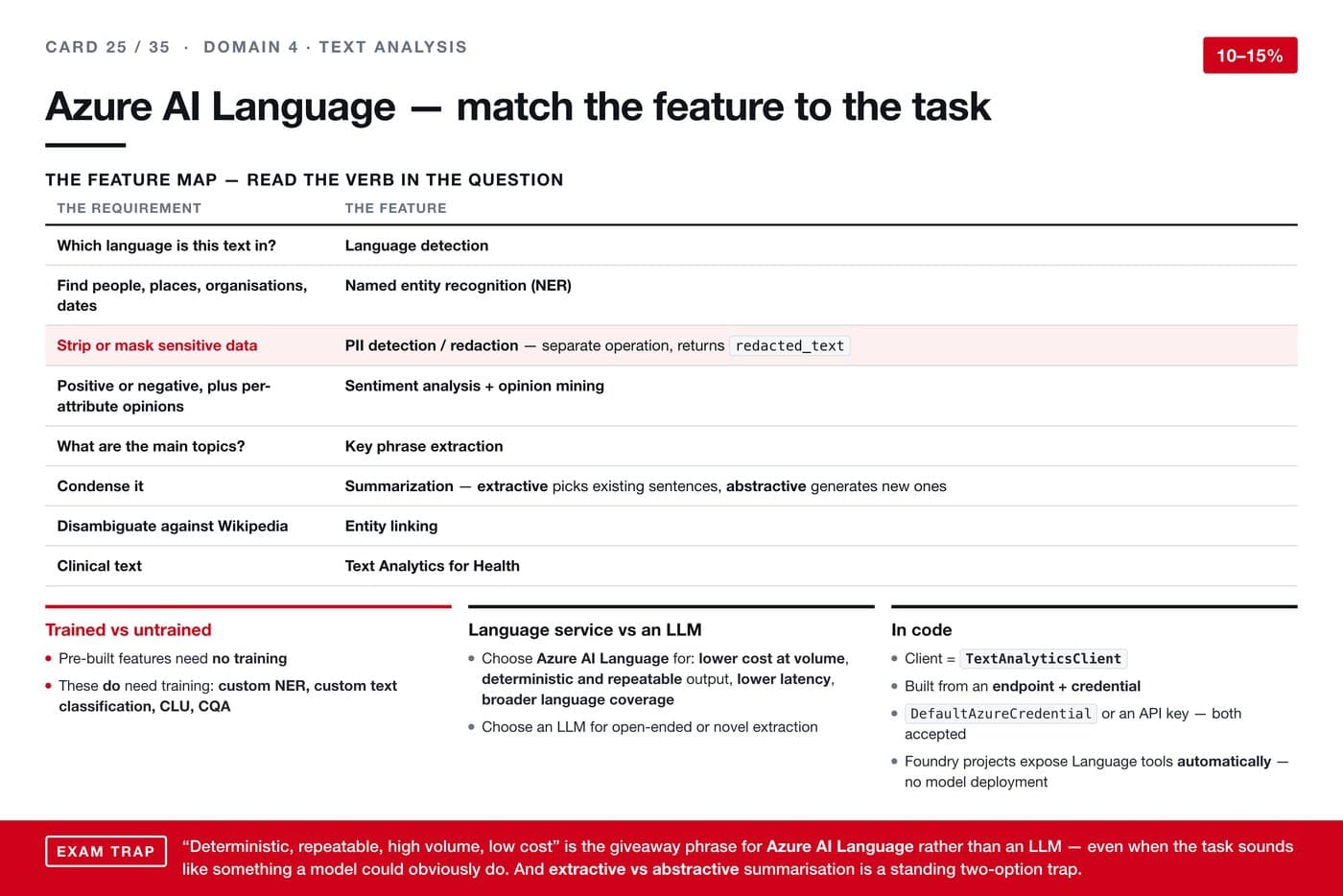 Card 25
Azure AI Language — match the feature to the task
Reading the verb to name the feature, extractive against abstractive summarisation, and the phrase that signals the Language service rather than a model.
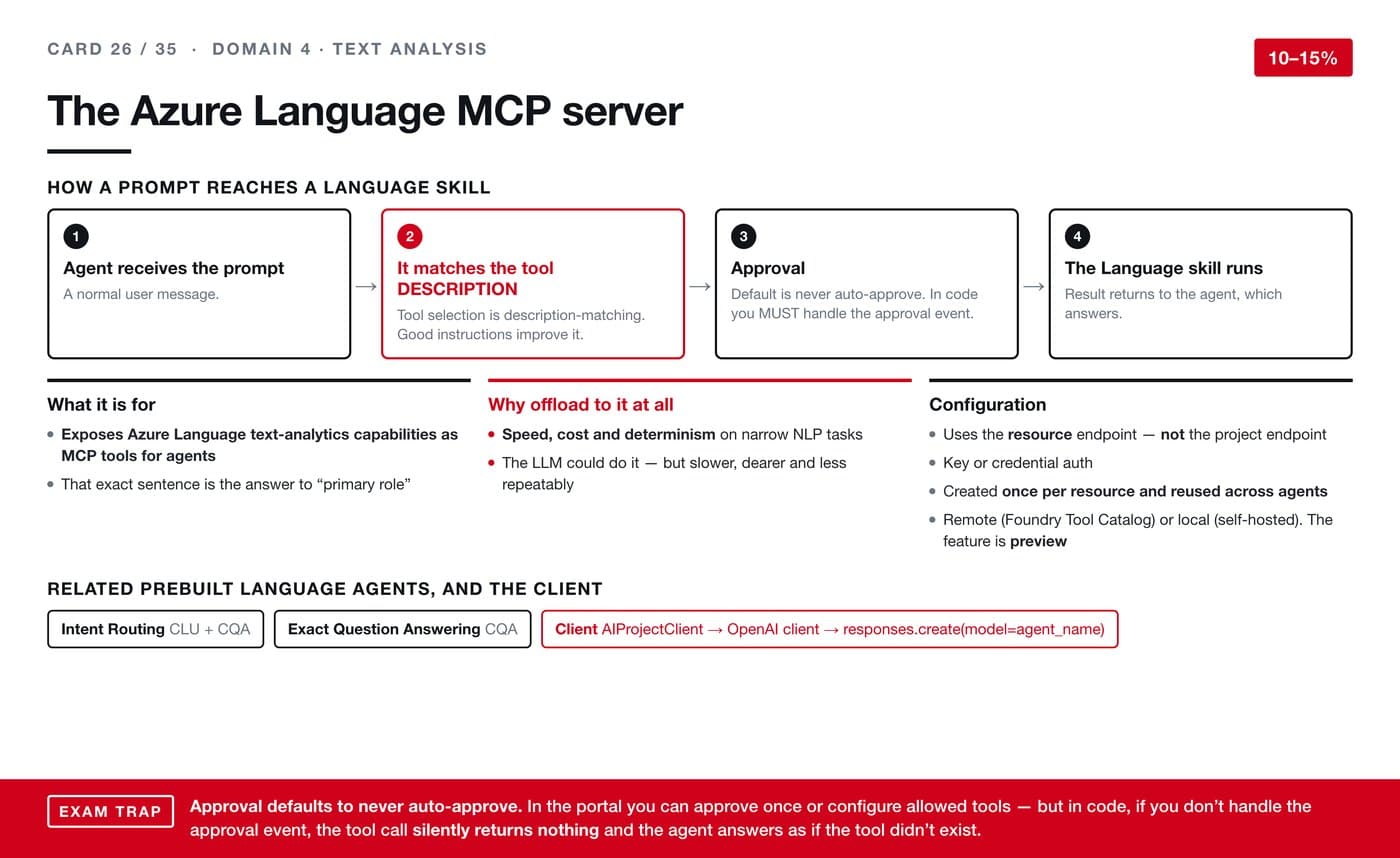 Card 26
The Azure Language MCP server
How a prompt reaches a language skill, why offloading narrow tasks beats reasoning your way to them, and the unhandled approval event that answers as if the tool did not exist.
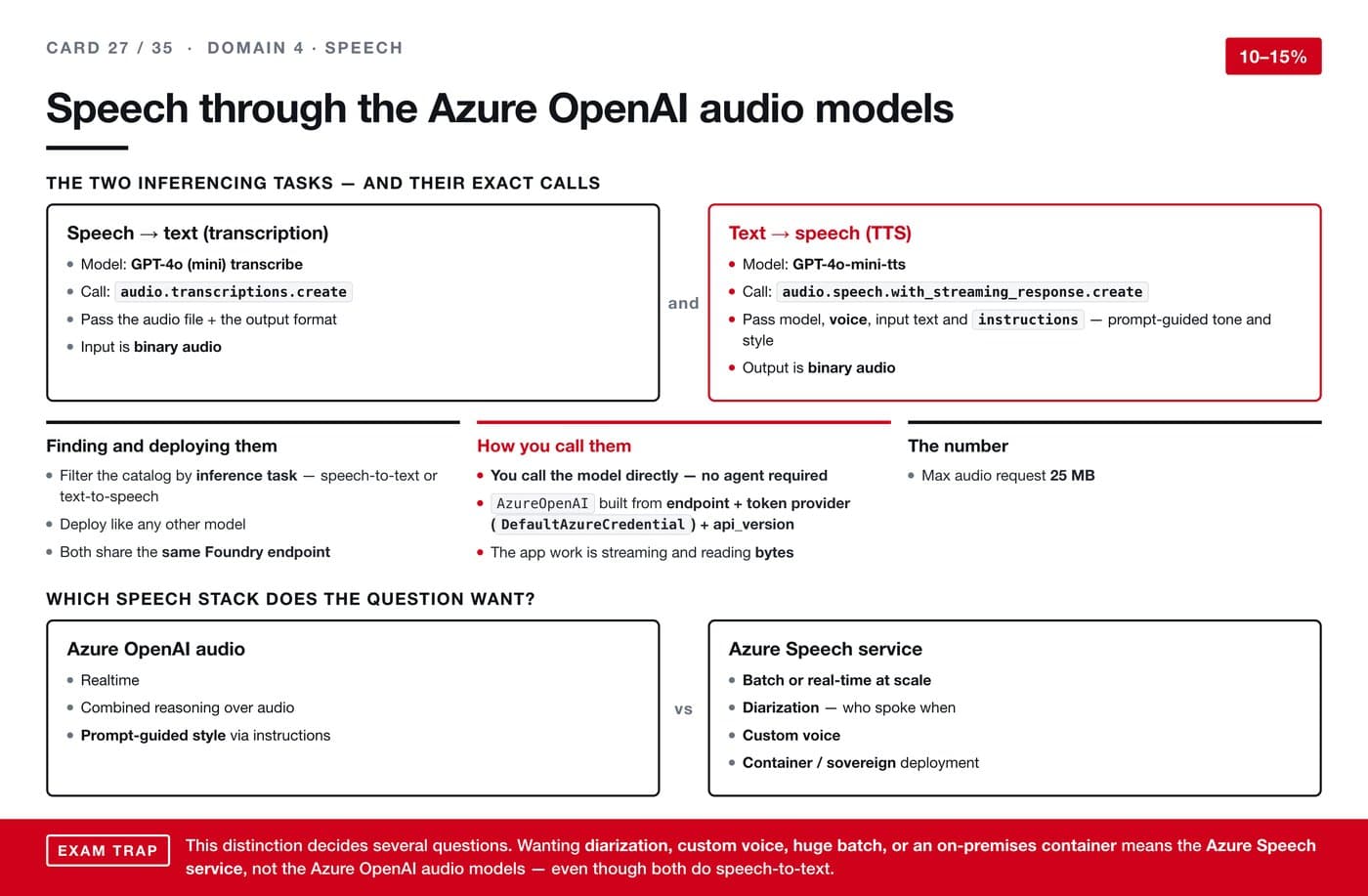 Card 27
Speech through the Azure OpenAI audio models
The two inferencing tasks and their exact calls, and the four requirements that mean the Speech service rather than the audio models.
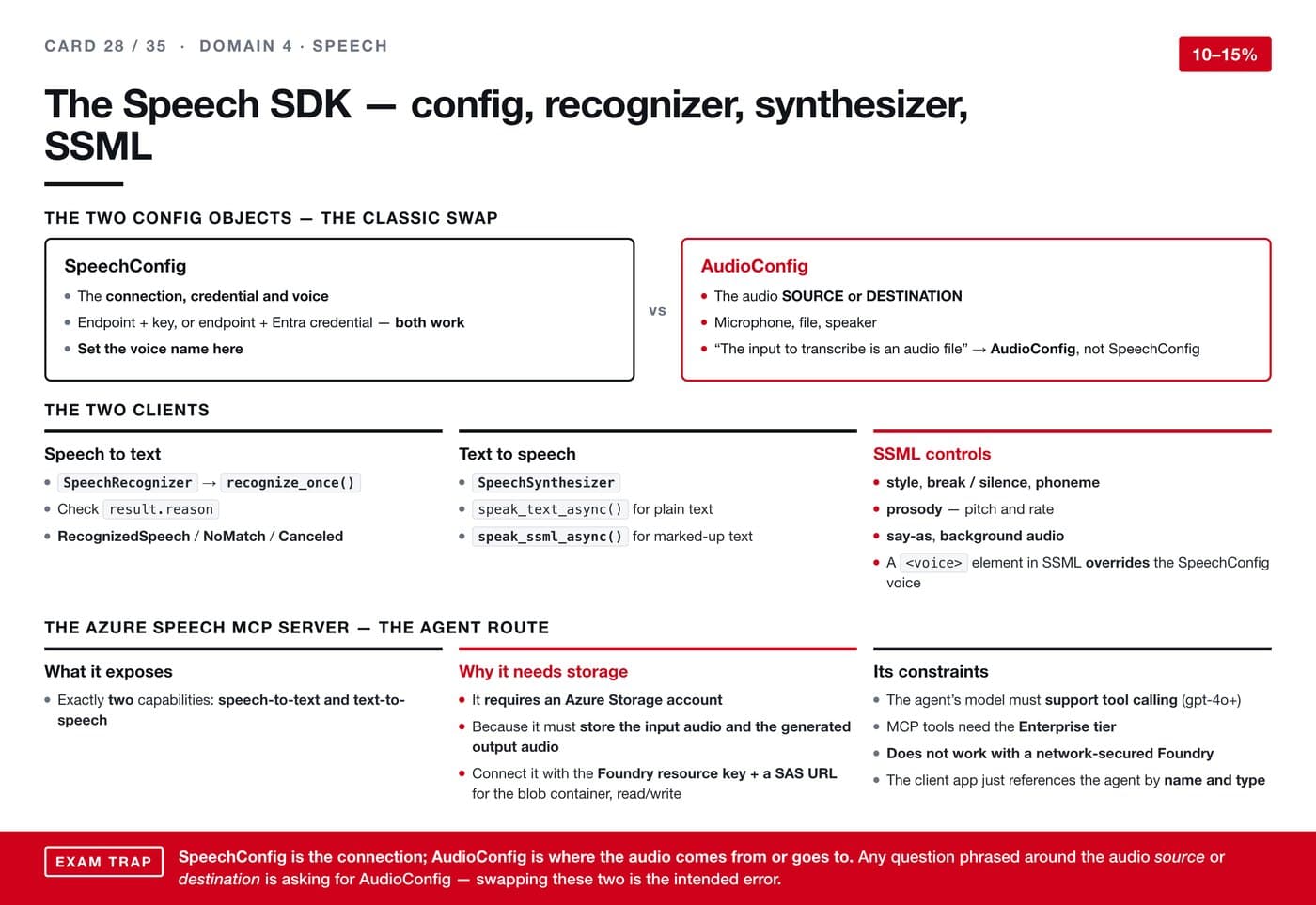 Card 28
The Speech SDK — config, recognizer, synthesizer, SSML
SpeechConfig is the connection, AudioConfig is where the audio lives — and the swap is the intended error. Plus SSML precedence and the MCP server’s constraints.
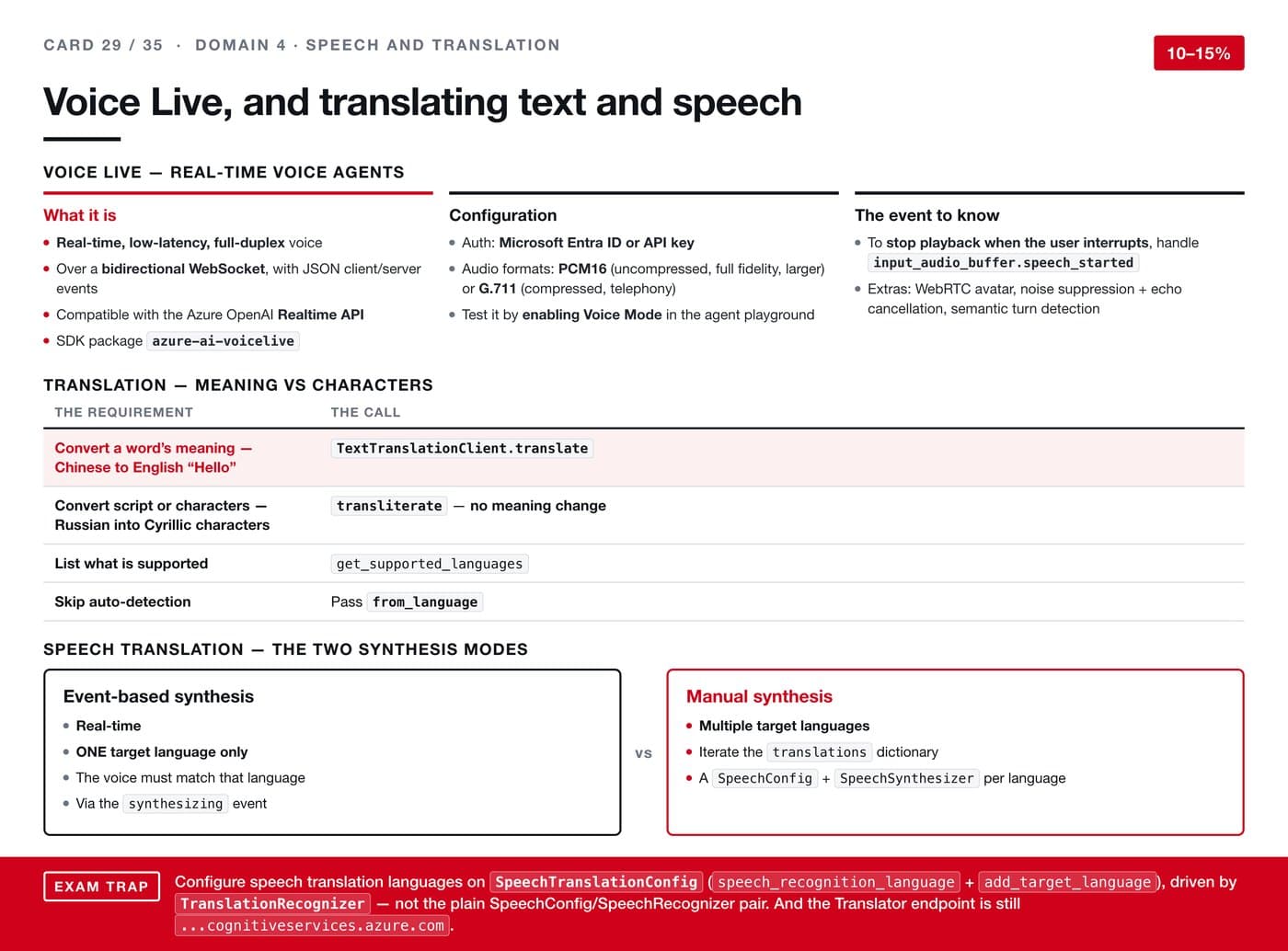 Card 29
Voice Live, and translating text and speech
Real-time voice agents and the interruption event, translation against transliteration, and the config pair that replaces the one card 28 taught you.
Domain 5 · Information extraction
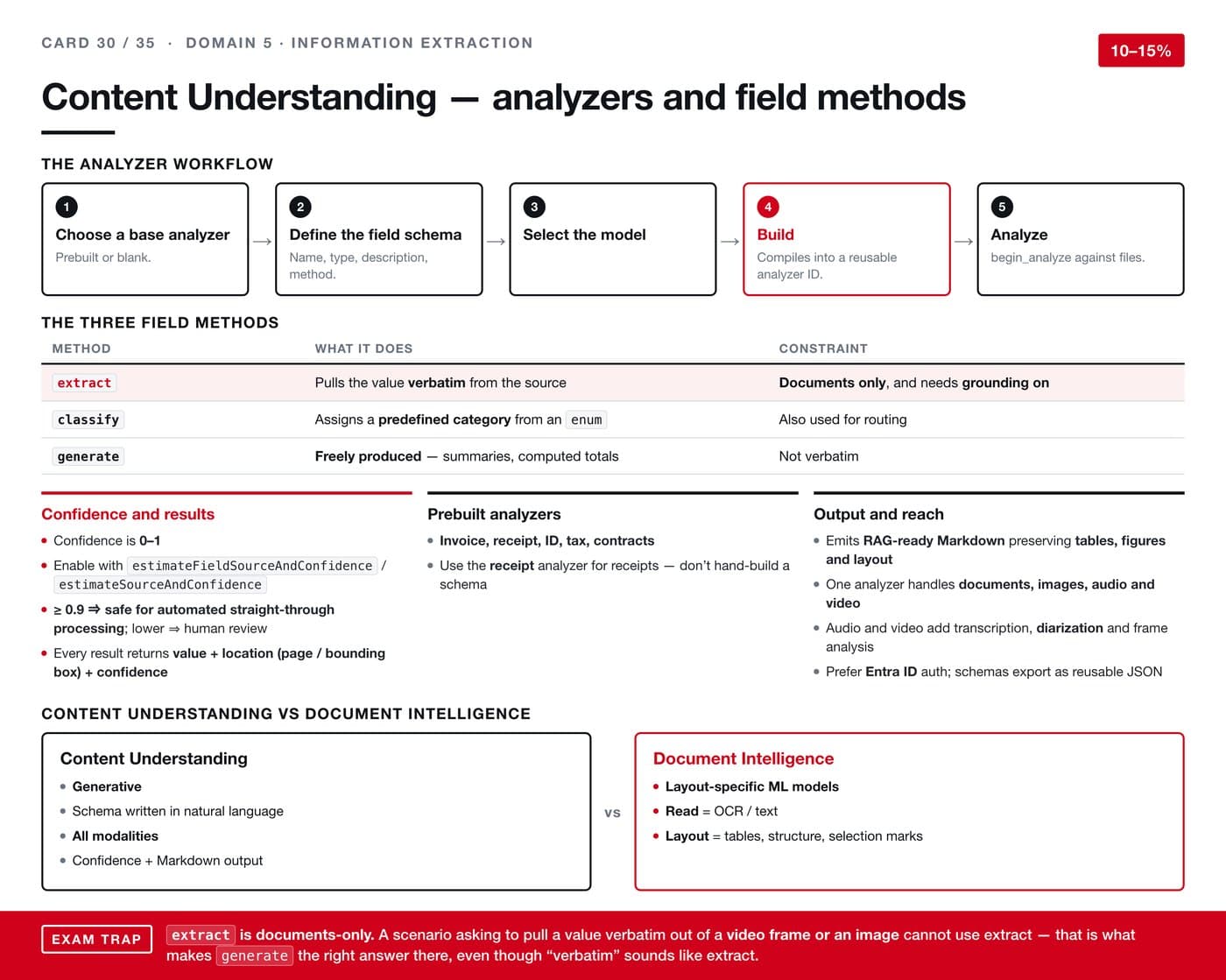 Card 30
Content Understanding — analyzers and field methods
The three field methods and their constraints, the value-location-confidence triple that makes automated processing trustworthy, and why verbatim from a video frame is not extract.
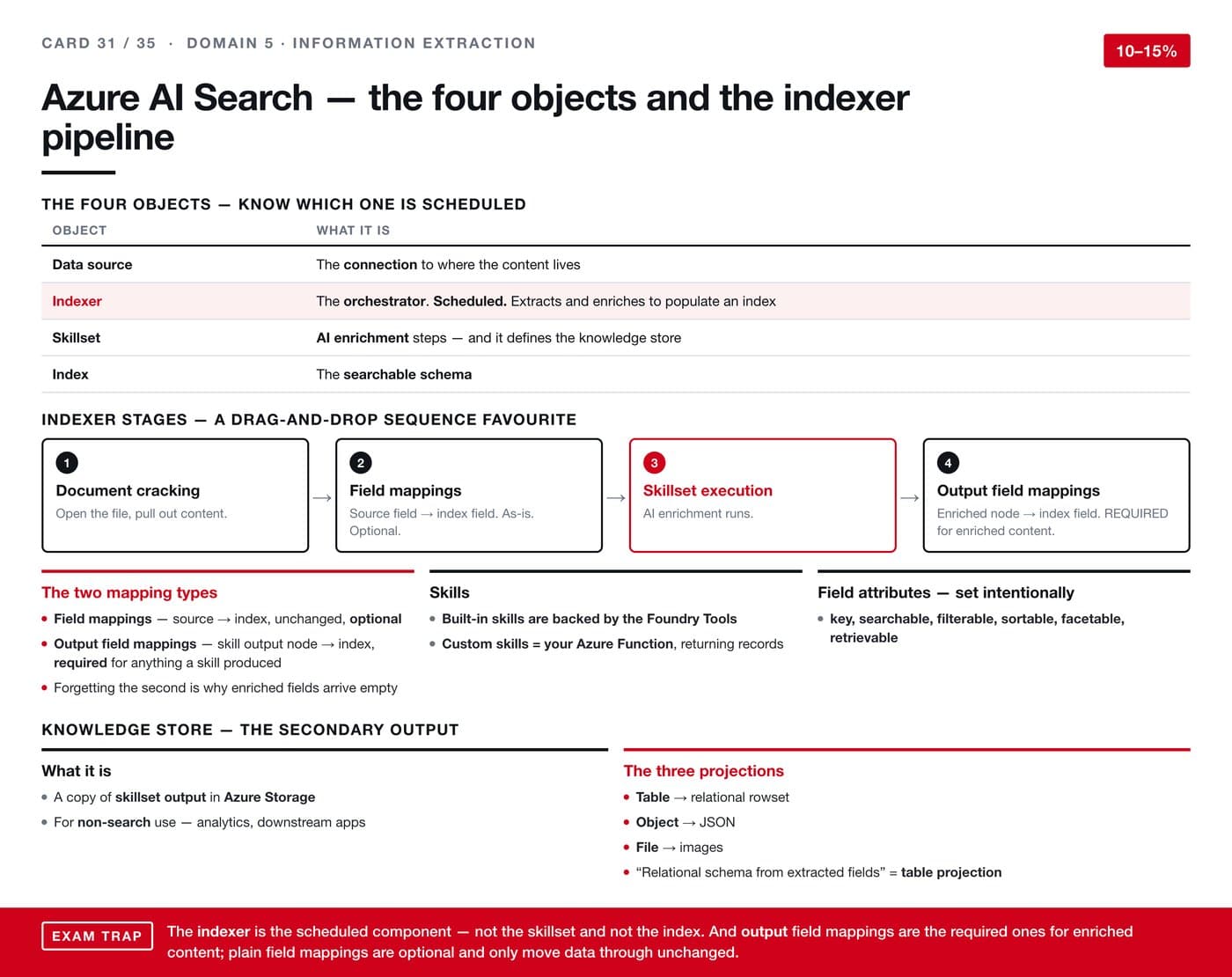 Card 31
Azure AI Search — the four objects and the indexer pipeline
Which object is the scheduled one, the indexer stages in order, and the mapping people forget — the reason enriched fields arrive empty with no error.
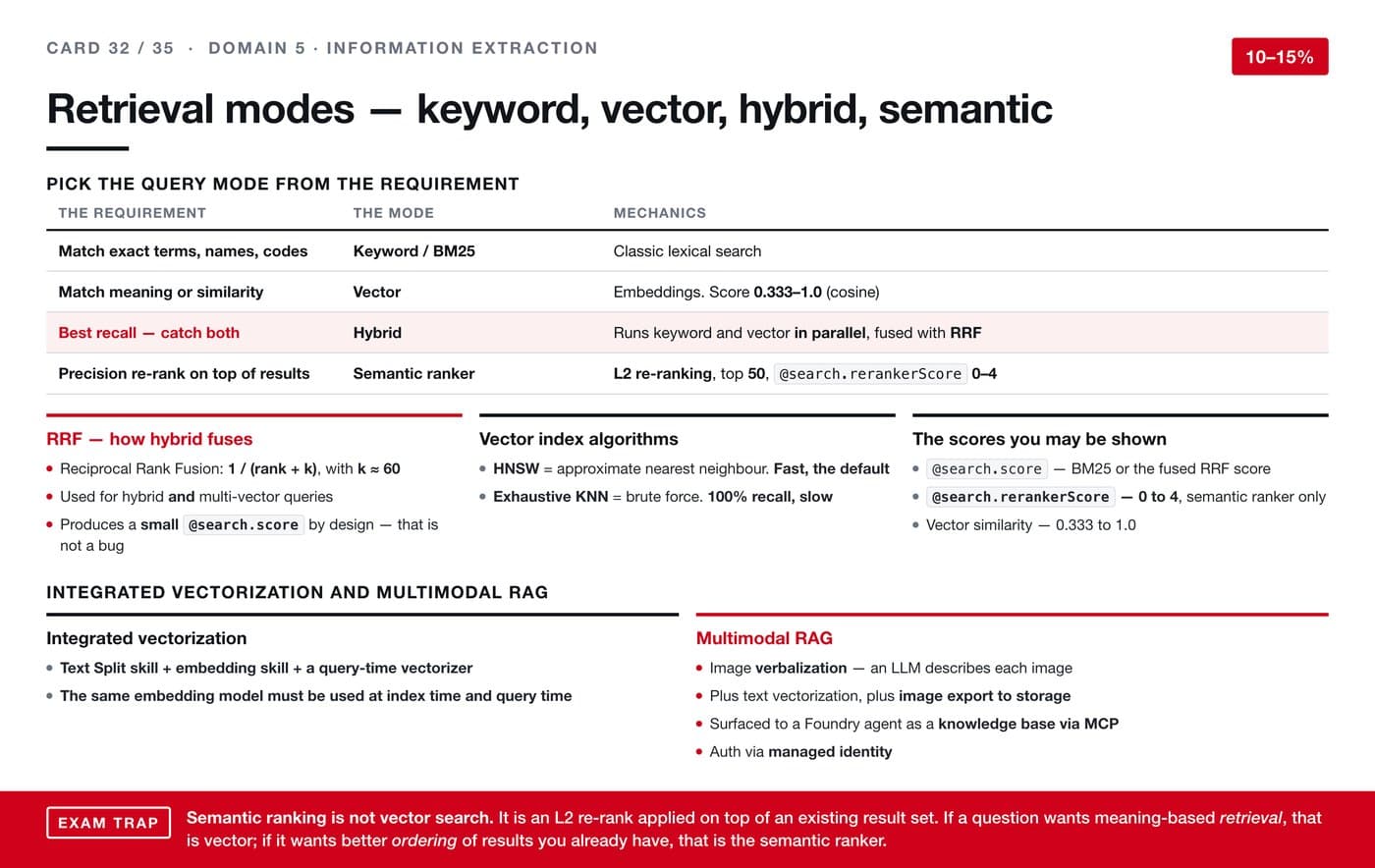 Card 32
Retrieval modes — keyword, vector, hybrid, semantic
Picking the mode from the requirement, why fused scores are small by design, and the distinction that decides it — vector retrieves, the semantic ranker reorders.
Master cards
 Card 33
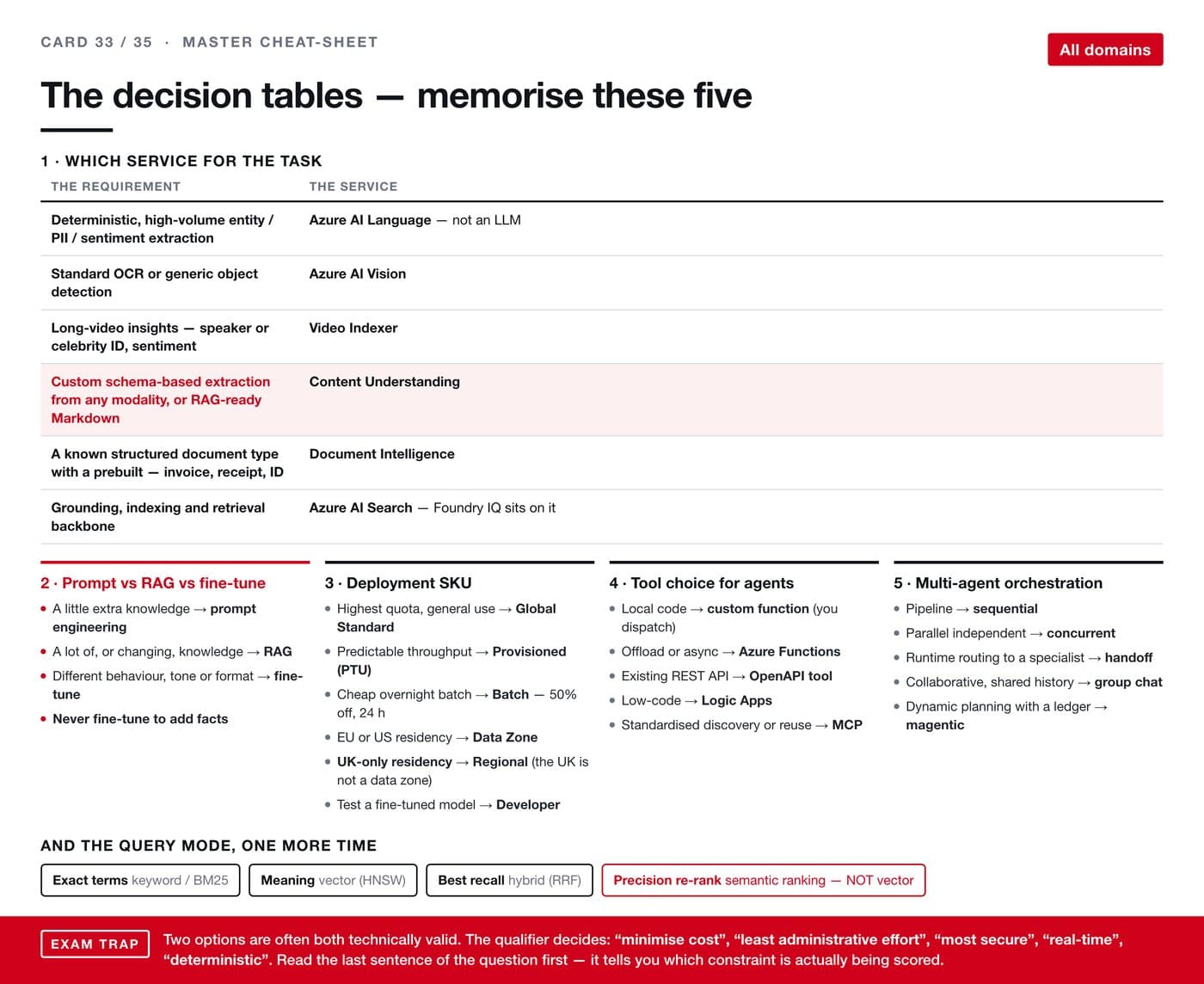
The decision tables — memorise these five
The five decisions that recur across every domain, gathered — plus the best single piece of technique: read the last sentence first, because the qualifier decides between two valid answers.
 Card 34
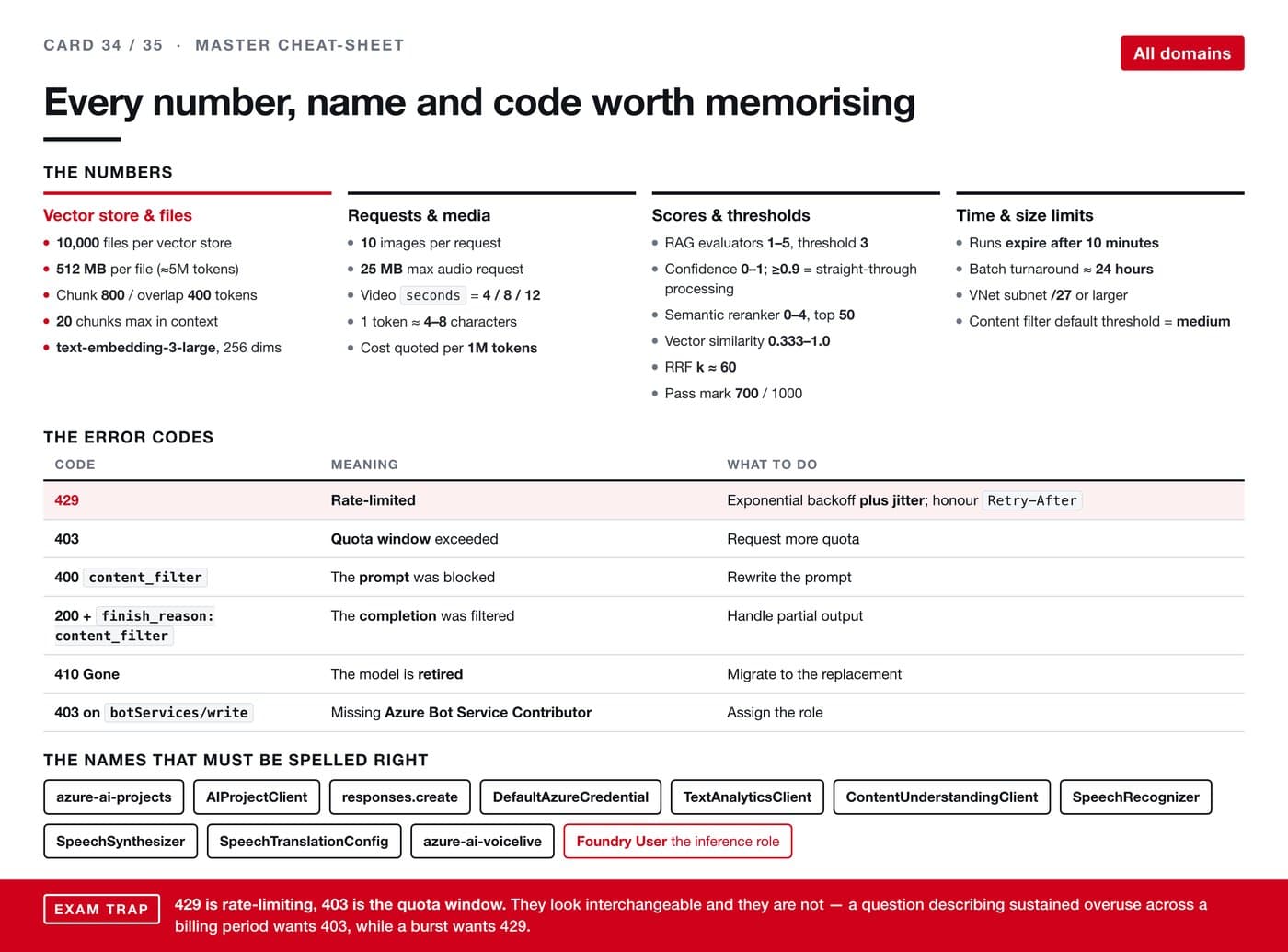
Every number, name and error code worth memorising
Every constant from the previous cards in one place, the six error codes and what to do about each, and why 429 and 403 are not interchangeable.
 Card 35
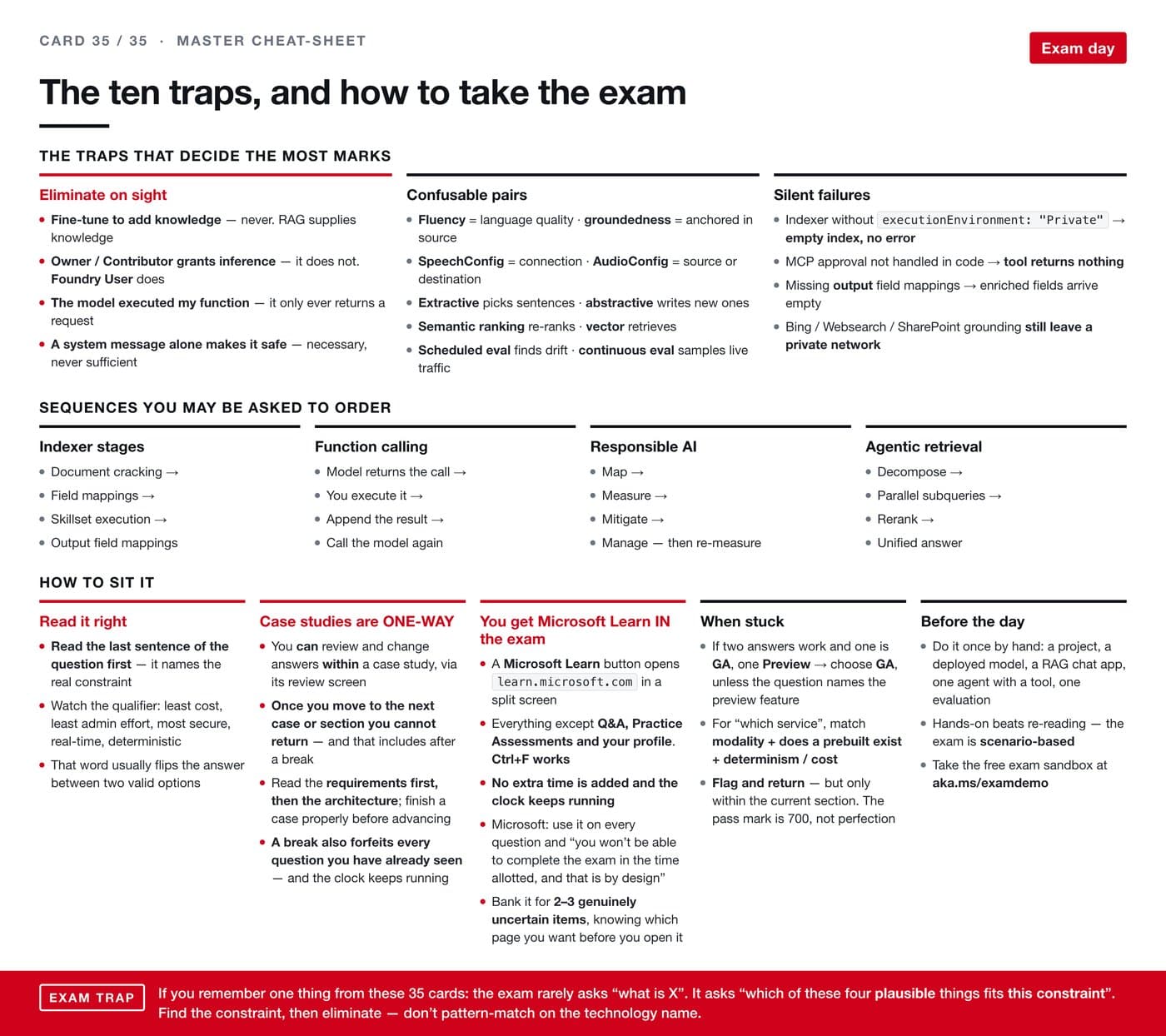
The ten traps, and how to take the exam
What to eliminate on sight, the confusable pairs, the sequences you may be asked to order, and how to sit it — one-way case studies, Learn in the exam, and finding the constraint.
Added after the gap sweep
 Card 36
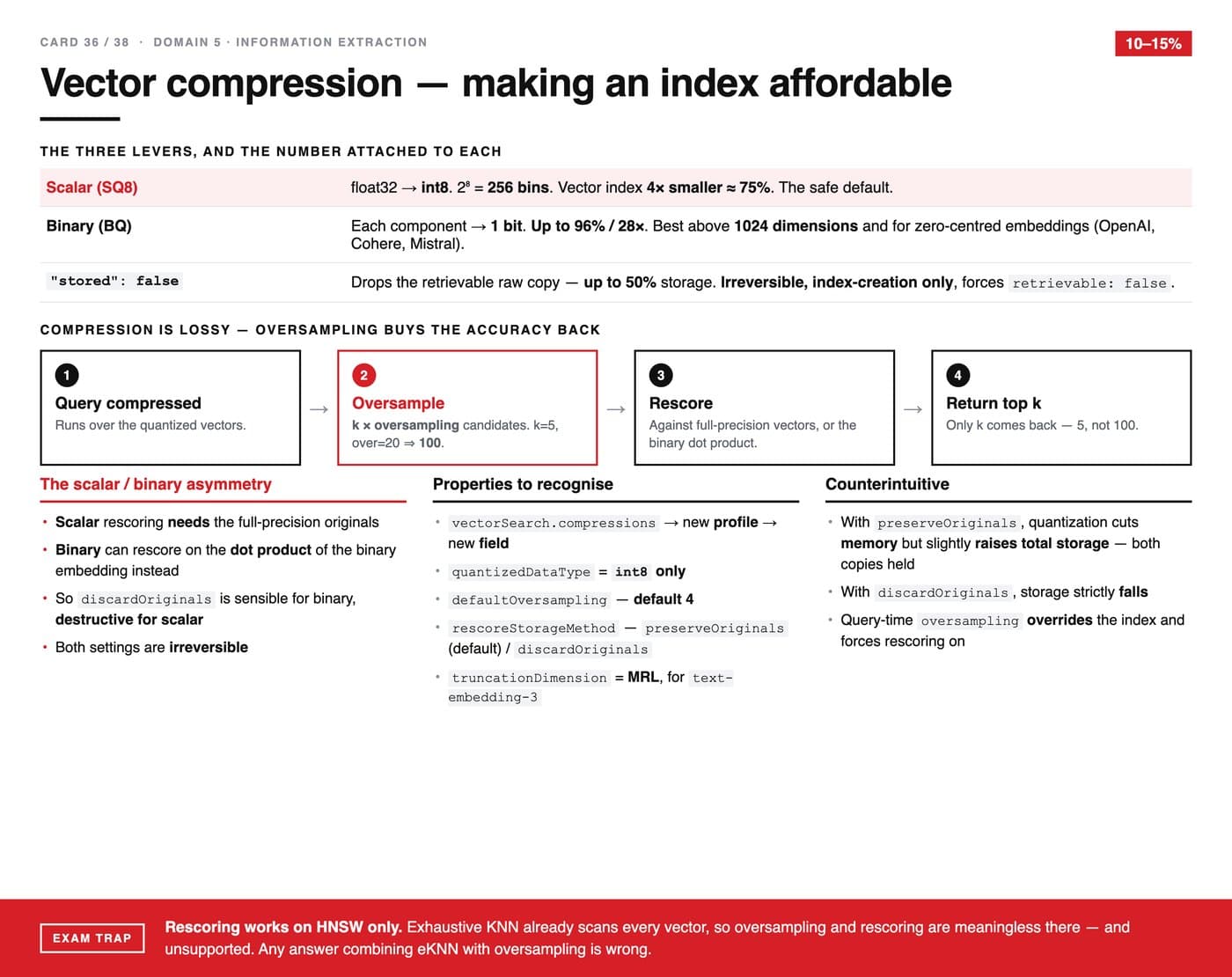
Vector compression — making an index affordable
The three levers and what each saves, why compression is lossy and oversampling buys the accuracy back, and the counterintuitive case where quantization raises total storage.
 Card 37
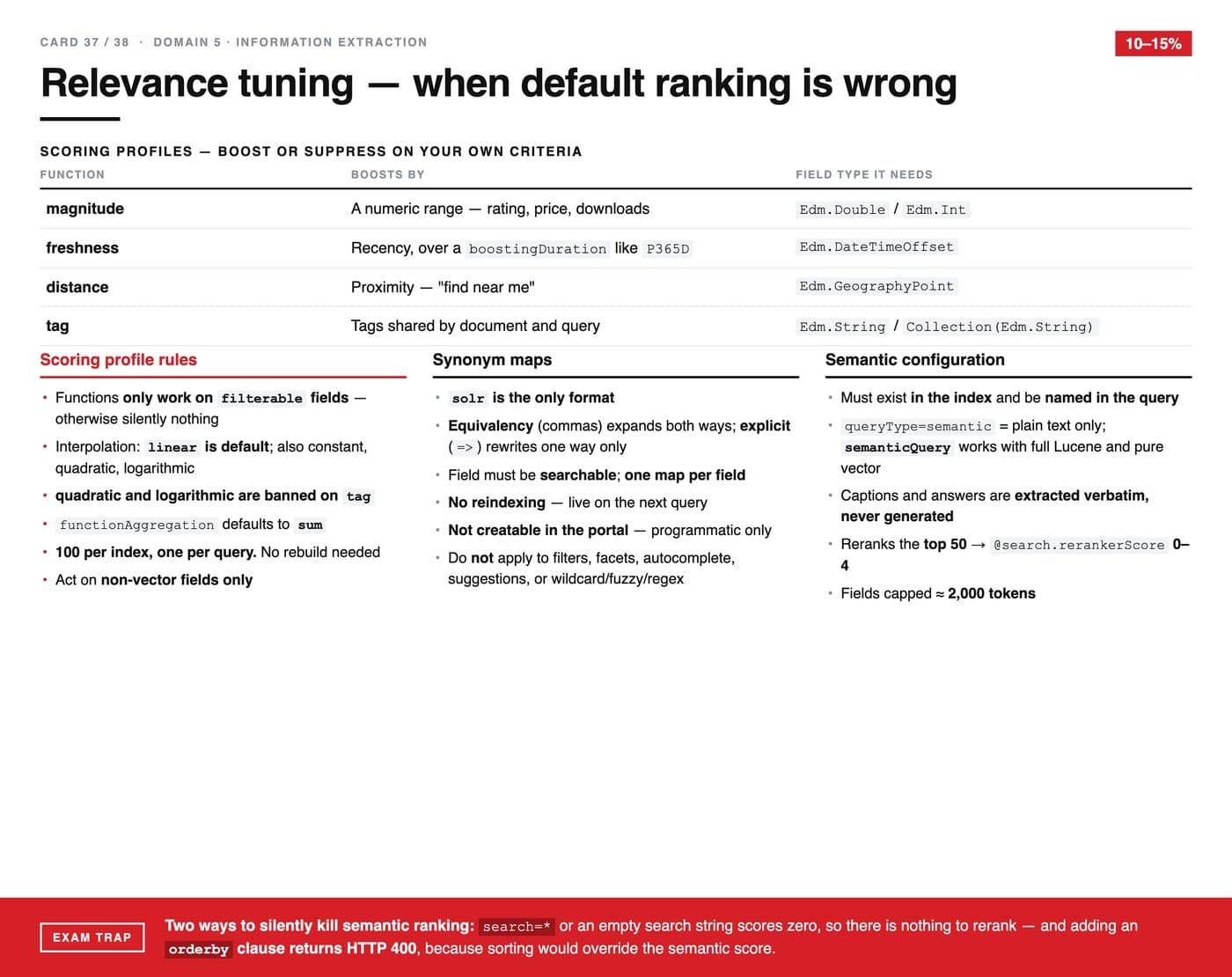
Relevance tuning — when default ranking is wrong
Scoring profiles and the field types they need, what synonym maps do not apply to, and the two ways to silently kill semantic ranking.
 Card 38
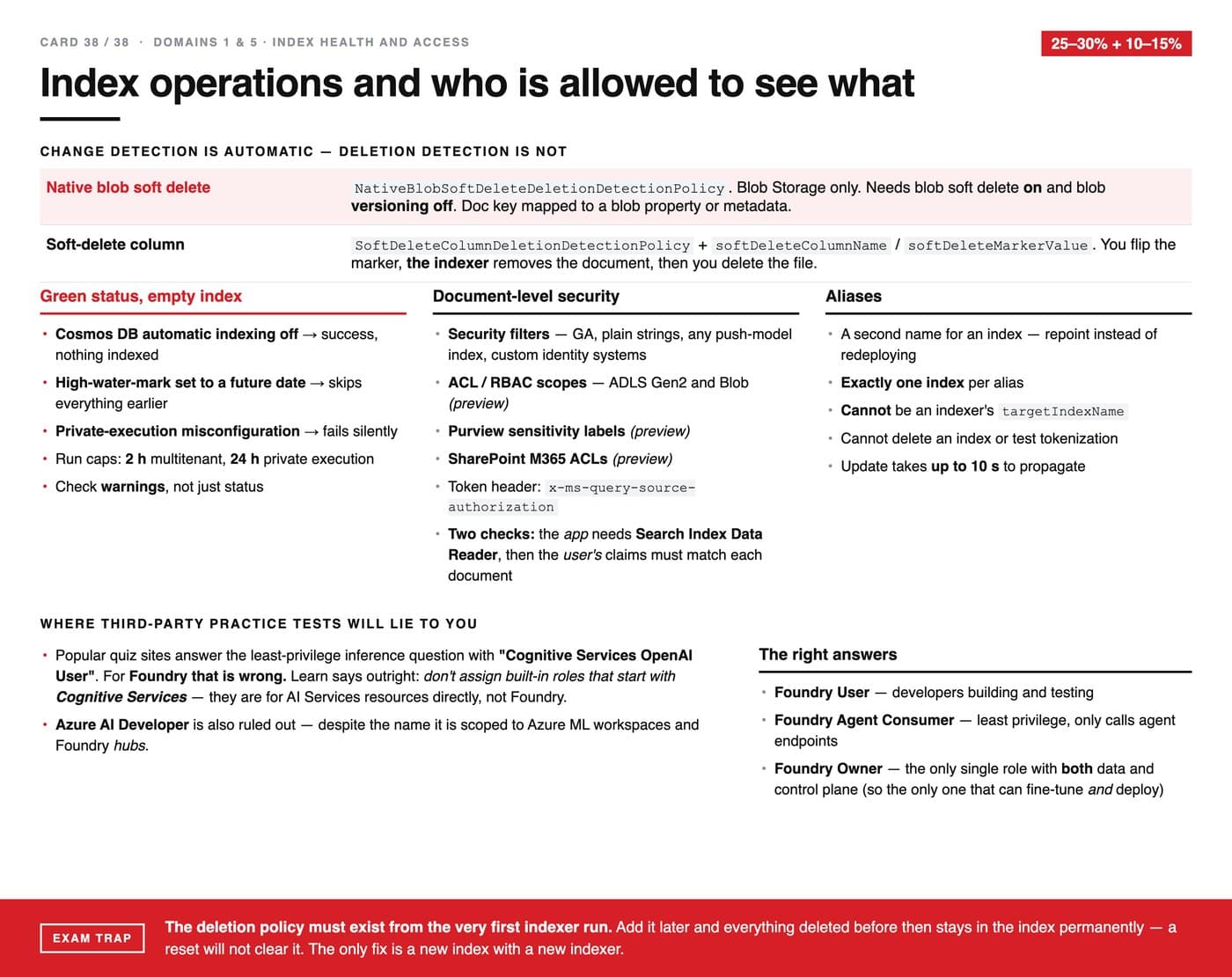
Index operations and who is allowed to see what
Deletions are not detected automatically, four ways an indexer reports green and indexes nothing, the two-check security model — and the role answer third-party practice tests get wrong.