Card 22 of 38· Domain 3 · Computer vision
Reasoning over images with a multimodal model
Two easy marks — a text-only model cannot see, and the text and image parts must arrive in one message. Plus the coarser severity scale image-only content returns.
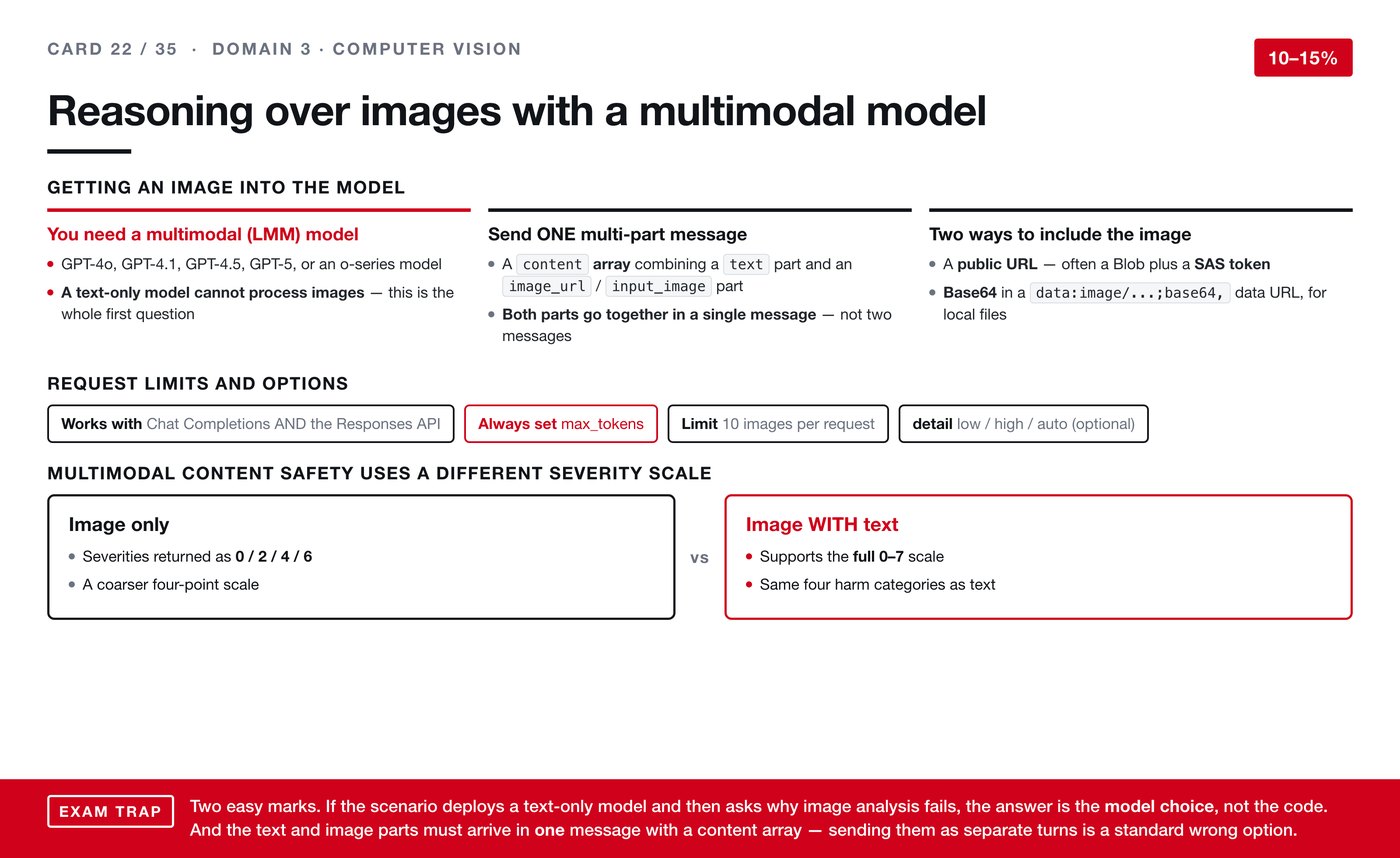
Two easy marks live on this card, and both come from the same place: knowing that a model has to be capable of seeing before any amount of correct code will make it see.
You need a multimodal model
A multimodal model — sometimes called a large multimodal model — is one that accepts images as well as text. GPT-4o, GPT-4.1, GPT-4.5, GPT-5 and the o-series models qualify.
A text-only model cannot process images. That is the whole of the first easy mark. If a scenario deploys a text-only model and then asks why image analysis is failing, the answer is the model choice, not the code.
One message, not two
Send a single multi-part message: a content array combining a text part and an image_url or input_image part.
Both parts go together in one message. Sending the text and the image as separate turns is a standard wrong option, and it is the second easy mark. It looks reasonable — you are providing both pieces of information — but the model needs them in the same message to reason across them.
Two ways to include the image
- A public URL, often a Blob address with a shared access signature token attached.
- Base64, in a
data:image/...;base64,data URL, for local files.
Limits and options
- Works with both Chat Completions and the Responses API.
- Always set
max_tokens. - The limit is 10 images per request.
detailis optional, and takes low, high or auto.
A different severity scale for images
This is the detail most likely to catch you out, because it breaks a pattern established elsewhere on the exam.
For image-only content, severities come back as 0, 2, 4, 6 — a coarser four-point scale.
For image with text, you get the full 0 to 7 range, with the same four harm categories as text.
So the scale depends on what is in the content, not on which service you called. If you have built thresholding logic around a 0-to-7 range and then send image-only content, your thresholds are being applied to a scale that does not produce the values they expect. Worth knowing in practice, not only for the paper.