Card 33 of 38· Master cards
The decision tables — memorise these five
The five decisions that recur across every domain, gathered — plus the best single piece of technique: read the last sentence first, because the qualifier decides between two valid answers.
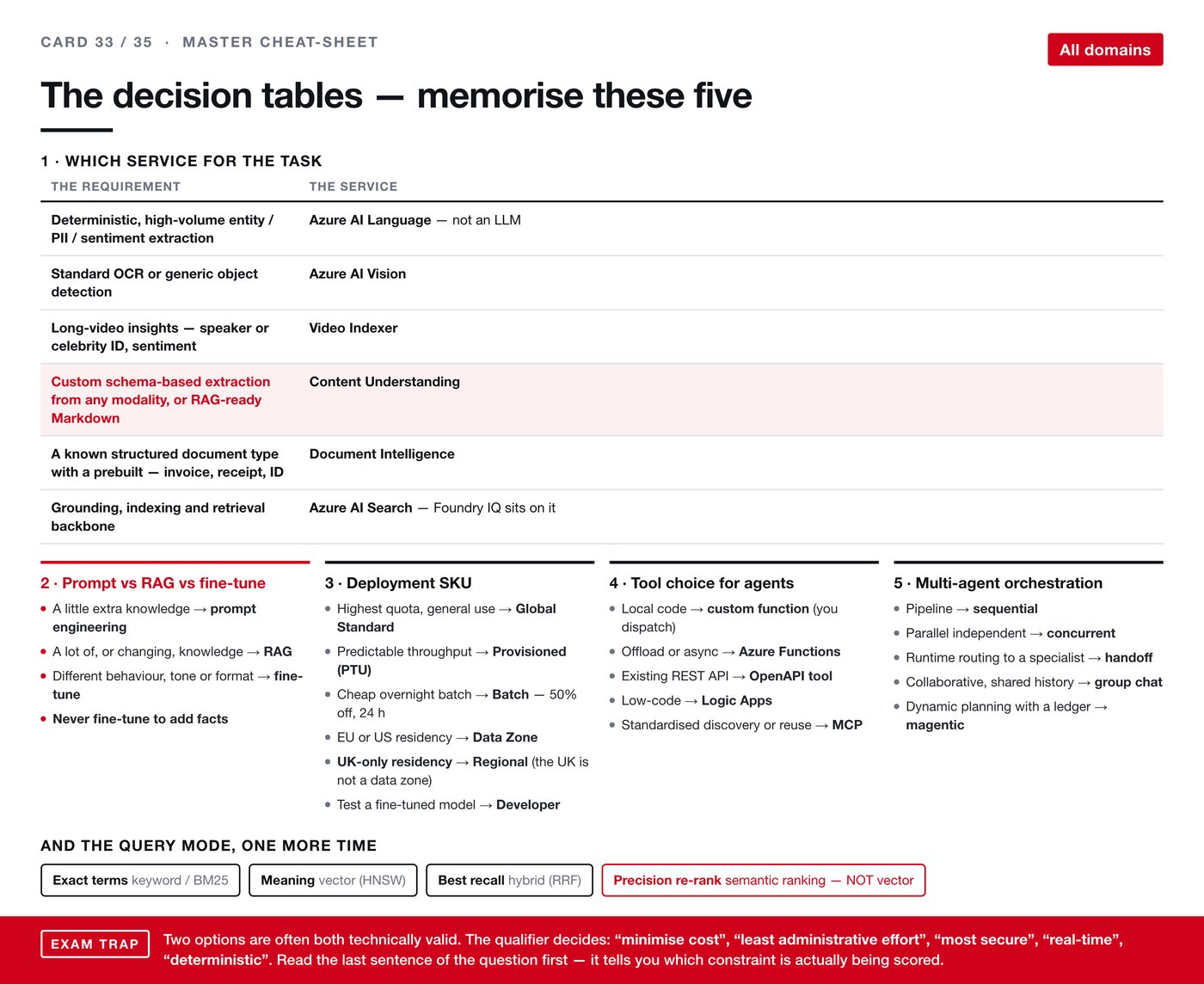
This card gathers the five decisions that recur across every domain. If you are short of time before the exam, this is the one to read last.
1 · Which service for the task
| What the requirement describes | The service |
|---|---|
| Deterministic, high-volume entity, personal-information or sentiment extraction | Azure AI Language — not a model |
| Standard text-from-image or generic object detection | Azure AI Vision |
| Long-video insights — speaker or celebrity identification, sentiment | Video Indexer |
| Custom schema-based extraction from any modality, or retrieval-ready Markdown | Content Understanding |
| A known structured document type with a prebuilt — invoice, receipt, identity | Document Intelligence |
| Grounding, indexing and the retrieval backbone | Azure AI Search — Foundry IQ sits on top of it |
2 · Prompt, retrieval or fine-tune
- A little extra knowledge → prompt engineering
- A lot of knowledge, or knowledge that changes → retrieval
- Different behaviour, tone or format → fine-tuning
- Never fine-tune to add facts
3 · Deployment SKU
- Highest quota, general use → Global Standard
- Predictable throughput → Provisioned
- Cheap overnight batch → Batch, around half price, 24-hour turnaround
- EU or US residency → Data Zone
- UK-only residency → Regional, because the UK is not a data zone
- Testing a fine-tuned model → Developer
4 · Tool choice for agents
- Local code → a custom function, which you dispatch
- Offloaded or asynchronous → Azure Functions
- An existing REST API → the OpenAPI tool
- Low-code → Logic Apps
- Standardised discovery or reuse → MCP
5 · Multi-agent orchestration
- A pipeline → sequential
- Parallel independent work → concurrent
- Runtime routing to a specialist → handoff
- Collaborative, shared history → group chat
- Dynamic planning with a ledger → Magentic
And the query mode, once more
Exact terms → keyword. Meaning → vector. Best recall → hybrid. Precision re-rank → semantic ranking, which is not vector.
The trap, and the best single piece of exam technique here
Two options are often both technically valid. What separates them is a qualifier in the question: minimise cost, least administrative effort, most secure, real-time, deterministic.
Read the last sentence of the question first. It usually carries the qualifier, and the qualifier tells you which constraint is actually being scored. Two answers that both work are not a badly written question — they are a question about priorities, and the priority is stated.