Card 12 of 38· Domain 2 · Generative AI and agents
Built-in agent tools — and the vector store numbers
Picking the tool from the phrasing, the exact lowercase type strings, the File Search setup and the vector store constants worth memorising.
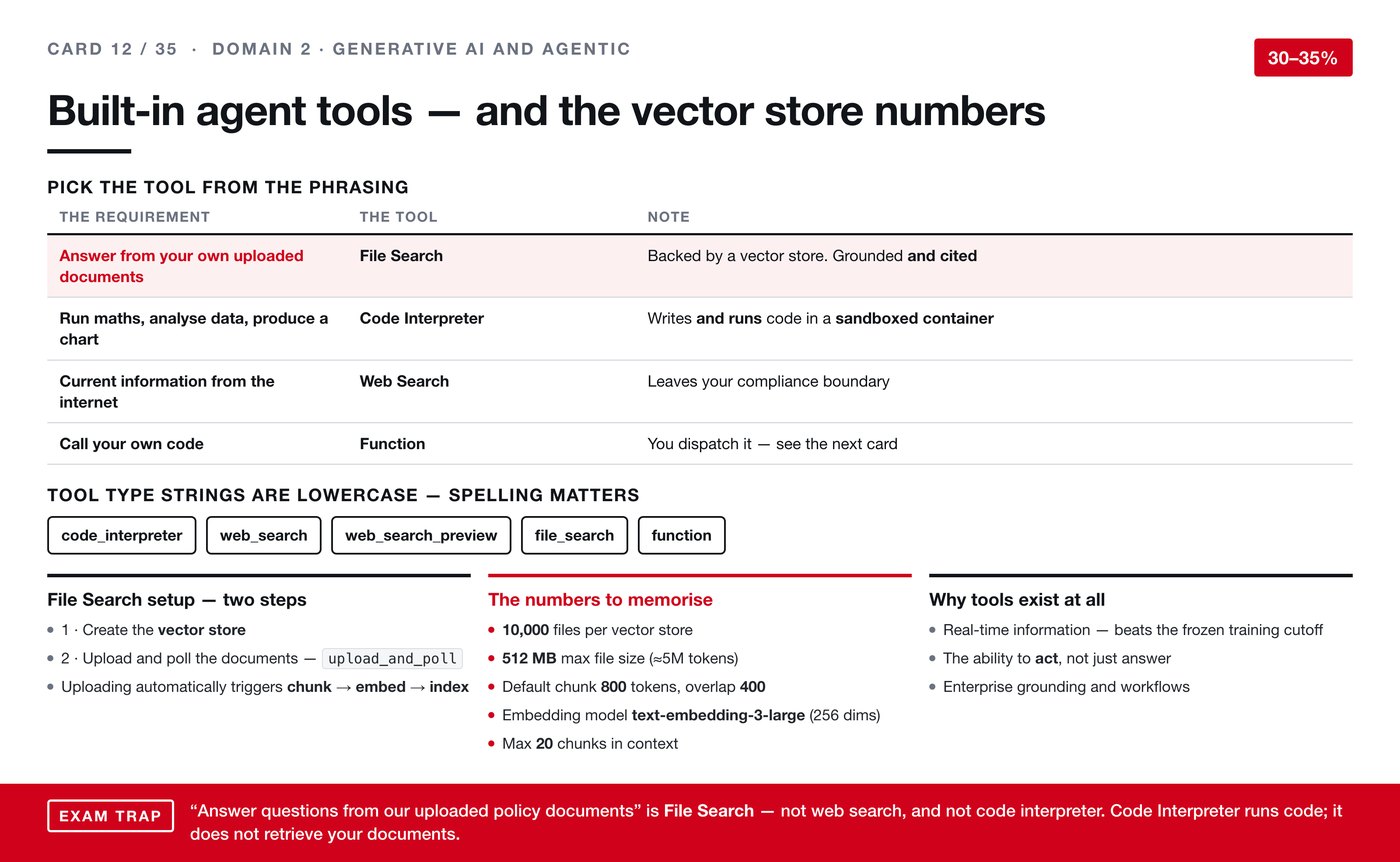
A tool is something an agent can reach for when answering is not enough. Four of them are built in, and questions here almost always work by describing a need and expecting you to name the tool.
Reading the requirement, naming the tool
| What the requirement describes | The tool | Worth knowing |
|---|---|---|
| Answering from your own uploaded documents | File Search | Backed by a vector store. Answers are grounded and cited. |
| Doing maths, analysing data, producing a chart | Code Interpreter | Writes and runs code in a sandboxed container |
| Current information from the internet | Web Search | Leaves your compliance boundary |
| Calling your own code | Function | You dispatch it yourself — see the next card |
The web search row connects back to network isolation. It is the tool that quietly breaks a "data stays inside the boundary" requirement.
The type strings are lowercase
Spelling is tested, so it is worth reading these carefully rather than recognising them: code_interpreter, web_search, web_search_preview, file_search, function.
Underscores, all lowercase. Note that web search has both a standard and a preview variant.
Setting up File Search
Two steps:
- Create the vector store — a database that holds text as numeric representations so it can be searched by meaning rather than by exact words.
- Upload the documents and poll until they are ready, using
upload_and_poll.
Uploading automatically triggers a three-stage sequence: chunk, then embed, then index. Chunking splits documents into passages; embedding turns each passage into numbers; indexing makes them searchable.
The numbers
These are the kind of constants that get asked directly:
- 10,000 files per vector store
- 512 MB maximum file size, roughly 5 million tokens
- Default chunk size 800 tokens, with an overlap of 400
- Embedding model
text-embedding-3-large, at 256 dimensions - A maximum of 20 chunks placed in context
The overlap is worth a moment's thought. At 800 tokens with 400 of overlap, consecutive chunks share half their content. That redundancy exists so a passage split across a chunk boundary still appears whole somewhere.
Why tools exist at all
Three reasons, and they are a decent summary of what separates an agent from a chatbot:
- Real-time information, which beats the model's frozen training cutoff.
- The ability to act, not merely to answer.
- Enterprise grounding and workflows — reaching your systems and your data.
The trap
"Answer questions from our uploaded policy documents" is File Search.
Not web search — the documents are yours, not the internet's. And not Code Interpreter, which is the more tempting wrong answer because it sounds capable and general. Code Interpreter runs code. It does not retrieve your documents.