Card 35 of 38· Master cards
The ten traps, and how to take the exam
What to eliminate on sight, the confusable pairs, the sequences you may be asked to order, and how to sit it — one-way case studies, Learn in the exam, and finding the constraint.
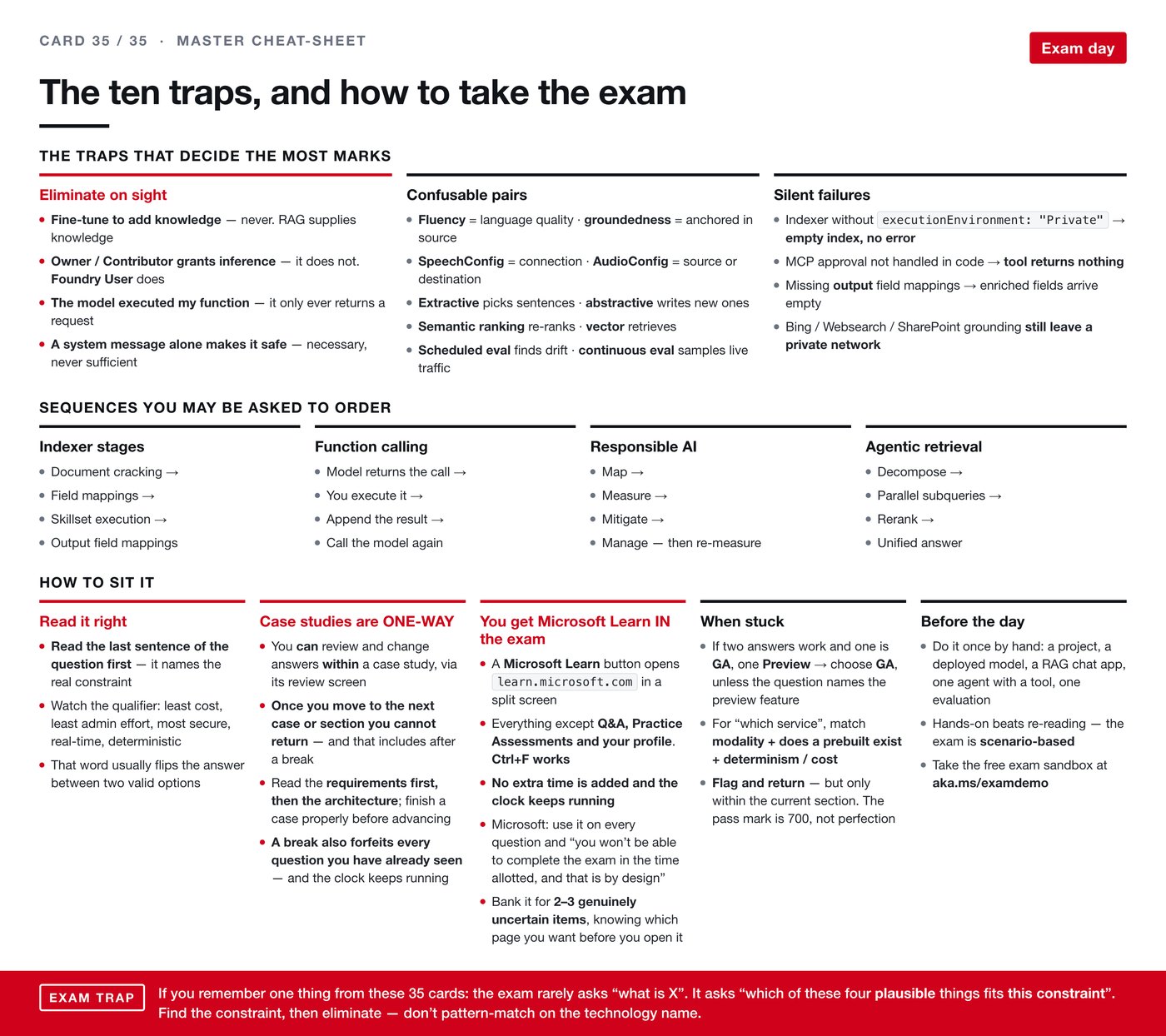
The last card is about sitting the exam rather than knowing the material. Read it the night before.
Eliminate on sight
Four options that are always wrong, whatever else the question says:
- Fine-tuning to add knowledge. Never. Retrieval supplies knowledge.
- Owner or Contributor grants inference. It does not. Foundry User does.
- The model executed my function. It only ever returns a request.
- A system message alone makes it safe. Necessary, never sufficient.
Confusable pairs
- Fluency is language quality; groundedness is being anchored in the source.
- SpeechConfig is the connection; AudioConfig is the source or destination.
- Extractive picks existing sentences; abstractive writes new ones.
- Semantic ranking re-ranks; vector retrieves.
- Scheduled evaluation finds drift; continuous evaluation samples live traffic.
Silent failures
Worth grouping, because they share a shape — the system reports success and produces nothing useful:
- An indexer without
executionEnvironment: "Private"gives you an empty index and no error. - An MCP approval not handled in code means the tool returns nothing.
- Missing output field mappings mean enriched fields arrive empty.
- Bing, web search and SharePoint grounding still leave a private network.
Sequences you may be asked to order
Indexer stages — document cracking, field mappings, skillset execution, output field mappings.
Function calling — the model returns the call, you execute it, you append the result, you call the model again.
Responsible AI — map, measure, mitigate, manage, then re-measure.
Agentic retrieval — decompose, parallel subqueries, rerank, unified answer.
How to sit it
Read it right. Read the last sentence of the question first — it names the real constraint. Watch for the qualifier: least cost, least administrative effort, most secure, real-time, deterministic. That word usually flips the answer between two otherwise valid options.
Case studies are one-way. You can review and change answers within a case study. Once you move to the next case or section you cannot return — and that includes after a break. Read the requirements first, then the architecture, and finish a case properly before advancing. A break also forfeits every question you have already seen, and the clock keeps running.
You get Microsoft Learn in the exam. A button opens learn.microsoft.com in a split screen. Everything is available except practice assessments and your profile, and Ctrl+F works. No extra time is added and the clock keeps running — Microsoft's own position is that you will not be able to complete the exam in the time allotted, and that this is by design. So bank it for two or three genuinely uncertain items, and know which page you want before you open it.
When stuck. If two answers work and one is generally available while the other is in preview, choose the generally available one — unless the question names the preview feature. For "which service", match on modality, then whether a prebuilt exists, then determinism and cost. Flag and return, but only within the current section.
Before the day. Do it once by hand: a project, a deployed model, a retrieval chat app, one agent with a tool, one evaluation. Hands-on beats re-reading, because the exam is scenario-based. There is a free exam sandbox at aka.ms/examdemo.
The one thing to remember
The exam rarely asks what something is. It asks which of four plausible things fits this constraint.
So find the constraint, then eliminate. Do not pattern-match on the technology name — that is exactly what the distractors are built to exploit. And the pass mark is 700, not perfection.