Card 24 of 38· Domain 3 · Computer vision
Content Understanding for images and video
Picking the service from the job, building an analyzer against your own schema, and the single constraint that eliminates Pro mode from video scenarios.
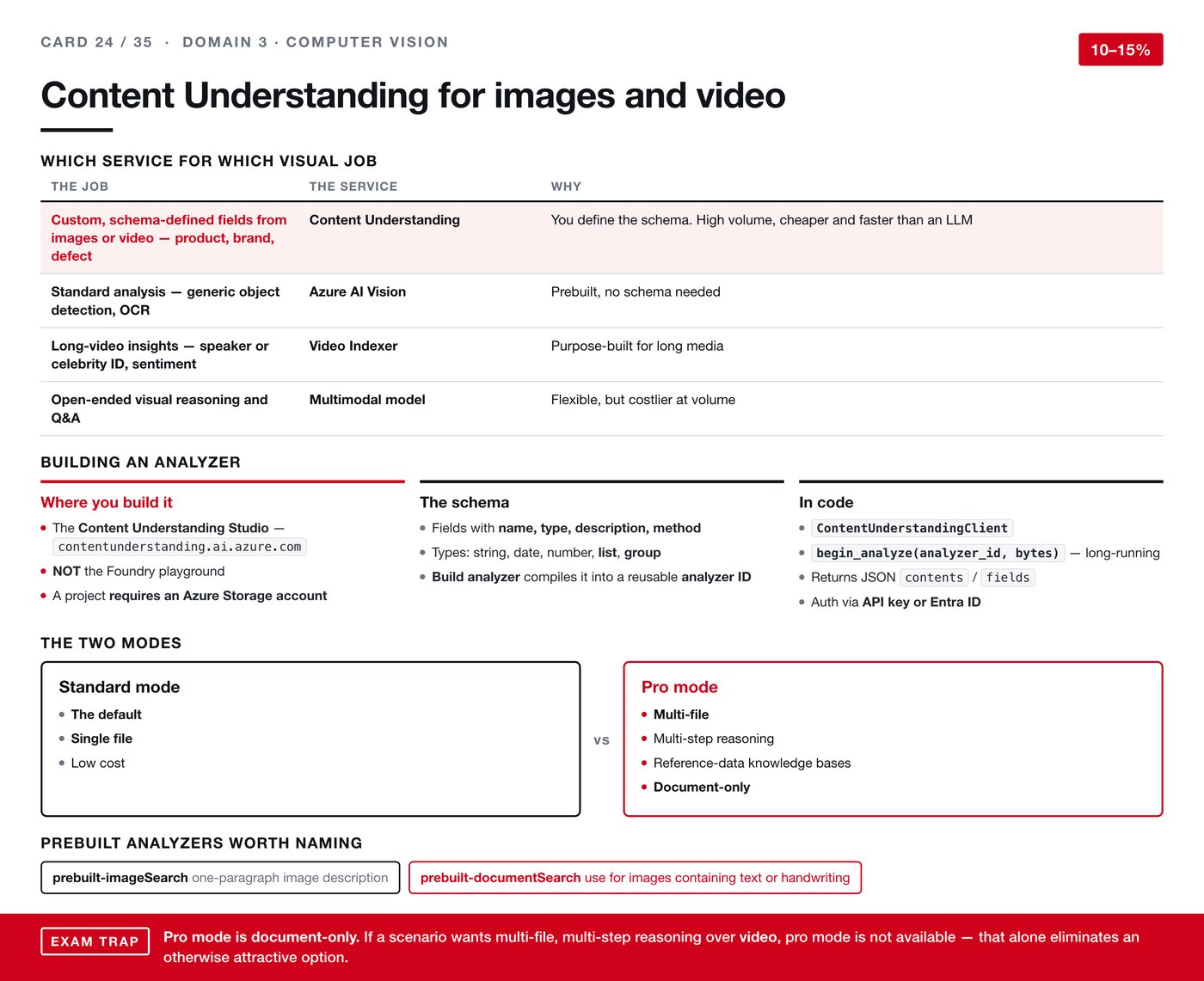
Four services can look at an image, and the exam tests whether you can pick the right one from the description of the job. The deciding factor is almost always whether you need fields you define yourself.
Which service for which visual job
| The job | The service | Why |
|---|---|---|
| Custom, schema-defined fields from images or video — product, brand, defect | Content Understanding | You define the schema. High volume, cheaper and faster than a language model |
| Standard analysis — generic object detection, reading text from images | Azure AI Vision | Prebuilt, no schema needed |
| Long-video insights — speaker or celebrity identification, sentiment | Video Indexer | Purpose-built for long media |
| Open-ended visual reasoning and question answering | A multimodal model | Flexible, but costlier at volume |
The first and last rows are the ones that get confused. Both can extract information from an image. The difference is that Content Understanding does it against a schema you defined, repeatably and cheaply at volume; a multimodal model does it flexibly and costs more per item. Scale decides it.
Building an analyzer
Where you build it: the Content Understanding Studio, at contentunderstanding.ai.azure.com. Not the Foundry playground — that distinction is examinable. A project requires an Azure Storage account.
The schema is a set of fields, each with a name, a type, a description and a method. Types available are string, date, number, list and group. Building the analyzer compiles the schema into a reusable analyzer ID.
In code: ContentUnderstandingClient, then begin_analyze(analyzer_id, bytes) — the begin_ prefix signalling a long-running operation. It returns JSON with contents and fields. Authentication is by API key or Entra ID.
Two modes
Standard mode is the default: a single file, low cost.
Pro mode offers multi-file input, multi-step reasoning, and reference-data knowledge bases.
Prebuilt analyzers worth knowing by name
prebuilt-imageSearch— produces a one-paragraph description of an image.prebuilt-documentSearch— use this for images that contain text or handwriting.
The trap
Pro mode is document-only.
This makes an otherwise attractive answer wrong. If a scenario asks for multi-file, multi-step reasoning over video, Pro mode is not available — and that single constraint eliminates the option regardless of how well the rest of it matches the requirement.
It is a good example of how this exam rewards knowing the boundaries of a feature rather than its headline. Everything in the scenario points at Pro mode except the media type, and the media type is decisive.