Card 16 of 38· Domain 2 · Generative AI and agents
Agents — what the Agent Service actually gives you
Why an agent is not a chat app, how conversation state is held, why the agent dictates the model, and the real answer to what the service buys you.
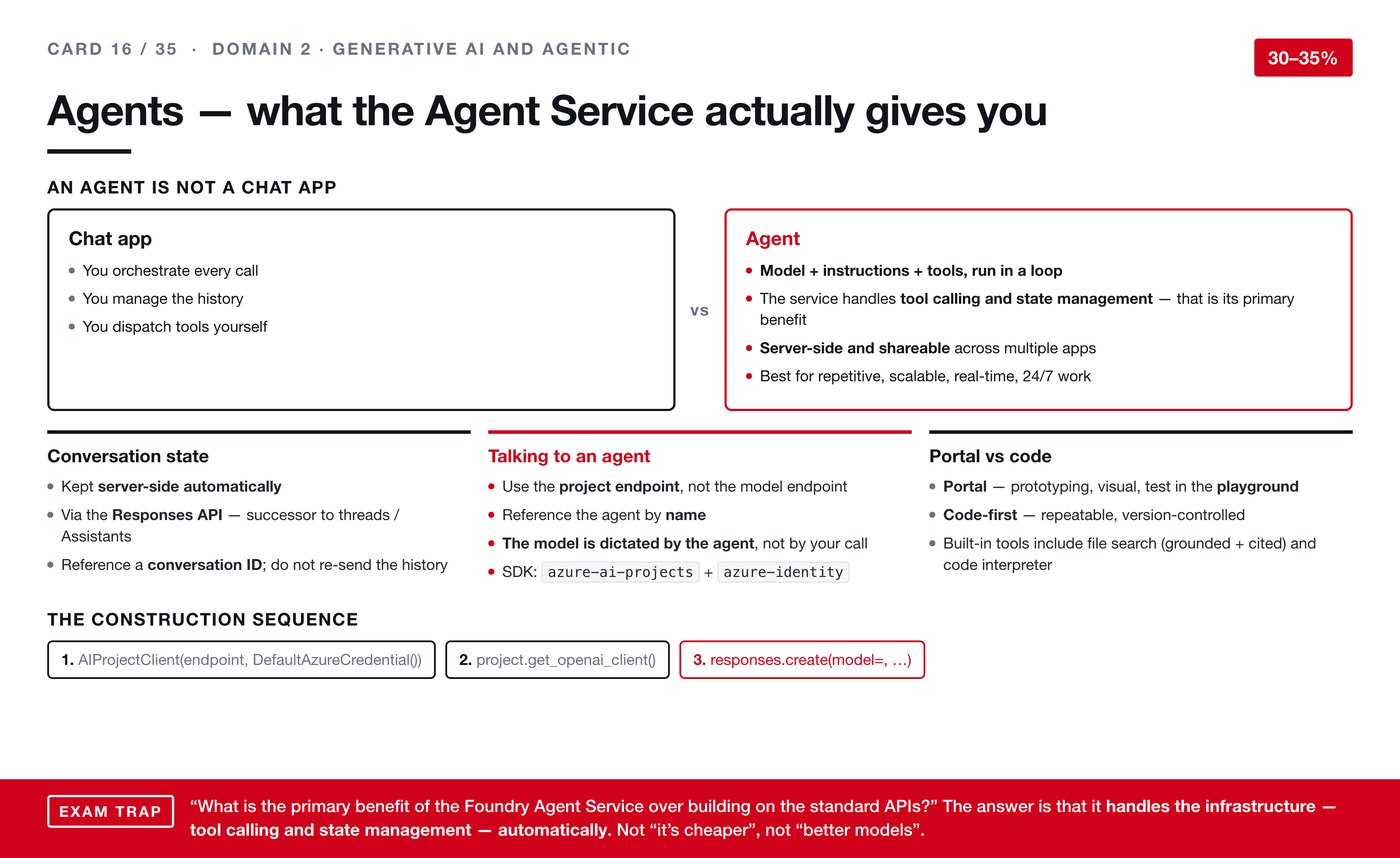
There is a genuine architectural difference between a chat application and an agent, and the exam wants you to be able to say what it is in one sentence.
An agent is not a chat app
In a chat app, you are the orchestrator. You make every call, you manage the history, and you dispatch the tools yourself. The model is a component you drive.
In an agent, the model, its instructions and its tools are packaged together and run in a loop. The service handles tool calling and state management for you. It is server-side and shareable across multiple applications.
That difference decides what each is good for. An agent suits repetitive, scalable, real-time work that has to run continuously. A chat app suits a bespoke flow you want to control end to end.
Conversation state
State is kept server-side automatically, through the Responses API — the successor to the older threads and Assistants approach.
You reference a conversation ID. You do not re-send the history. Trying to manage history yourself against an agent is fighting the thing that is meant to be its advantage.
Talking to an agent
Four points, all examinable:
- Use the project endpoint, not the model endpoint.
- Reference the agent by name.
- The model is dictated by the agent, not by your call. You do not choose the model at call time; the agent definition already did.
- The SDK packages are
azure-ai-projectsandazure-identity.
The third point catches people. It follows from the definition — a model, instructions and tools bound together — but it feels wrong if you are used to naming a model on every request.
Portal or code
The portal suits prototyping: visual, and you can test in the playground. Code-first suits anything you need to be repeatable and version-controlled.
Built-in tools include file search, which returns answers that are grounded and cited, and code interpreter.
The construction sequence
The same bridge as card 8, which is worth noticing:
AIProjectClient(endpoint, DefaultAzureCredential())project.get_openai_client()responses.create(model=, ...)
Learning it once covers both cards.
The trap
Asked for the primary benefit of the Agent Service over building on the standard APIs, the answer is that it handles the infrastructure — tool calling and state management — automatically.
The tempting wrong answers are that it is cheaper, or that it gives you better models. Neither is true. The models are the same models. What you are buying is not having to write the orchestration loop and the state handling yourself, which is exactly the work described in cards 8 and 13. If you have written both by hand, the benefit is obvious.