Card 27 of 38· Domain 4 · Text analysis and speech
Speech through the Azure OpenAI audio models
The two inferencing tasks and their exact calls, and the four requirements that mean the Speech service rather than the audio models.
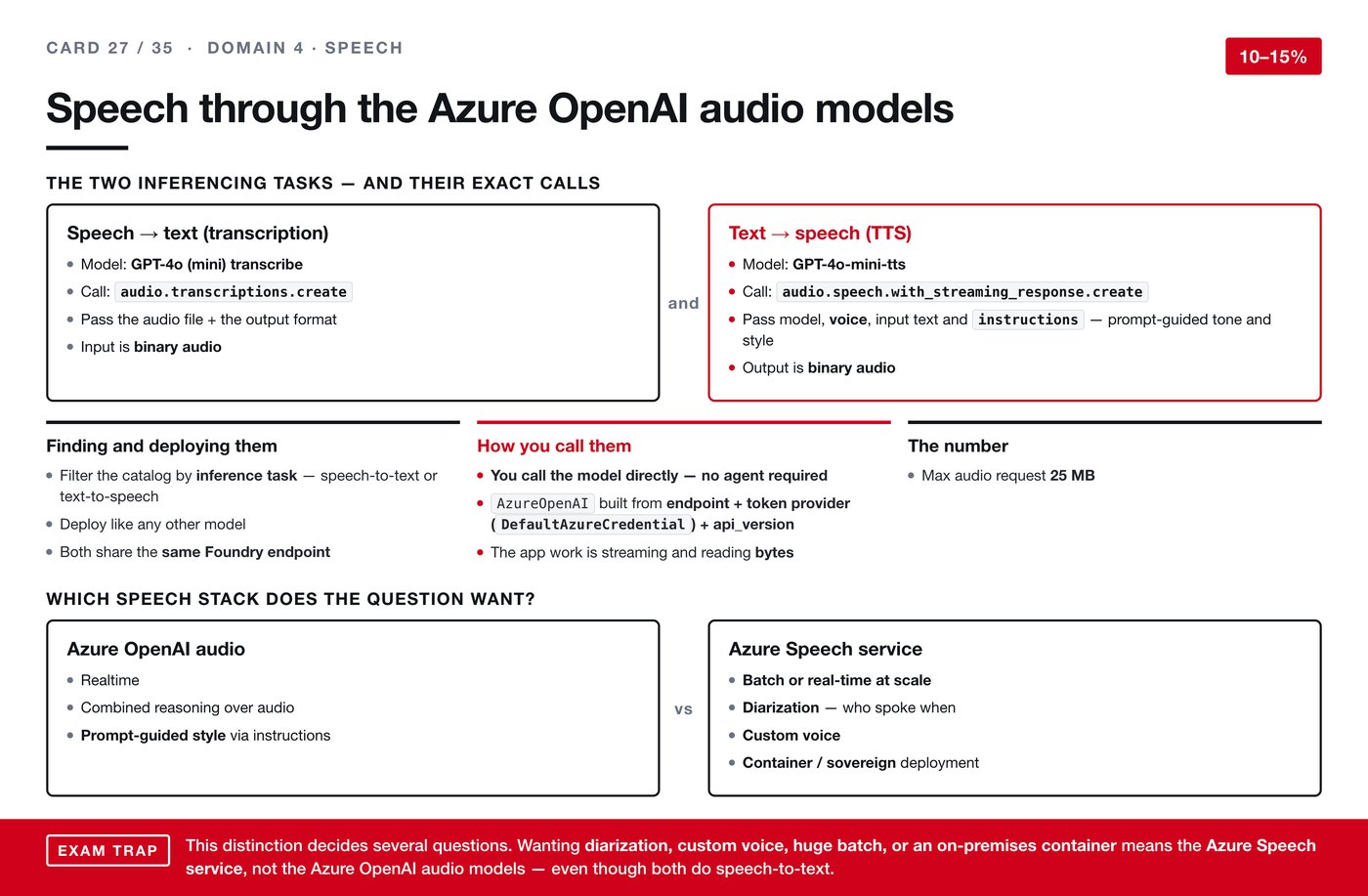
There are two separate ways to do speech on this platform, and the exam's favourite question here is not how either works — it is which one a scenario is asking for.
The two inferencing tasks
Speech to text, or transcription:
- Model: GPT-4o transcribe, or the mini variant.
- Call:
audio.transcriptions.create. - You pass the audio file and the output format.
- The input is binary audio.
Text to speech:
- Model: GPT-4o-mini-tts.
- Call:
audio.speech.with_streaming_response.create. - You pass the model, the voice, the input text, and
instructions— which give prompt-guided control over tone and style. - The output is binary audio.
The instructions parameter is the interesting one. It means the delivery is steerable in natural language, rather than through a fixed set of voice settings.
Finding and calling them
Filter the catalogue by inference task — speech-to-text or text-to-speech. Deploy them like any other model. Both share the same Foundry endpoint.
Then a point that matters: you call the model directly. No agent is required. Build an AzureOpenAI client from an endpoint, a token provider using DefaultAzureCredential, and an api_version. The application-side work is streaming and reading bytes.
One number: the maximum audio request is 25 MB.
Which speech stack does the question want
This distinction decides several questions, so it is worth more attention than the call signatures.
Azure OpenAI audio suits realtime work, combined reasoning over audio, and prompt-guided style through instructions.
The Azure Speech service suits batch or realtime at scale, diarization — working out who spoke when — custom voice, and container or sovereign deployment.
The trap
Both do speech-to-text, which is exactly why the question works.
If a scenario wants diarization, custom voice, very large batch processing, or an on-premises container, the answer is the Azure Speech service — not the Azure OpenAI audio models.
Take the container case seriously beyond the exam. Deploying into your own container or a sovereign environment is what organisations reach for when audio cannot leave their estate at all. That requirement rules out the hosted audio models regardless of how well they would otherwise perform, and it is the same class of constraint as the residency question on card 3: a capability that cannot be deployed where the data must stay is not a capability you can use.