Card 01 of 38· Domain 1 · Plan and manage
The Foundry mental model — resource, project, tools
The hierarchy you must never invert, which of the three tools does what, when to reach for each SDK, and the six responsible-AI principles by name.
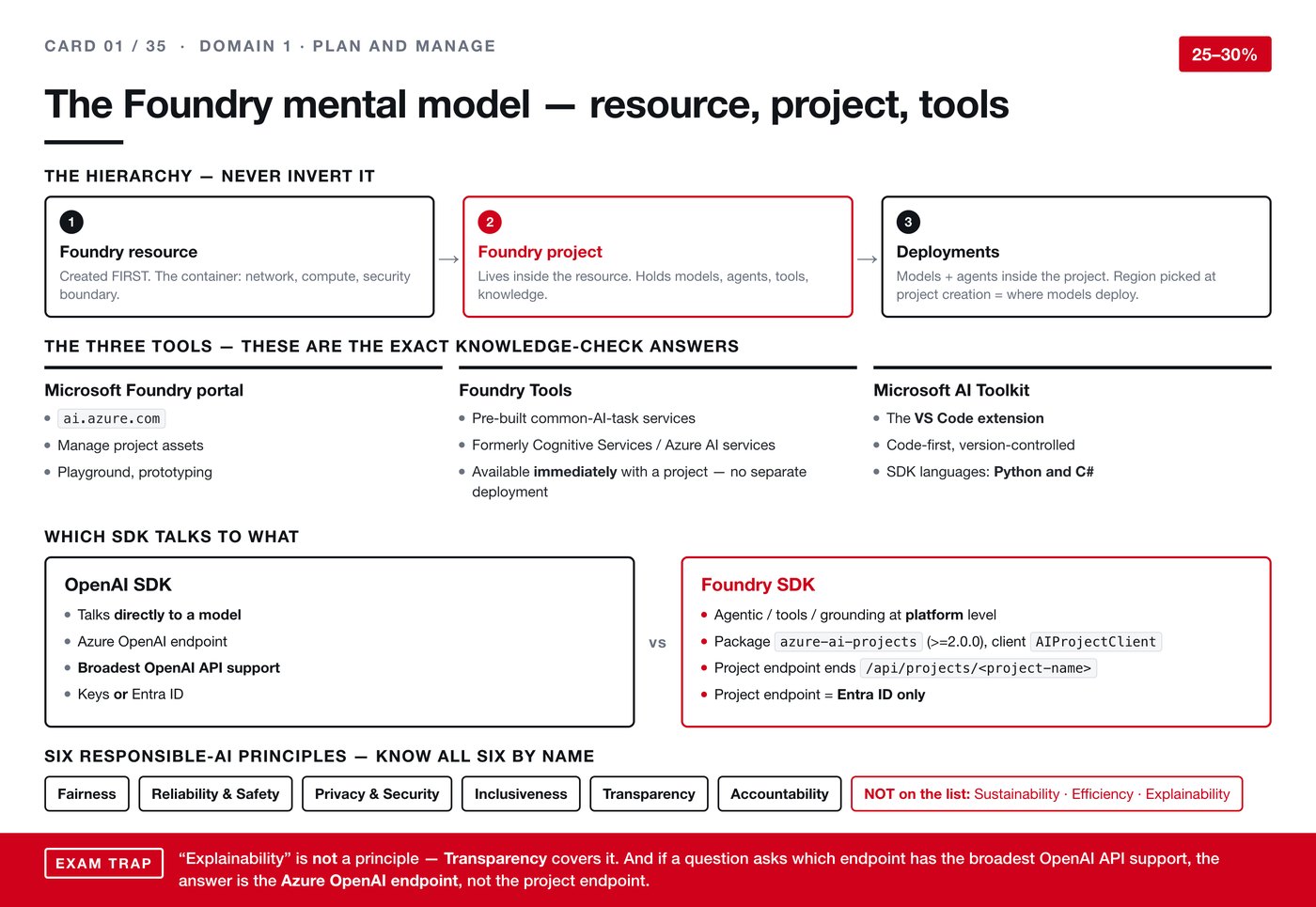
Everything else in this exam sits on top of three ideas: where your work lives, which tool you open to do it, and which library your code talks to. Get those straight and a lot of questions answer themselves.
The hierarchy, and why the order matters
Microsoft Foundry is the platform you build generative AI on. It used to be called Azure AI Foundry, and before that Azure AI Studio. All three names are still in circulation, so expect any of them.
Three things stack up, always in this order:
- The Foundry resource. This is created first. It is the container — the thing that holds your networking, your compute and your security boundary. Think of it as the plot of land.
- The Foundry project. This lives inside the resource. It holds the things you actually work with: your models, your agents, your tools and your knowledge. This is the building on the plot.
- The deployments. These are the models and agents running inside the project. The region you choose when you create the project is where those models get deployed.
The order is the point. You cannot have a project without a resource underneath it. A question that describes creating a project first, or that puts a resource inside a project, is describing something impossible.
One consequence worth holding on to: region is decided at project creation, and it decides where your models run. That is a small click with a large blast radius if you have data-residency rules to answer to.
The three tools, and which is which
These come up as knowledge checks, and the distinction is cleaner than it first looks.
- The Microsoft Foundry portal — the website, at
ai.azure.com. You manage project assets here, and you prototype in the playground. It is the click-around surface. - Foundry Tools — a set of ready-made services for common AI tasks, things like reading text or handling speech. These were previously called Azure AI services, and before that Cognitive Services. The detail that gets tested: they are available immediately with a project. You do not deploy them separately.
- The Microsoft AI Toolkit — an extension for Visual Studio Code, which is a code editor. This is the code-first, version-controlled route. The software development kits, or SDKs — the libraries your code imports — are Python and C#.
Which library talks to what
Two SDKs, and the difference is about how far up the stack you are working.
The OpenAI SDK talks directly to a model. You point it at an Azure OpenAI endpoint. Its advantage is breadth: it has the broadest support for the OpenAI application programming interface, the API. It accepts either keys or Entra ID, which is Microsoft's identity system.
The Foundry SDK works at the platform level instead — agents, tools and grounding rather than raw model calls. The package is azure-ai-projects, version 2.0.0 or later, and the client class is AIProjectClient. Its endpoint ends with /api/projects/<project-name>. Note this one: the project endpoint is Entra ID only. No keys.
That last pair is a favourite. If a question asks which endpoint gives the broadest OpenAI API support, the answer is the Azure OpenAI endpoint, not the project endpoint.
The six principles, by name
Microsoft's responsible AI framework has six principles, and you need them by name, because the trap is a plausible seventh.
Fairness · Reliability and Safety · Privacy and Security · Inclusiveness · Transparency · Accountability.
Explainability is not one of them. It sounds like it should be, and it is a real idea, but it is covered under Transparency. Sustainability and Efficiency are not on the list either. If one of those four appears as an option, it is the wrong answer.