Card 39 of 44· Added after the August 2026 sweep
The grounding pipeline — whose pipeline is it?
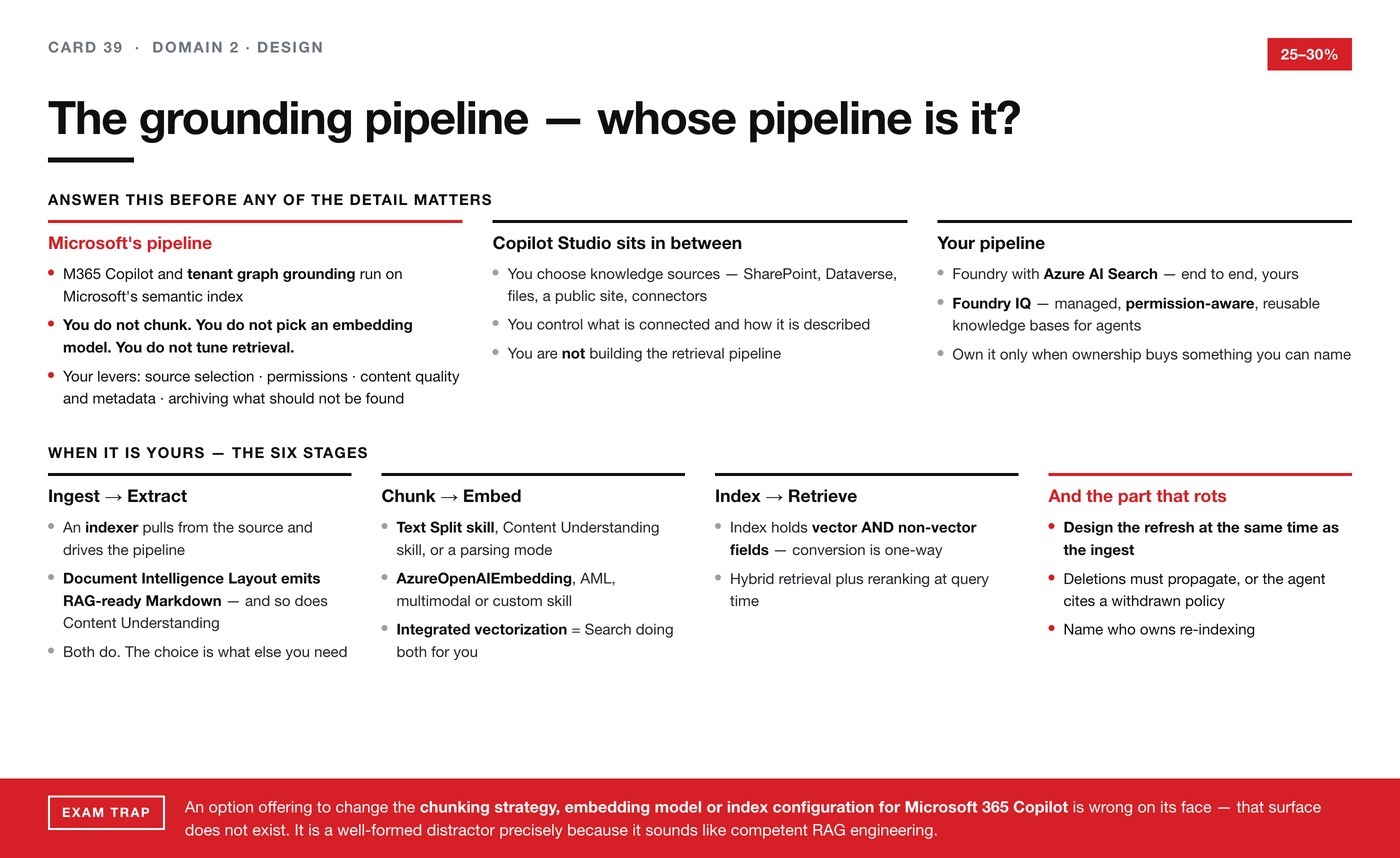
Domain 2. Microsoft owns the index for Microsoft 365 grounding, so chunking is not a customer surface — and the six stages for when the pipeline genuinely is yours.
The syllabus asks you to design data processing for AI models and grounding. There
is one question to answer before any of the detail matters, and getting it wrong
produces architecture that cannot be built.
Whose pipeline is it?
Microsoft 365 Copilot and tenant graph grounding run on Microsoft's own semantic
index. You do not chunk. You do not choose an embedding model. You do not tune a
retrieval strategy. That machinery exists, but it is Microsoft's and it is not a
customer surface.
So when a scenario is grounded in Microsoft 365 content, your levers are entirely
different ones: source selection (what is in scope at all), permissions
(retrieval is permission-trimmed, so the access model is the retrieval control),
content quality and metadata, and removing what should not be found —
archiving, not just restricting.
Copilot Studio sits in between. You choose knowledge sources — SharePoint,
Dataverse, uploaded files, a public website, connectors — and you control what is
connected and how it is described. You are not building the retrieval pipeline.
Foundry with Azure AI Search is yours end to end.
When it is yours, the six stages
Ingest. An indexer pulls from a supported data source and drives the
pipeline. It handles change detection — and deletion detection is the part people
forget.
Extract. Turn documents into text a model can use. Azure AI Document
Intelligence Layout returns RAG-ready Markdown when you ask for it, preserving
headings, lists and tables, and it can return cropped images of figures. Azure
AI Content Understanding covers multimodal cases and structured field
extraction. Both produce Markdown — the choice is about what else you need, not
about which one can.
Chunk. Not strictly required, but necessary for anything but small documents,
because embedding models have token limits. In a skillset that is the Text Split
skill, the Content Understanding skill, or a document parsing mode.
Embed. An embedding skill turns chunks into vectors — AzureOpenAIEmbedding
against the text-embedding models, an AML skill pointing at the Foundry
catalog, a multimodal embeddings skill, or a custom one.
Index. The result lands in a search index holding both vector and non-vector
fields. Vector conversion is one-way, so you keep the readable text alongside the
embedding.
Retrieve and rank. Hybrid retrieval plus reranking at query time.
Integrated vectorization is the name for having Azure AI Search do the chunk
and embed steps for you, at both indexing and query time. It exists to reduce the
number of moving parts you build and maintain.
Foundry IQ is the layer above: a managed knowledge layer that turns enterprise
content into reusable, permission-aware knowledge bases for agents. That word
reusable is the architectural point — knowledge prepared for one agent should
serve the next.
Do not build a pipeline you were not asked for
If the grounding data lives in Microsoft 365 and the audience is internal,
Microsoft's index is the answer. Building a parallel one is duplicated cost, a
second permission model and a second thing to keep fresh.
Own the pipeline when you genuinely need what ownership buys: content Microsoft's
index cannot reach, retrieval tuning you can prove you need, or a residency
constraint the managed service does not satisfy.
Exam trap. An option offering to change the chunking strategy, embedding
model or index configuration for Microsoft 365 Copilot is wrong on its face.
That surface does not exist — which is exactly why it makes a good distractor.
The one line to carry: the common failure is not a bad chunking strategy, it
is a pipeline that ingests beautifully once and then quietly diverges — so design
the refresh at the same time as the ingest, and name who owns it.