Card 38 of 44· Added after the August 2026 sweep
The named Dynamics 365 agents, app by app
Domain 2. Two platform families and what each inherits, then every named agent — Sales seven, Customer Service seven, Project Operations three, and why Commerce has none.
People who sat AB-100 keep saying the same thing about Dynamics: coverage is
broad, and it is across all modules. So the named agents matter. But before the
names, there is a structural idea that makes them far easier to hold.
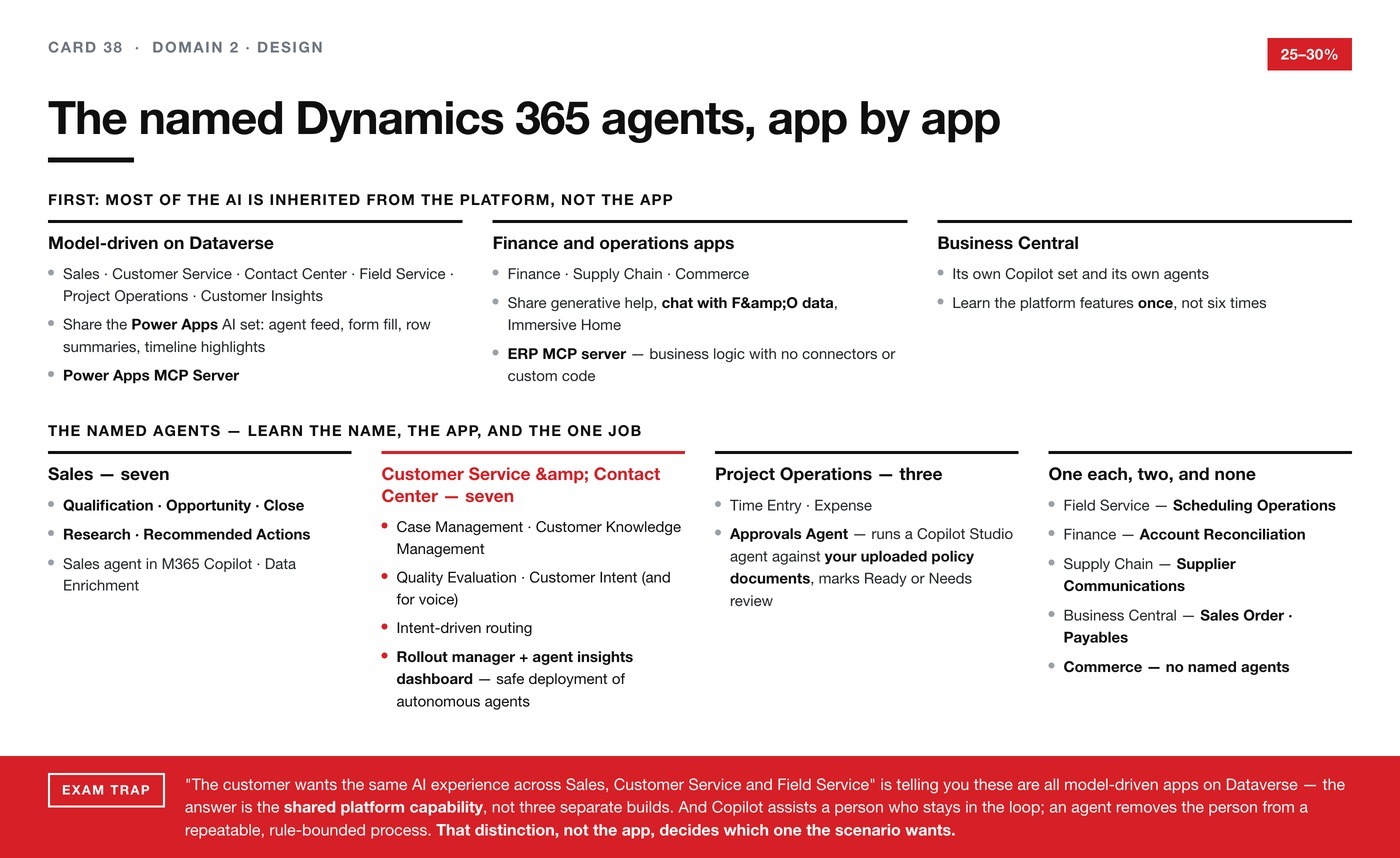
Most of the AI is inherited from the platform, not built into the app
Dynamics 365 is not one product. It is two families on two different platforms,
and a large share of what you see in any given app comes from underneath it.
Model-driven apps on Dataverse — Sales, Customer Service, Contact Center,
Field Service, Project Operations, Customer Insights. Because they share the Power
Apps foundation, every Copilot capability available to model-driven apps appears
across all of them: the agent feed (one activity stream of everything agents
have done for you), form-fill assistance, find and visualise data in a view, row
summaries, timeline highlights, and the Power Apps MCP Server.
Finance and operations apps — Finance, Supply Chain, Commerce. Their own
shared set: generative help and guidance, chat with finance and operations
data, workflow history summaries, Immersive Home, and the ERP MCP server,
which lets agents reach the app's business logic with no custom code, connectors
or APIs.
Business Central is its own thing again.
If you see the same feature listed under five apps, it is a platform feature.
Learn it once.
The named agents
Sales has seven — the deepest set. Sales Qualification (researches leads and
engages), Sales Opportunity (surfaces emerging risk), Sales Close (runs the cycle
end to end), Sales Research, Recommended Actions, the Sales agent in Microsoft 365
Copilot, and AI-powered Data Enrichment.
Customer Service and Contact Center share one set of seven — note that these
two apps are treated together. Case Management, Customer Knowledge Management
(mines closed cases for knowledge), Quality Evaluation, Customer Intent and
Customer Intent for voice, intent-driven routing, plus Rollout manager and the
agent insights dashboard.
Those last two are the most under-rated items on the list, because they are the
answer to "how do we deploy autonomous agents safely" — a governance question
wearing a Customer Service costume.
Project Operations has three, all production ready preview: Time Entry,
Expense, and the Approvals Agent. That last one is worth reading twice: it
uses a Copilot Studio agent to review time, expense and material entries against
policy documents the customer uploaded, marking each Ready for approval or
Needs review. Grounded in the customer's own policy, producing a recommendation
for a human to approve. That shape answers a lot of scenarios.
One each — Field Service has Scheduling Operations, Finance has Account
Reconciliation, Supply Chain has Supplier Communications. Business Central
has two — Sales Order and Payables. Commerce has none — its Copilot features
serve store associates and merchandisers, and its work is physical and
situational.
Exam trap. "The customer wants the same AI experience across Sales,
Customer Service and Field Service" is telling you these are model-driven apps
on Dataverse. The answer is the shared platform capability, not three builds.
The one line to carry: Copilot assists a person who stays in the loop, an
agent removes the person from a repeatable rule-bounded process — and that
distinction, not the app, decides which one a scenario wants.