Card 37 of 44· Added after the August 2026 sweep
What things actually cost — credits, not tokens
Domain 1. Copilot Studio bills per action at rates that vary a hundredfold, the biggest lever is a licensing decision, and running out of capacity disables agents rather than slowing them.
Almost everything written about AI cost control assumes you are billed per token.
In the Microsoft world that is only half true — and the half that is false is the
half most people are working in.
Copilot Studio bills in credits, per action
A Copilot Credit is charged per thing the agent does, and the exchange rate
between one action and another varies by a factor of a hundred.
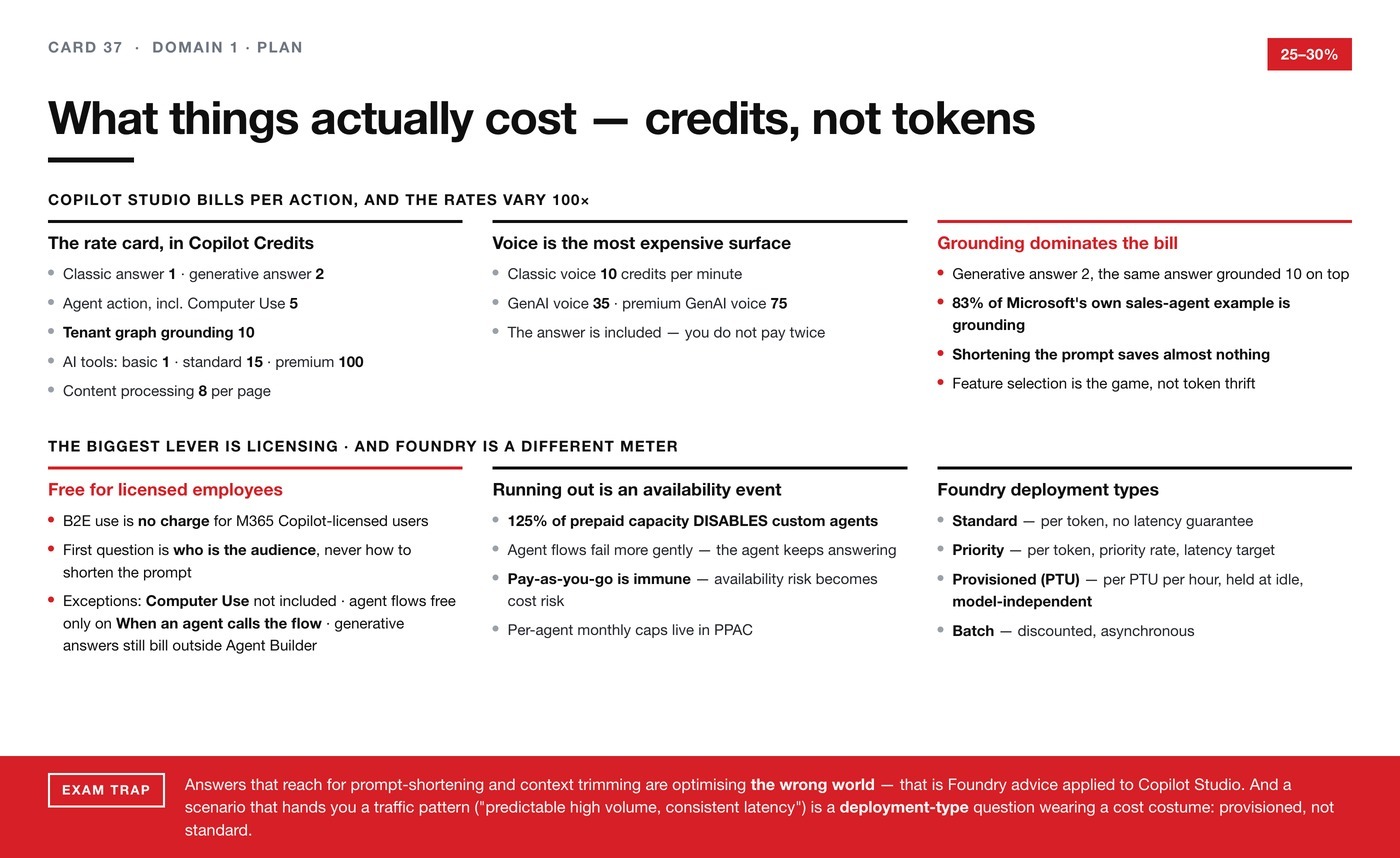
Classic answer 1. Generative answer 2. Agent action — trigger, deep
reasoning, topic transition, Computer Use — 5. Tenant graph grounding 10.
AI tools: basic 1, standard 15, premium 100 per ten responses. Content
processing 8 per page.
Voice is charged per minute and is the most expensive surface in the product:
classic 10, generative 35, premium generative 75. The answer itself is
included in that rate, so you are not paying twice.
Money: a 25,000-credit pack is $200 per tenant per month on annual commitment,
about $0.008 a credit. Pay-as-you-go through an Azure meter is about $0.01
with no commitment.
Which means prompt length is almost irrelevant
Look at what the rates imply. A generative answer costs 2. The same answer
grounded in Microsoft Graph costs 10 on top of that. In Microsoft's own worked
example of a sales agent, grounding is 83% of the bill.
No amount of prompt trimming touches that. Feature selection is the game, not
token thrift.
The biggest lever is a licensing decision
Employee-facing agent use is free for people licensed with Microsoft 365
Copilot, provided the agent runs under that user's authenticated identity.
So the same agent, doing the same work, costs either nothing or a great deal
depending entirely on who uses it. The first cost question is never how do we
make this cheaper. It is who is the audience.
Three exceptions break the rule, and they are exactly the kind of detail that
becomes a distractor. Computer-Using Agents are not included in the licence.
Agent flows ride free only on the When an agent calls the flow trigger. And
generative answers still bill unless the agent was built in Agent Builder and
the response does not use tenant graph grounding.
Running out is an availability event, not just a cost one
Enforcement triggers at 125% of prepaid capacity and custom agents are
disabled. Not throttled — disabled. Users see "this agent is currently
unavailable". Agent flows fail more gently: new runs are blocked but the agent
keeps answering.
Pay-as-you-go is immune to enforcement. That is the real argument for it on
anything business-critical: it converts an availability risk into a cost risk.
Capacity is pooled at tenant level but environment allocations are honoured, so
you can ring-fence capacity for the agents that must not die. And there are
per-agent monthly caps in the Power Platform admin center.
Foundry is a different meter
Four deployment categories, and choosing between them is the cost decision.
Standard — per token, no latency guarantee, for development and unpredictable
traffic. Priority processing — per token at a priority rate with a latency
target. Provisioned (PTU) — per PTU per hour, capacity held for you whether or
not requests are being made, for mission-critical volume. Batch — discounted,
asynchronous, for bulk work with no latency requirement.
A PTU is model-independent — you do not buy them for a particular model.
Exam trap. Answers reaching for prompt-shortening are optimising the wrong
world. And a scenario that hands you a traffic pattern is a deployment-type
question wearing a cost costume.
The one line to carry: who is the audience, what does the agent do per turn,
and which meter is it on — answer those three and the cost question answers
itself.