Card 36 of 44· Added after the August 2026 sweep
AI maturity, and Success by Design
Domain 1. Two frameworks with two different scopes, the four AI adoption maturity levels, and why selling a level ahead of where an organisation sits is how these programmes fail.
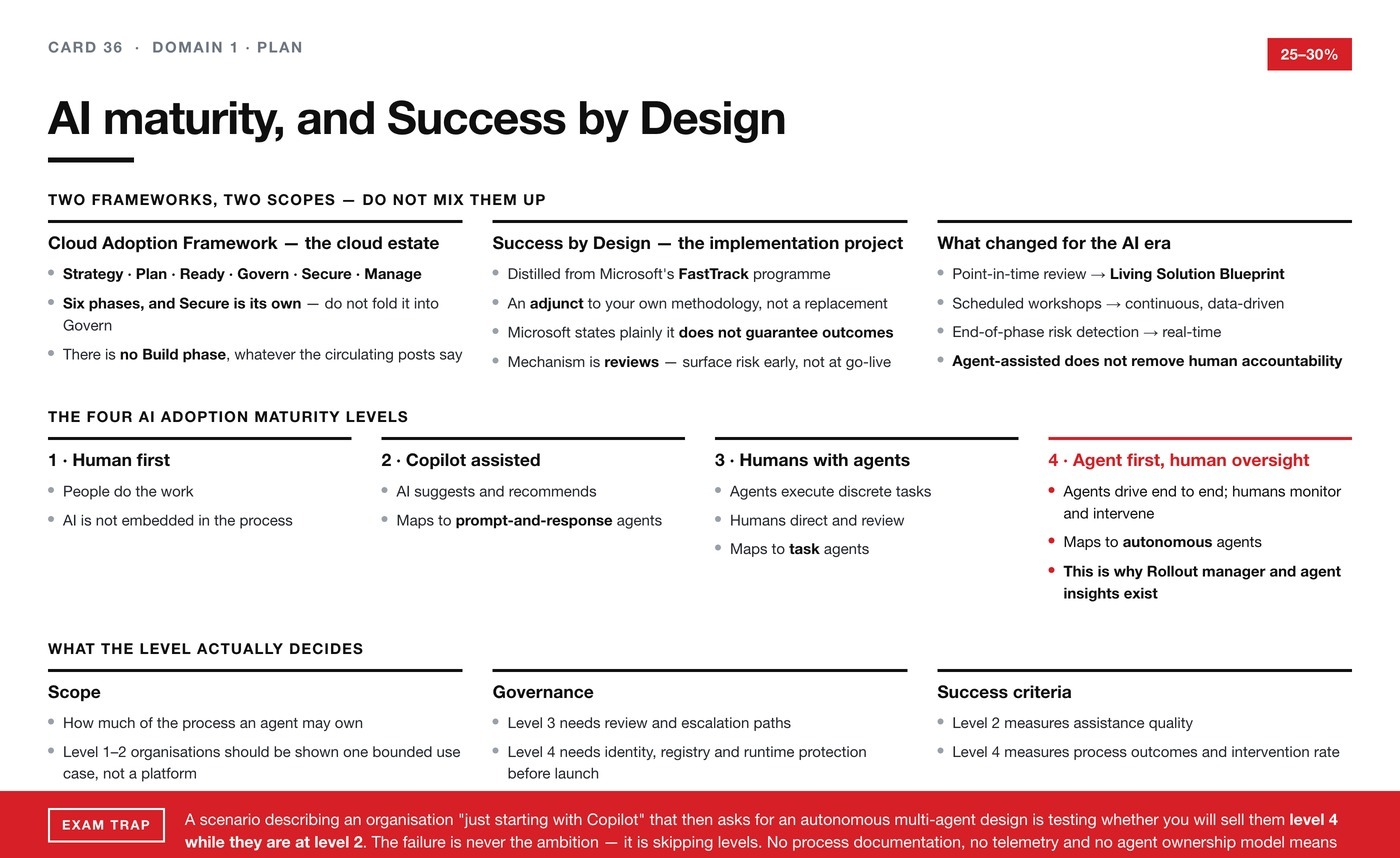
Two frameworks turn up constantly in AB-100 material, and they are routinely
mixed up. They answer different questions about different things.
Cloud Adoption Framework governs the cloud estate
Six phases, in order: Strategy, Plan, Ready, Govern, Secure, Manage.
Two things worth pinning down. Secure is its own phase — it is not a wing of
Govern. And there is no Build phase, despite a widely-shared post that gives a
tidy four-phase version with one in it. If you have seen "Plan → Govern & Secure →
Build → Manage" somewhere, that is the version to forget.
Success by Design governs the implementation project
Different scope entirely. This one is about your Dynamics 365 and Power Platform
delivery, not your cloud estate.
It comes out of Microsoft's FastTrack programme — the distilled experience of
thousands of deployments. Microsoft is careful about what it claims: it is an
adjunct to whatever methodology you already use, and it explicitly does not
guarantee outcomes. Its mechanism is reviews — structured exercises in
reflection and pattern-matching, so risk surfaces early instead of at go-live.
In plain terms: the Cloud Adoption Framework asks are we building the right
estate. Success by Design asks is this project going to fail, and can we tell
yet.
What changed for the AI era
Success by Design has moved from point-in-time Solution Blueprint Reviews to a
Living Solution Blueprint — continuously refined from telemetry, transcripts,
documents and agent analysis. Scheduled workshops become continuous. Guidance
becomes dynamic recommendations. Risk detection moves from end-of-phase to
real-time.
It also carries three agentic design principles: treat agents as first-class
components of the architecture rather than add-ons, design processes with
agent-assisted and autonomous execution in mind, and model processes for
agents including collaboration, exception handling and escalation.
And one sentence Microsoft states plainly, which is the one to remember:
moving to an agent-assisted model does not remove human accountability. The
team still validates agent outputs, defines agent scope and data access, and
maintains oversight.
The four AI adoption maturity levels
This is the most usable thing in the framework.
Level 1 — Human first. People do the work. AI is not embedded in the process.
Level 2 — Copilot assisted. AI suggests and recommends. Maps to
prompt-and-response agents.
Level 3 — Humans with agents. Agents execute discrete tasks; humans direct and
review. Maps to task agents.
Level 4 — Agent first with human oversight. Agents drive processes end to end;
humans monitor and intervene. Maps to autonomous agents — which is precisely why
Rollout manager and the agent insights dashboard exist in Customer Service.
Knowing where an organisation actually sits sets realistic scope, governance and
success criteria. It is also the cleanest way to push back on a customer who wants
level 4 while operating at level 1.
Exam trap. A scenario describing an organisation "just starting with
Copilot" that then asks for an autonomous multi-agent design is testing whether
you will sell them level 4 while they are at level 2.
The one line to carry: the failure is never the ambition, it is skipping
levels — an organisation with no process documentation, no telemetry and no agent
ownership model fails at level 4 for reasons that have nothing to do with the
technology.