Card 35 of 44· Master cards
How the questions are built, and how to read them
The five judgements the exam rewards, the five distractor patterns to spot, and the order to read a question in so the constraint eliminates two options before you start.
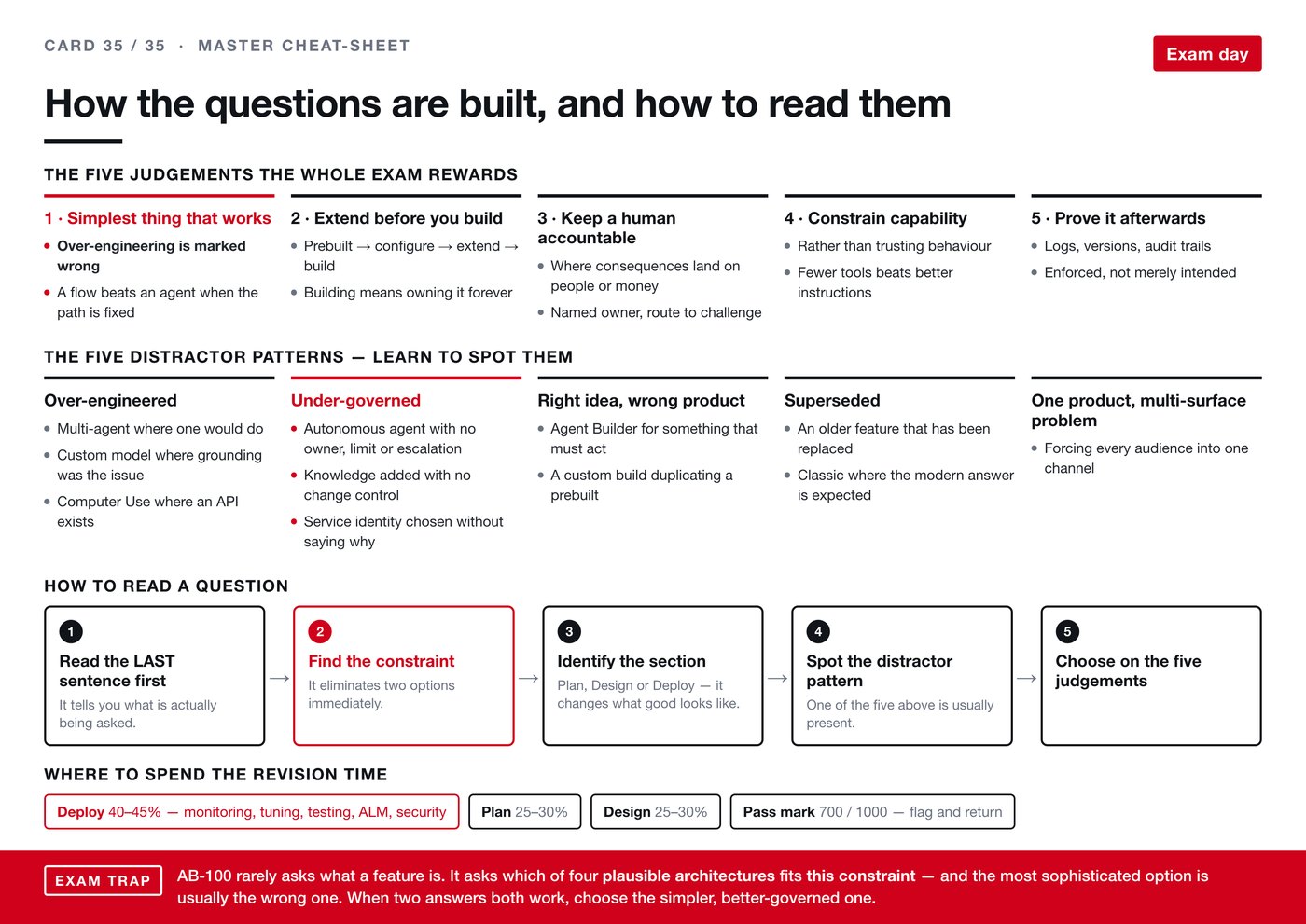
The last card, and the one to read on the morning. Not content — technique. How
the questions are built, and how to take them apart.
The five judgements the whole exam rewards
The simplest thing that works. Over-engineering is marked wrong. A flow beats
an agent when the path is fixed.
Extend before you build. Prebuilt, then configure, then extend, then build.
Building means owning it forever.
Keep a human accountable where consequences land on people or money. A named
owner, and a route to challenge.
Constrain capability rather than trusting behaviour. Fewer tools beats better
instructions.
Prove it afterwards. Logs, versions, audit trails. Enforced rather than merely
intended.
Every scenario question is really asking which of those five you have understood.
The five distractor patterns
Over-engineered — multi-agent where one would do, a custom model where
grounding was the issue, Computer Use where an API exists.
Under-governed — an autonomous agent with no owner, limit or escalation;
knowledge added with no change control; a service identity chosen without saying
why.
Right idea, wrong product — Agent Builder for something that must act, or a
custom build duplicating a prebuilt.
Superseded — an older feature that has been replaced, or classic where the
modern answer is expected.
One product for a multi-surface problem — forcing every audience into one
channel.
Learning to name these is worth more than memorising features, because one of them
is usually sitting in the option list.
How to read a question
Read the last sentence first. It tells you what is actually being asked.
Find the constraint. It eliminates two options immediately.
Identify the section — Plan, Design or Deploy — because it changes what good
looks like.
Spot the distractor pattern. One of the five above is usually present.
Choose on the five judgements.
Where to spend the revision time
Deploy is 40–45% — monitoring, tuning, testing, lifecycle, security. Plan is
25–30%. Design is 25–30%. Pass mark is 700 out of 1000, so flag and return rather
than stalling.
Exam trap. AB-100 rarely asks what a feature is. It asks which of four
plausible architectures fits this constraint — and the most sophisticated
option is usually the wrong one. When two answers both work, choose the simpler,
better-governed one.
The one line to carry: find the constraint, then pick the simplest
well-governed thing that satisfies it.
That completes all thirty-five cards. The exam's centre of gravity is everything
that happens after the demo, and the guide is weighted the same way: restraint in
Plan, discipline in Design, and evidence in Deploy.