Card 40 of 44· Added after the August 2026 sweep
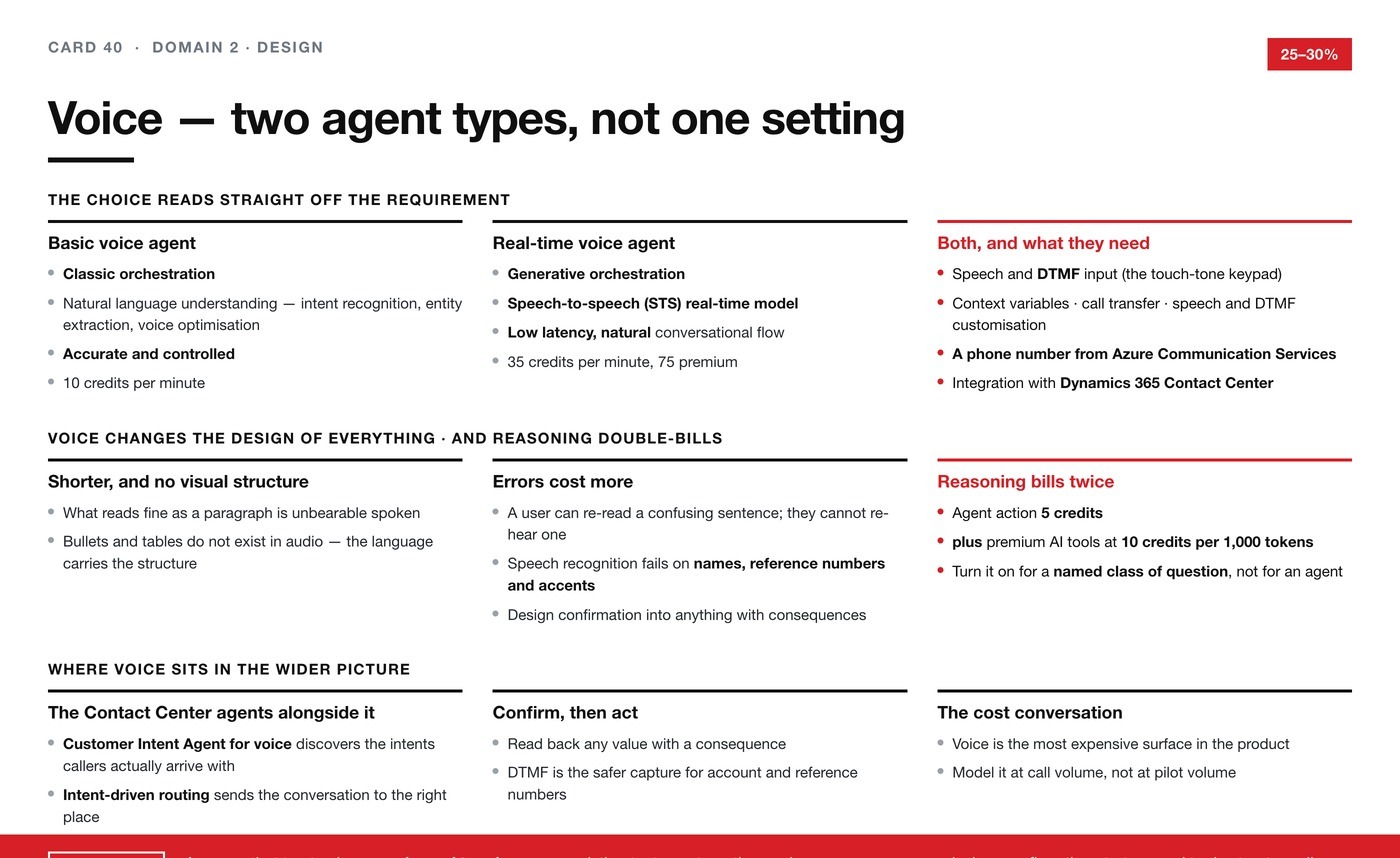
Voice — two agent types, not one setting
Domain 2. Basic against real-time voice agents and how the requirement picks between them, what both need to exist at all, and why reasoning bills twice.
Voice is not a rendering option you apply at the end. And in Copilot Studio it is
not one setting either — it is two different kinds of agent sitting on two
different orchestration models.
Two voice agent types
Basic voice agents run on classic orchestration. They use natural language
understanding models for intent recognition and entity extraction, with voice
optimisation on top. The character of them is accurate and controlled. Ten
credits a minute.
Real-time voice agents run on generative orchestration and use a
speech-to-speech real-time model. The character is low latency and natural
— it feels like a conversation. Thirty-five credits a minute, seventy-five for
premium.
The choice reads straight off the requirement. "Must capture a reference number
correctly, accurate, controlled" → basic. "Natural, interruptible, feels like
talking to someone" → real-time.
What both of them need
Both support speech and DTMF input — DTMF is the touch-tone keypad, "press 1
for accounts". Both support context variables, call transfer, and customisation of
speech and DTMF handling.
And before you can build either, you need a phone number. That comes from
Azure Communication Services — a new number or an existing one ported in — and
the agent integrates with Dynamics 365 Contact Center. A scenario describing a
voice agent with no telephony platform is describing something incomplete.
Voice changes the design of everything
Responses must be shorter. What reads fine as a paragraph is unbearable spoken.
There is no visual structure. Bullet lists and tables do not exist in audio.
The structure has to be carried by the language itself.
Errors cost more. A user can re-read a confusing sentence. They cannot easily
re-hear one.
Speech recognition is imperfect, especially with names, reference numbers and
accents. Design confirmation into anything where a misheard value has
consequences — and DTMF is the safer capture for account numbers.
Turn-taking matters. Long monologues feel wrong, and confirmations matter more
because there is no screen to check.
And while we are on agent behaviours — reasoning double-bills
Reasoning means letting the agent think through a problem in several steps before
answering. It improves quality on genuinely complex questions and costs both
latency and money.
In Copilot Studio the cost is worse than "more tokens". A reasoning model bills
twice: as an agent action at 5 credits, and at the premium AI tools
rate of 10 credits per 1,000 tokens. This is the one place in Copilot Studio
where token volume genuinely drives the bill — and it is exactly where people
switch reasoning on to improve quality without modelling what it costs.
Treat it as something you turn on for a named class of question, not for an
agent.
Exam trap. Answers that treat voice as a channel toggle over an existing
text agent are the weaker ones — response design, confirmation strategy and
topic structure all change.
The one line to carry: "natural" carries a per-minute price a high-volume line
will feel — real-time voice costs three and a half times classic, so model it at
call volume rather than pilot volume.
Currency (19 Aug 2026). Three voice additions in preview: Teams Phone Agent can
hand a call off to your custom voice agent, consent-based recording asks callers for
consent with configurable retention, and hold and resume lets the agent pause
mid-conversation. See card 44.