Card 12 of 44· Domain 2 · Design
The three agent shapes
Prompt-and-response, task and autonomous, how to read the shape out of a scenario, and the four controls every autonomous agent needs without exception.
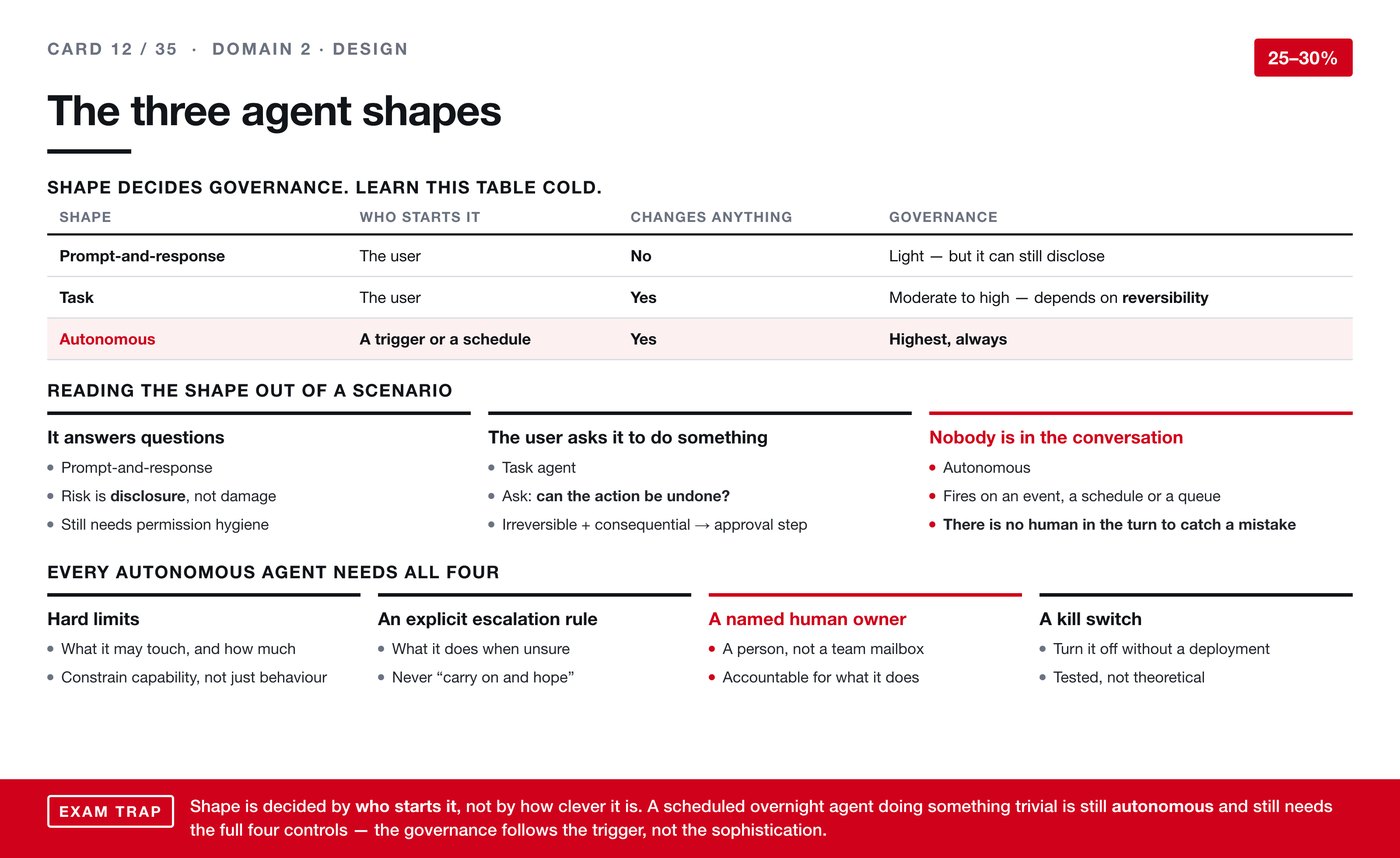
Domain 2 opens with a classification that governs everything after it. Three
shapes, and the shape decides how heavily the thing is governed.
The three shapes
Prompt-and-response. The user starts it, and it changes nothing. Governance
is light — but not absent, because it can still disclose something it should not.
Task. The user starts it, and it does change something. Governance runs from
moderate to high, and what decides is reversibility. An action you can undo
is a different proposition from one you cannot.
Autonomous. A trigger or a schedule starts it, and it changes things.
Governance is highest, always, with no exceptions worth arguing for.
Reading the shape out of a scenario
The exam describes a situation rather than naming the shape, so practise the
translation.
It answers questions → prompt-and-response. The risk here is disclosure
rather than damage, which still means permission hygiene matters.
The user asks it to do something → task agent. The follow-up question is
always: can the action be undone? Irreversible and consequential together means
an approval step.
Nobody is in the conversation → autonomous. It fires on an event, a schedule
or a queue, and the defining fact is that there is no human in the turn to catch
a mistake.
Every autonomous agent needs all four
Not three of them. All four.
Hard limits — what it may touch and how much. Constrain the capability, not
just the instructions about behaviour.
An explicit escalation rule — what it does when it is unsure. Never "carry on
and hope".
A named human owner — a person, not a team mailbox, accountable for what it
does.
A kill switch — able to turn it off without a deployment, and tested rather
than theoretical. An untested kill switch is a belief, not a control.
Exam trap. Shape is decided by who starts it, not by how clever it is. A
scheduled overnight agent doing something trivial is still autonomous and still
needs the full four controls — the governance follows the trigger, not the
sophistication.
The one line to carry: who starts it decides the shape, the shape decides the
governance, and nothing about how simple the task looks changes either.