Card 11 of 44· Domain 1 · Plan
The money — ROI, TCO, and build versus buy
The four parts of total cost, how to build an ROI case that survives a finance conversation, and why the omitted operate line always flatters a custom build.
The last card in Domain 1, and the one most likely to decide a real project. The
exam tests whether you can spot a cost case that has quietly left out the
expensive part.
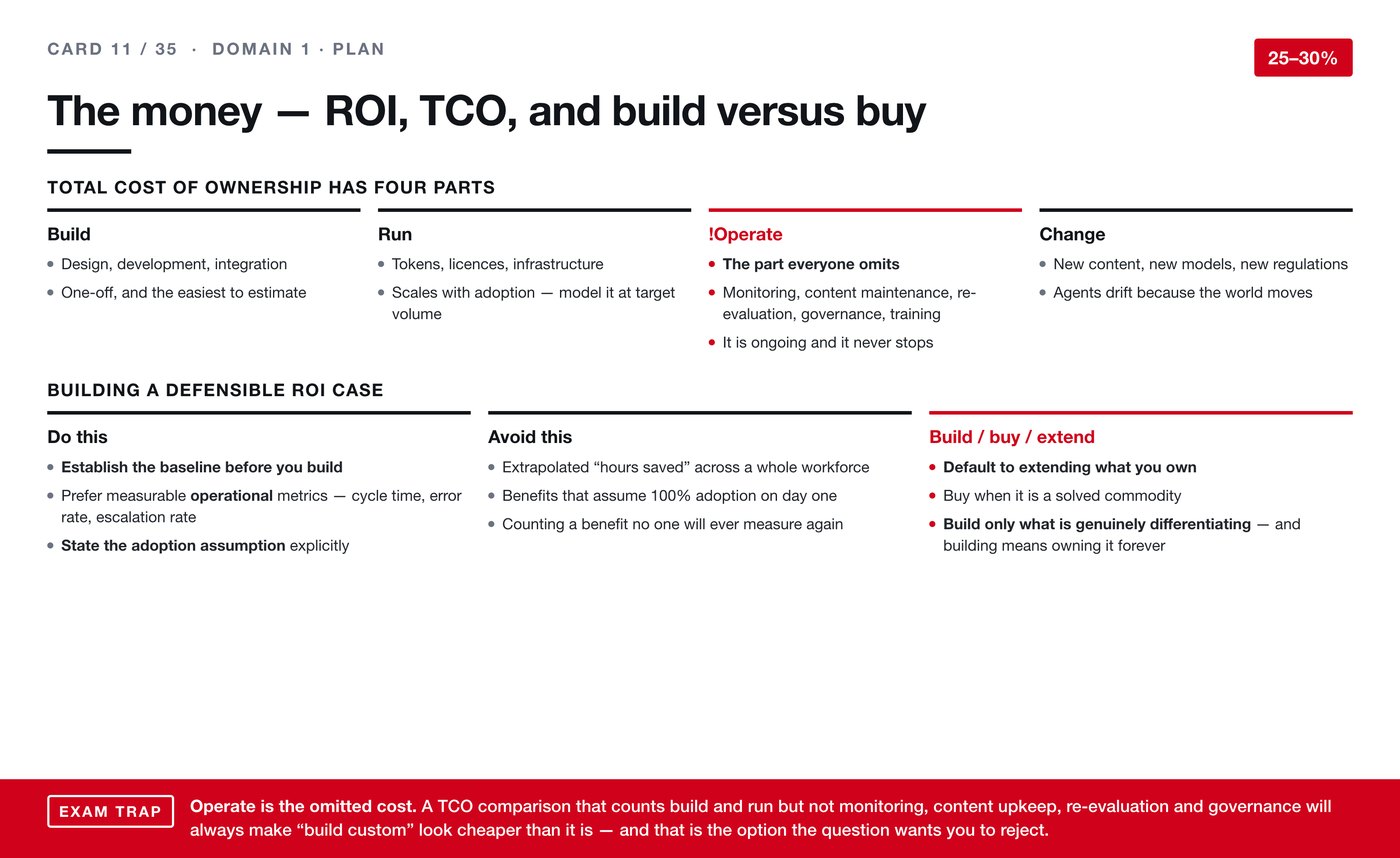
Total cost of ownership has four parts
Build. Design, development, integration. One-off, and the easiest part to
estimate — which is precisely why it dominates the conversation.
Run. Tokens, licences, infrastructure. It scales with adoption, so model it at
target volume rather than at pilot volume.
Operate. The part everyone omits: monitoring, content maintenance,
re-evaluation, governance, training. It is ongoing and it never stops.
Change. New content, new models, new regulations. Agents drift because the
world moves, not because anything broke.
Building a defensible ROI case
Do this. Establish the baseline before you build — the same instruction as
card 4, and it appears twice because it is the one people skip. Prefer measurable
operational metrics: cycle time, error rate, escalation rate. And state the
adoption assumption explicitly, so it can be challenged rather than buried.
Avoid this. Extrapolated "hours saved" spread across a whole workforce.
Benefits that assume full adoption on day one. Counting a benefit nobody will ever
measure again.
Each of those is a way of producing a large number that no finance director will
believe twice.
Build, buy or extend
Default to extending what you own.
Buy when it is a solved commodity.
Build only what is genuinely differentiating — and remember that building
means owning it forever.
Exam trap. Operate is the omitted cost. A TCO comparison that counts build
and run but not monitoring, content upkeep, re-evaluation and governance will
always make "build custom" look cheaper than it is — and that is the option the
question wants you to reject.
The one line to carry: if a cost comparison has no operate line, it is not a
comparison — it is an argument for building something.
That completes Domain 1. The pattern running through all eight cards is the same:
the exam rewards the restrained answer. Measure before you build, extend before
you build, split only for surface, owner or risk, and never let a prompt carry a
rule that has to hold every time.
Goes with: card 37, which puts real Microsoft numbers behind this — Copilot
Studio bills in credits per action, not tokens, and the biggest lever turns out to
be a licensing decision.