Card 10 of 44· Domain 1 · Plan
Model choice and the model router
The ladder climbed in order, what a router must have before it is safe to use, and why choosing small against large follows the shape of the task rather than the ambition.
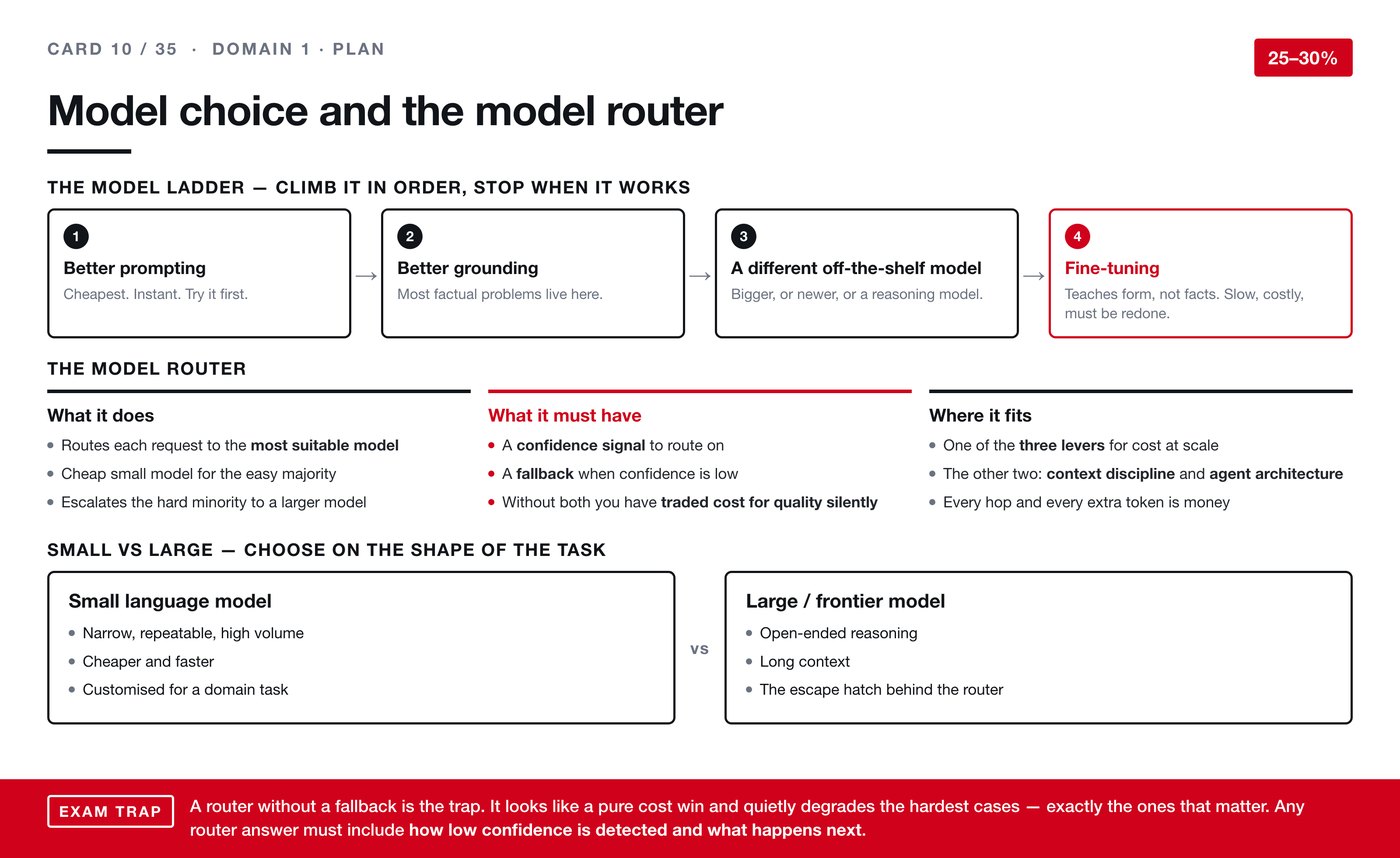
Card 7 introduced the ladder as part of the build-versus-buy decision. This card
takes it seriously as a model-selection discipline, then adds the routing pattern
that most production systems eventually need.
The model ladder
Climb it in order and stop when it works.
Better prompting. Cheapest, instant, and worth trying first every time.
Better grounding. Most factual problems live here. If the complaint is about
what the system knows, this is almost always the rung.
A different off-the-shelf model. Bigger, newer, or one built for reasoning.
Fine-tuning. Teaches form, not facts. Slow, costly, and it has to be redone
when the base model moves.
The order matters because each rung is cheaper and more reversible than the one
after it.
The model router
What it does. Routes each request to the most suitable model — a cheap small
model for the easy majority, escalating the hard minority to something larger.
What it must have. A confidence signal to route on, and a fallback when
confidence is low. Without both, you have traded cost for quality silently,
which is the worst way to make that trade because nobody notices it happening.
Where it fits. Routing is one of three levers for cost at scale. The other two
are context discipline and agent architecture — because every hop and every extra
token is money.
Small against large — choose on the shape of the task
A small language model suits narrow, repeatable, high-volume work. Cheaper,
faster, and can be customised for a domain task.
A large or frontier model suits open-ended reasoning and long context, and it
is the escape hatch sitting behind the router.
Notice the framing: the choice follows the shape of the task, not the ambition
of the project.
Exam trap. A router without a fallback is the trap. It looks like a pure cost
win and quietly degrades the hardest cases — exactly the ones that matter. Any
router answer must include how low confidence is detected and what happens next.
The one line to carry: a router without a fallback is not a cost optimisation,
it is a quality cut nobody agreed to.
Currency (19 Aug 2026). Claude Sonnet 5 and GPT-5.5 Chat became generally
available as an agent's primary model in June 2026, alongside Anthropic, xAI, Mistral
and OpenAI options. One caveat outlives the names: some models require data
processing outside your organisation's geography, which is a residency decision
wearing a model-choice costume. See card 44.