Card 09 of 44· Domain 1 · Plan
Prompts as an organisational asset
Why a prompt library exists, the guidelines worth publishing, where small models earn their place, and the rule that a prompt is guidance rather than enforcement.
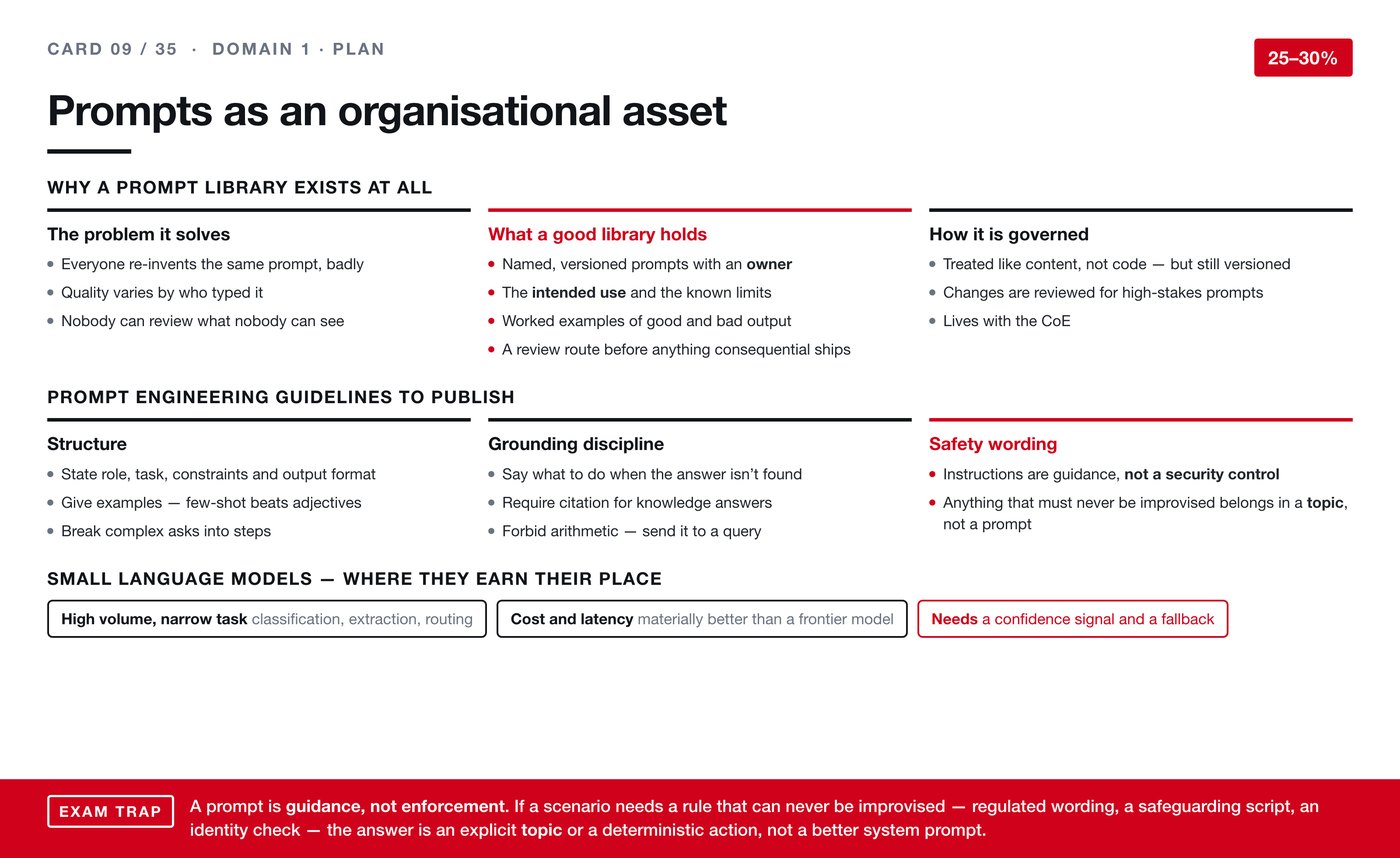
This card treats prompts as something an organisation owns rather than something
individuals type, and it ends on a distinction that decides a surprising number
of exam questions.
Why a prompt library exists at all
The problem it solves. Everyone re-invents the same prompt, badly. Quality
varies by whoever happened to type it. And nobody can review what nobody can see.
What a good library holds. Named, versioned prompts with an owner. The
intended use and the known limits. Worked examples of good and bad output. A
review route before anything consequential ships.
How it is governed. Treated like content rather than code, but still versioned.
Changes reviewed for high-stakes prompts. It lives with the Center of Excellence.
Prompt engineering guidelines worth publishing
Structure. State role, task, constraints and output format. Give examples —
few-shot beats adjectives, which is a useful way to remember that showing works
better than describing. Break complex asks into steps.
Grounding discipline. Say what to do when the answer is not found. Require a
citation for knowledge answers. Forbid arithmetic and send it to a query.
Safety wording. And here is the load-bearing idea: instructions are guidance,
not a security control. Anything that must never be improvised belongs in a
topic, not in a prompt.
Small language models — where they earn their place
Three conditions, and they tend to appear together.
A high-volume, narrow task — classification, extraction, routing.
Cost and latency that are materially better than a frontier model.
And the requirement that comes with them: a confidence signal and a fallback,
because a smaller model needs a route for the cases it cannot handle.
Exam trap. A prompt is guidance, not enforcement. If a scenario needs a rule
that can never be improvised — regulated wording, a safeguarding script, an
identity check — the answer is an explicit topic or a deterministic action, not
a better system prompt.
The one line to carry: if it must always happen, it does not belong in a
prompt. Put it somewhere the model cannot talk itself out of.