Card 13 of 44· Domain 2 · Design
Copilot Studio — orchestration, topics and fallback
The three orchestration modes and when each is right, the honest trade between classic and generative, and why the fallback log is the best monitoring you can buy.
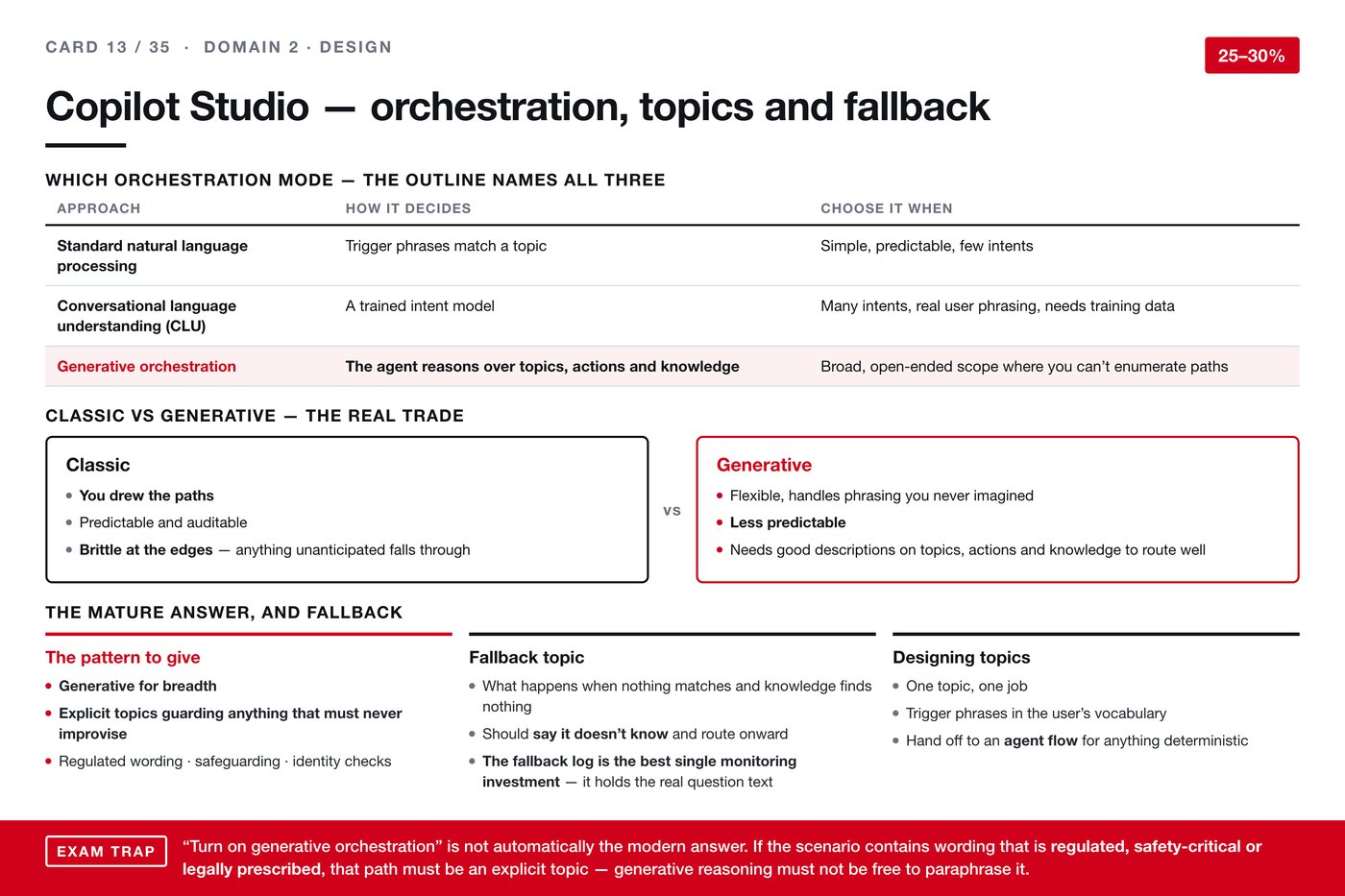
Copilot Studio offers three ways for an agent to decide what a user meant, and
the outline names all three. Knowing when each is right is more useful than
knowing how any of them works internally.
The three orchestration modes
Standard natural language processing. Trigger phrases match a topic. Choose it
when the scope is simple and predictable with few intents.
Conversational language understanding. A trained intent model does the
matching. Choose it when there are many intents and real user phrasing to
handle — and note that it needs training data, which is a cost.
Generative orchestration. The agent reasons over its topics, actions and
knowledge to work out the route itself. Choose it when the scope is broad and
open-ended and you genuinely cannot enumerate the paths in advance.
The real trade between classic and generative
Classic means you drew the paths. Predictable and auditable, which is exactly
what a regulated environment wants. Its weakness is that it is brittle at the
edges: anything you did not anticipate falls straight through.
Generative is flexible and copes with phrasing you never imagined. Its
weakness is that it is less predictable, and it depends heavily on the quality of
the descriptions you write for topics, actions and knowledge — those descriptions
are how it routes, so vague ones produce vague routing.
The mature answer
Not one or the other. Generative for breadth, with explicit topics guarding
anything that must never be improvised — regulated wording, safeguarding,
identity checks.
That pattern gives you flexibility where flexibility helps and determinism where
being wrong is expensive.
Fallback, and why it earns its place
The fallback topic is what happens when nothing matches and the knowledge search
finds nothing. It should say plainly that it does not know, and route onward.
And a line worth acting on in real projects: the fallback log is the best single
monitoring investment you can make, because it holds the real text of the
questions your agent could not answer. That is the most honest description of the
gap between what you built and what people actually want.
Designing topics
One topic, one job. Trigger phrases written in the user's vocabulary rather than
the department's. And hand off to an agent flow for anything that must be
deterministic.
Exam trap. "Turn on generative orchestration" is not automatically the modern
answer. If the scenario contains wording that is regulated, safety-critical or
legally prescribed, that path must be an explicit topic — generative reasoning
must not be free to paraphrase it.
The one line to carry: generative for breadth, explicit topics for anything
that must come out the same way every time.
Scope note (19 Aug 2026). Everything on this card describes the standard
harness. Copilot Studio now runs on three harnesses, and an agent built on the
GitHub Copilot harness has no topics at all — you describe it in natural language
and it generates the configuration. Orchestration mode is only configurable on
the standard harness. Card 43 sets out all three and why the choice cannot be
undone.