Card 14 of 44· Domain 2 · Design
Agent flows and prompt actions
The two ways to make an agent do something, where each belongs, and the pattern that answers most scenario questions: reason at the edges, execute through a flow.
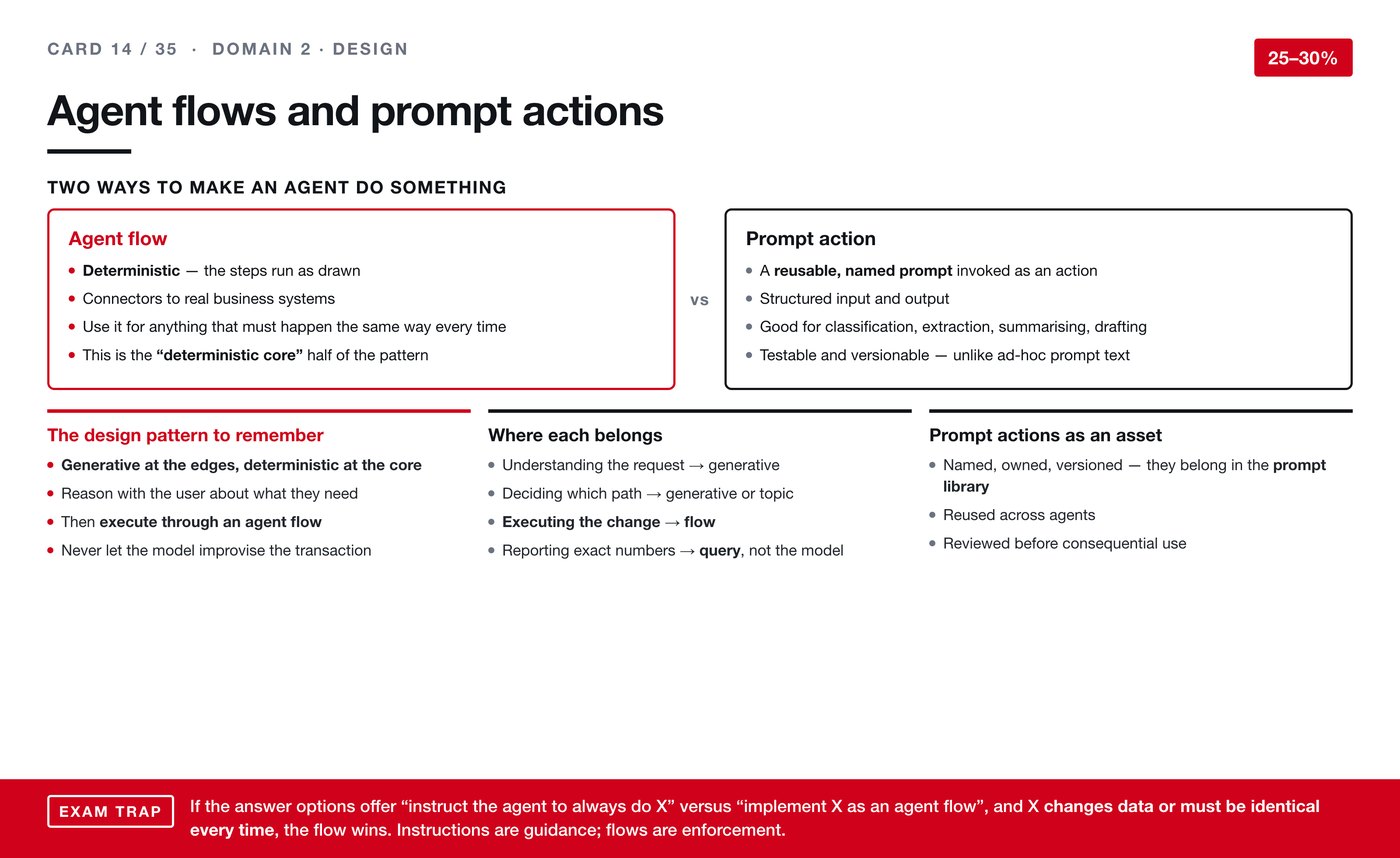
Two mechanisms for making an agent actually do something, and they are not
interchangeable. Knowing which belongs where is the point of this card.
Agent flow
Deterministic. The steps run exactly as drawn, every time. It connects to real
business systems, and it is what you use for anything that must happen the same
way on every occasion.
This is the deterministic core half of the pattern that runs through the whole
exam.
Prompt action
A reusable, named prompt invoked as an action, with structured input and
output. Good for classification, extraction, summarising and drafting.
The property that matters: it is testable and versionable, unlike prompt text
typed ad hoc into a box. That is what makes it something an organisation can own
rather than something an individual happens to have written.
The design pattern to remember
Generative at the edges, deterministic at the core.
Reason with the user about what they need. Then execute through an agent flow.
Never let the model improvise the transaction itself.
That sentence answers a surprising number of scenario questions on its own.
Where each belongs
Understanding the request → generative.
Deciding which path to take → generative, or a topic.
Executing the change → a flow.
Reporting exact numbers → a query, not the model.
Prompt actions as an asset
Named, owned and versioned, living in the prompt library. Reused across agents
rather than rewritten. Reviewed before anything consequential uses them.
The same idea as card 9: a prompt an organisation depends on is a managed asset,
not a piece of text somebody typed once.
Exam trap. If the options offer "instruct the agent to always do X" against
"implement X as an agent flow", and X changes data or must be identical every
time, the flow wins. Instructions are guidance; flows are enforcement.
The one line to carry: reason at the edges, execute through a flow, and never
let the model improvise a transaction.
Scope note (19 Aug 2026). Agent flows are standard-harness. Copilot Studio has
since added workflows as a building block in their own right — a drag-and-drop
automation where each step can reason and act, with built-in testing and
human-in-the-loop controls. Agent flows remain the established flow format.
Card 43 covers the harness model and what changed alongside it.