Card 05 of 44· Domain 1 · Plan
Data readiness — the five grounding dimensions
Each dimension learned by its failure mode, why a smaller curated corpus beats a comprehensive one, and the reason availability means permissions rather than uptime.
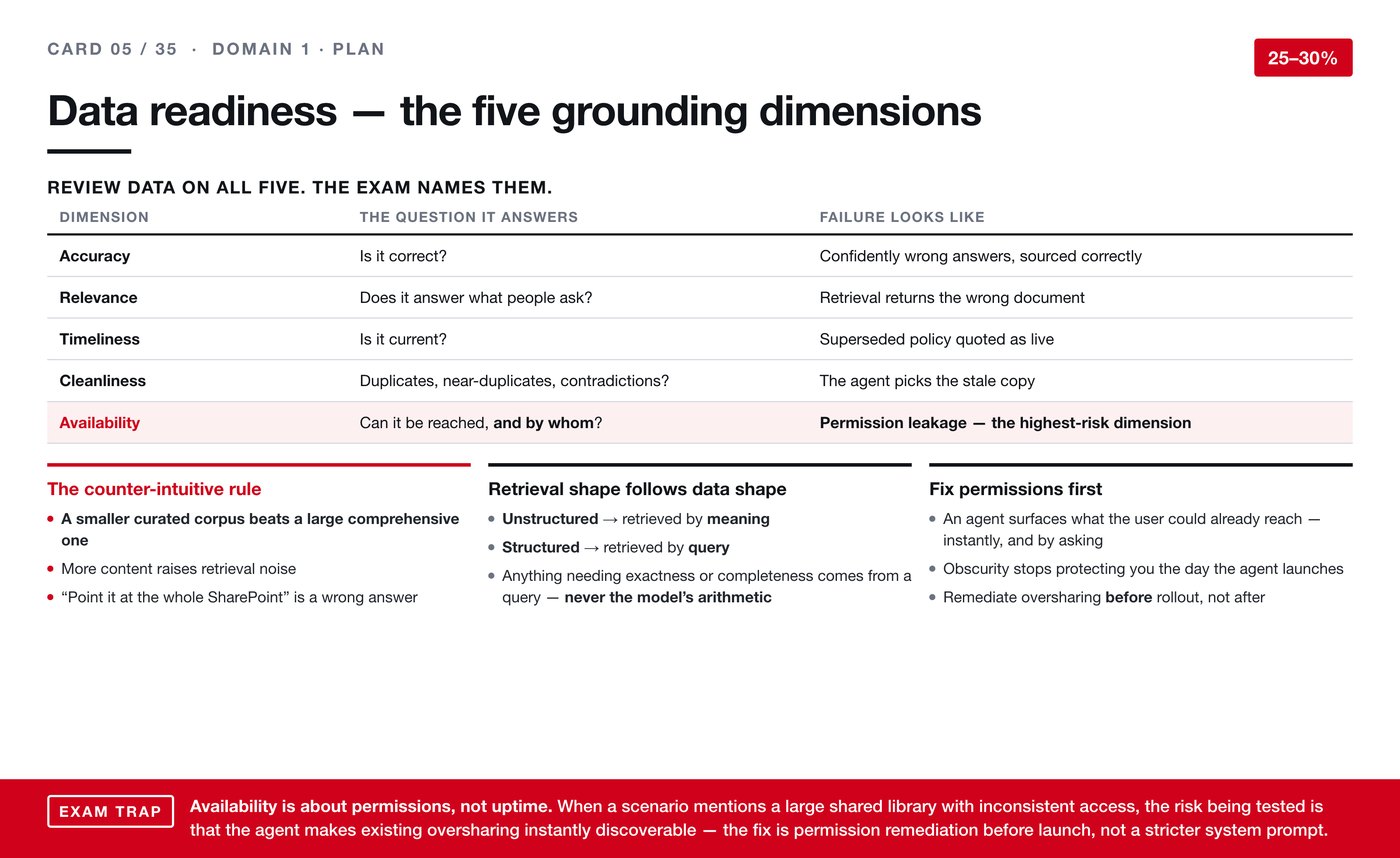
The official outline asks you to review data for grounding, and it names the
dimensions. Learn them by their failure mode rather than their definition —
that is how the scenarios are written.
The five dimensions
Accuracy. Is it correct? Failure looks like confidently wrong answers, sourced
correctly. The citation is real; the content it points at is not right. That is
harder to catch than an obvious invention.
Relevance. Does it answer what people actually ask? Failure looks like
retrieval returning the wrong document.
Timeliness. Is it current? Failure looks like a superseded policy quoted as
though it were live.
Cleanliness. Duplicates, near-duplicates and contradictions. Failure looks
like the agent picking the stale copy — and it will, sometimes, without telling
anyone.
Availability. Can it be reached, and by whom? Failure looks like permission
leakage, and this is the highest-risk dimension of the five.
The counter-intuitive rule
A smaller curated corpus beats a large comprehensive one. More content raises
retrieval noise, so adding everything makes answers worse rather than better.
Which means "point it at the whole SharePoint" is a wrong answer, however
reasonable it sounds in a meeting.
Retrieval shape follows data shape
Unstructured content is retrieved by meaning. Structured data is retrieved
by query.
And the rule that recurs across the whole exam: anything needing exactness or
completeness comes from a query, never from the model's arithmetic.
Fix permissions first
An agent surfaces what a user could already reach — instantly, and by asking. It
does not create the exposure; it removes the obscurity that was hiding it.
Obscurity stops protecting you the day the agent launches. So oversharing is
remediated before rollout, not after.
Exam trap. Availability here means permissions, not uptime. When a scenario
mentions a large shared library with inconsistent access, the risk being tested
is that the agent makes existing oversharing instantly discoverable. The fix is
permission remediation before launch — not a stricter system prompt.
The one line to carry: the agent does not create the oversharing problem, it
makes it findable, and no prompt wording fixes a permissions problem.
Goes with: card 39, which answers the question that comes before any pipeline
design — whose pipeline is it, Microsoft's or yours.
Currency (19 Aug 2026). Bing Custom Search can now be added as a knowledge
source using a Custom Configuration ID — a curated, scoped web index rather than the
open web, and considerably more defensible when a scenario worries about what the agent
might read. See card 44.