Card 04 of 44· Domain 1 · Plan
Requirements — deciding where an agent genuinely helps
The four-step assessment, the three lenses the outline names, how to organise data so other systems can use it, and why the baseline has to exist before you build.
Domain 1 is a quarter to nearly a third of the exam, and it opens here: given a
business process, should an agent touch it at all? The scenarios are written so
that the enthusiastic answer is usually wrong.
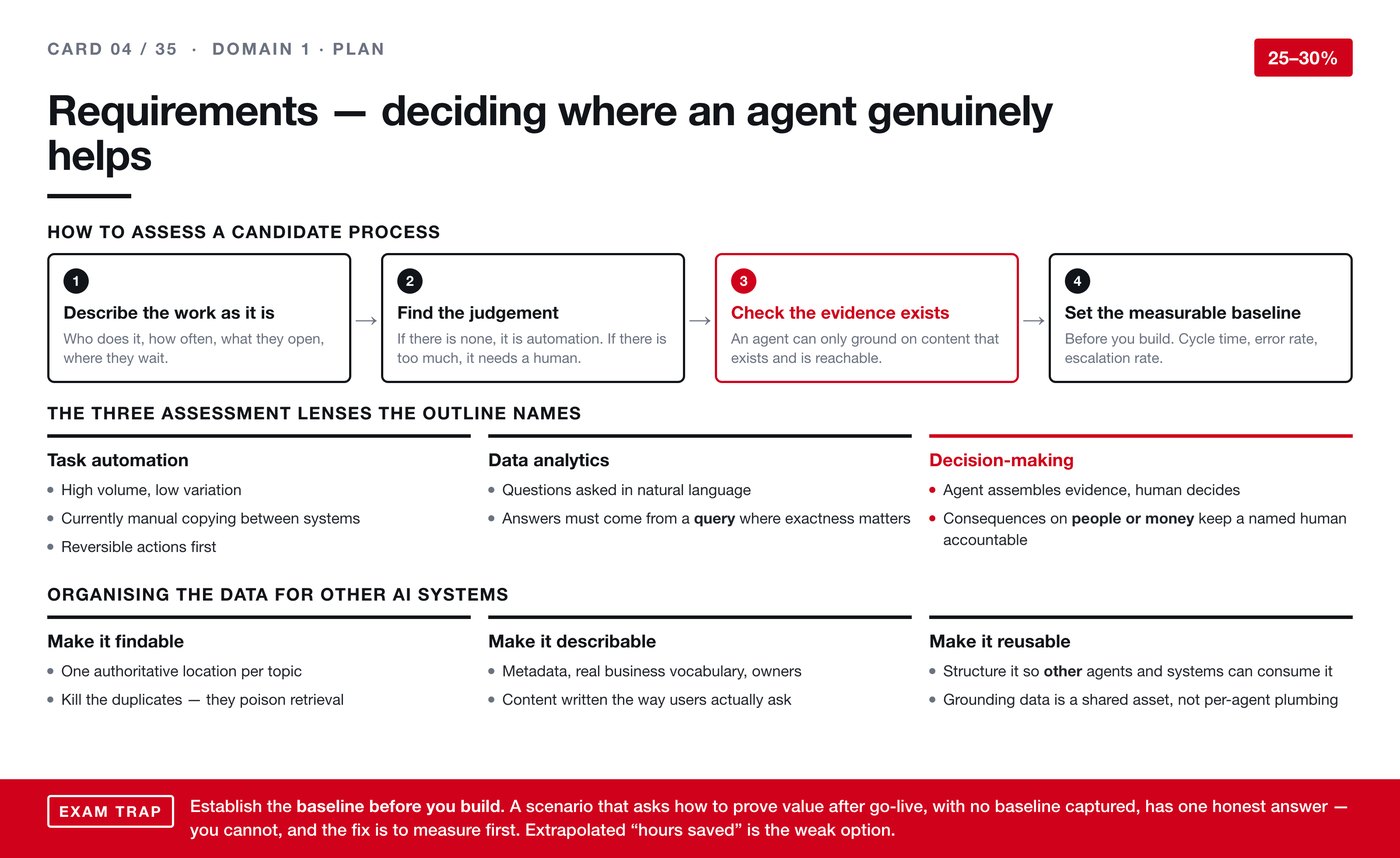
How to assess a candidate process
Four steps, in order.
Describe the work as it is. Who does it, how often, what they open, where they
wait. Not the improved version — the current one, honestly.
Find the judgement. This is the diagnostic step. If there is no judgement in
the task at all, it is automation and a flow will do. If there is too much
judgement, it needs a human. An agent lives between those two.
Check the evidence exists. An agent can only ground on content that exists and
is reachable. If the knowledge lives in someone's head or in an inbox nobody can
search, you do not have an agent project yet.
Set the measurable baseline. Before you build. Cycle time, error rate,
escalation rate.
The three assessment lenses
The official outline names three places to look, and each has its own tell.
Task automation — high volume, low variation, currently done by people copying
between systems by hand. Start with reversible actions.
Data analytics — questions asked in natural language, where answers must come
from a query because exactness matters.
Decision-making — the agent assembles the evidence and a human decides. Where
consequences land on people or money, a named human stays accountable.
Organising the data so other systems can use it
The outline asks about preparing data for AI generally, not just for your one
agent. Three properties.
Findable — one authoritative location per topic. Kill the duplicates, because
they poison retrieval: two versions of the truth means the system will sometimes
serve the wrong one, confidently.
Describable — metadata, real business vocabulary, named owners, and content
written the way users actually ask rather than the way the department names
things internally.
Reusable — structured so that other agents and systems can consume it.
Grounding data is a shared asset, not plumbing for a single agent.
Exam trap. Establish the baseline before you build. A scenario that asks
how to prove value after go-live, with no baseline captured, has one honest
answer: you cannot, and the fix is to measure first. Extrapolated "hours saved"
is the weak option and it is there to be rejected.
The one line to carry: no judgement means a flow, too much judgement means a
human, and no reachable evidence means you have a content problem rather than an
agent project.