Card 06 of 44· Domain 1 · Plan
AI adoption, and the Center of Excellence
The six Cloud Adoption Framework phases and why guardrails come before the first build, the three jobs of a CoE, and why the strongest governance answer makes the compliant path the easiest one.
This card covers the organisational side of Domain 1: how an organisation moves
from interest to adoption, and what the AI Center of Excellence is genuinely for.
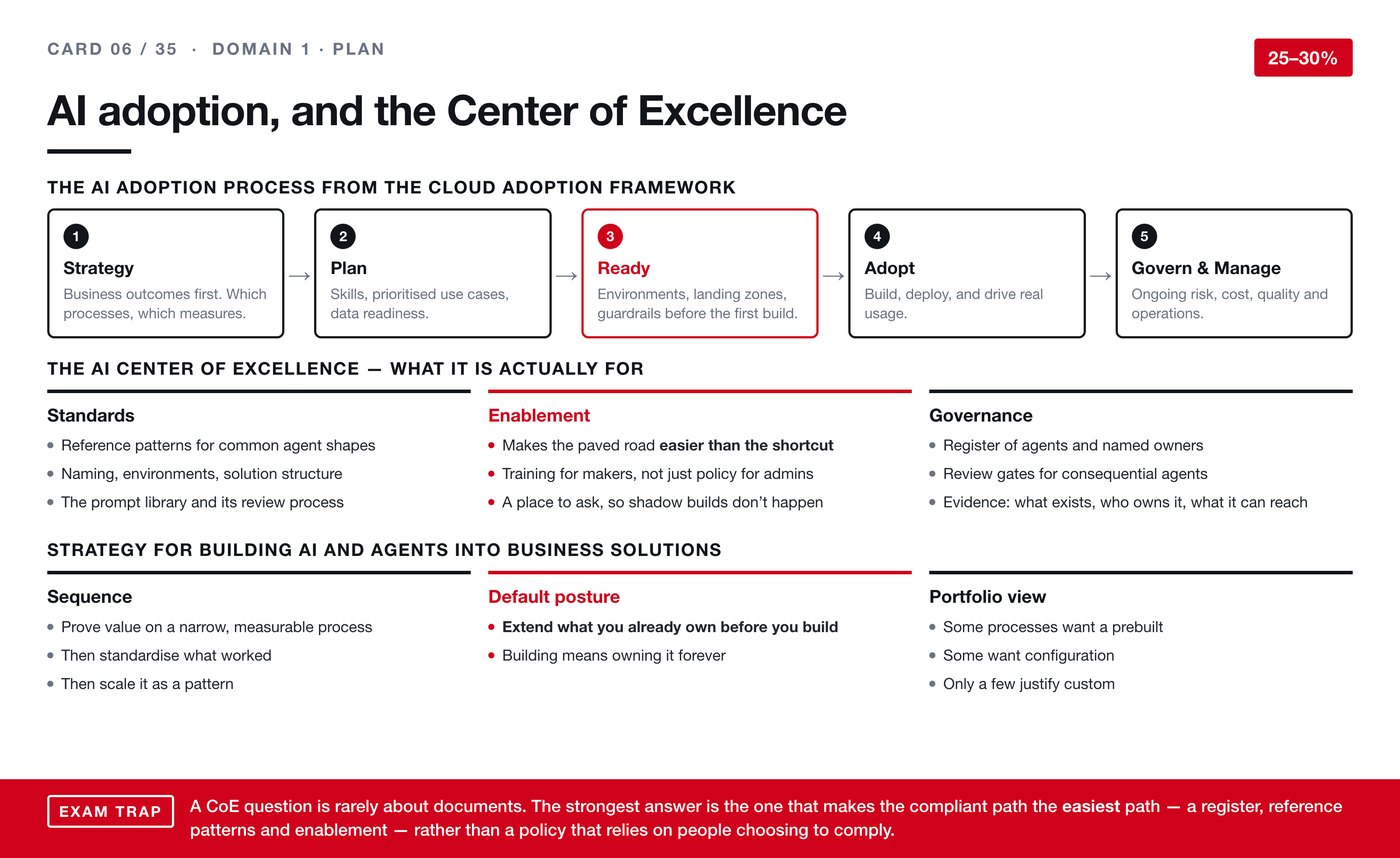
The adoption process
Six phases, taken from the Cloud Adoption Framework and applied to AI.
Strategy — business outcomes first. Which processes, and which measures.
Plan — skills, prioritised use cases, data readiness.
Ready — environments, landing zones and guardrails, established before the
first build. The sequencing is the point: the guardrails exist before anything
is created inside them, not after somebody has already shipped.
Govern — policy, risk and compliance for what gets built.
Secure — and this is a phase in its own right, not a wing of Govern. If you
merge the two you lose a distinction the exam makes.
Manage — ongoing cost, quality and operations. And driving real usage, which is
worth saying out loud: deployment without adoption is a common and expensive place
to stop.
Two corrections worth stating plainly, because both errors are circulating.
There is no Build phase. A widely-shared preparation post gives a tidy
four-phase version — "Plan → Govern & Secure → Build → Manage" — and it is wrong.
And Secure and Govern are separate, not one combined phase.
(An earlier version of this card gave a five-stage version with an "Adopt" phase.
That was wrong, and it is corrected here — checked against Microsoft Learn on
19 August 2026.)
What the Center of Excellence is actually for
Three jobs, and the middle one is where most CoEs fail.
Standards — reference patterns for common agent shapes, naming, environments,
solution structure, and the prompt library with its review process.
Enablement — and here is the sentence worth memorising: it makes the paved
road easier than the shortcut. Training for makers, not just policy for
admins. Somewhere to ask, so that shadow builds do not happen in the first place.
Governance — a register of agents with named owners, review gates for
consequential agents, and evidence of what exists, who owns it and what it can
reach.
Strategy for building AI into business solutions
Sequence. Prove value on a narrow, measurable process. Then standardise what
worked. Then scale it as a pattern. In that order — scaling something you have not
proven is how organisations end up with forty half-used agents.
Default posture. Extend what you already own before you build. Building means
owning it forever, and that cost is easy to forget on the day you are excited
about it.
Portfolio view. Some processes want a prebuilt product, some want
configuration, and only a few genuinely justify something custom.
Exam trap. A CoE question is rarely about documents. The strongest answer is
the one that makes the compliant path the easiest path — a register,
reference patterns, enablement — rather than a policy that depends on people
choosing to comply.
The one line to carry: governance that relies on people reading a policy loses
to governance that makes the right route the convenient one.
Goes with: card 36, which sets the Cloud Adoption Framework against Success by
Design — a different framework for a different scope — and adds the four AI
adoption maturity levels.