Card 10 of 40· Develop
Diagnosing the four context window failures
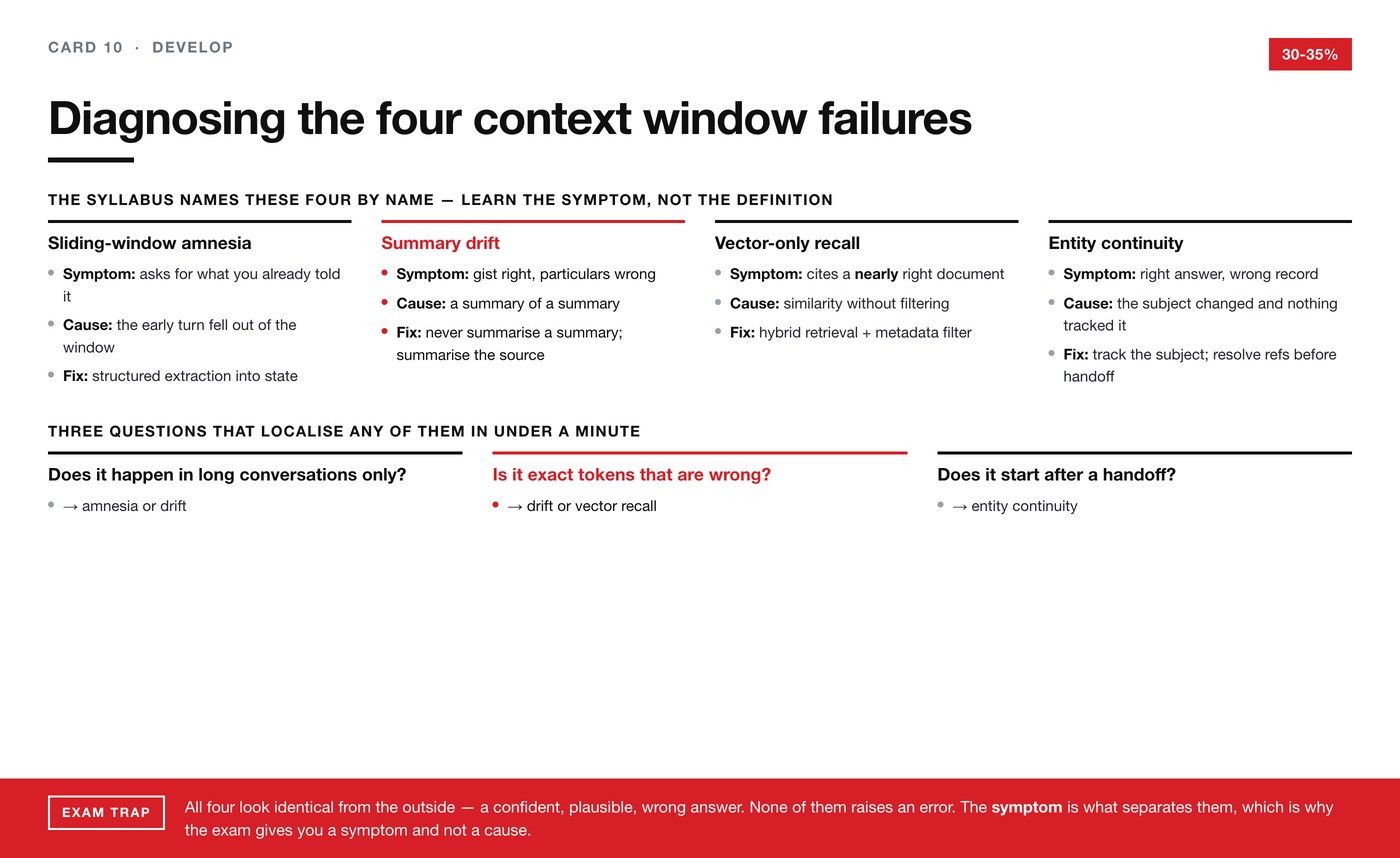
Sliding-window amnesia, summary drift, vector-only recall and entity continuity — told by symptom, because from the outside all four look identical.
The syllabus names four context window problems explicitly — sliding-window
amnesia, summary drift, vector-only recall and entity continuity issues — and then
does not define them. Microsoft names them; the definitions are left to you.
That is unusual, and it tells you how they will be tested. You will not be asked
what summary drift is. You will be given a symptom and asked what is causing it.
So learn these by symptom.
The four, and what each looks like from outside
Sliding-window amnesia. The agent asks for something you already told it.
Twenty turns ago you gave it the account number; now it wants the account number
again. The cause is mechanical — the early turn fell out of the context window and
nothing preserved it. The fix is structured extraction: pull the facts that
matter into typed state the moment they arrive, so they are not competing with
small talk for space.
Summary drift. The gist is right and the particulars are wrong. The agent
describes the policy correctly and gets the effective date wrong; summarises the
case accurately and misstates the amount. The cause is almost always a summary of a
summary — each round of compression keeps the shape and sheds the specifics, and
the errors compound because nothing ever goes back to the source. The fix is to
never summarise a summary. Summarise the original.
Vector-only recall. The agent cites a document that is nearly right. The
2023 version of the policy rather than the 2026 one. The wrong product line's
manual. The cause is similarity search with nothing constraining it — those
documents genuinely are similar, and similarity is all it was asked for. The fix is
hybrid retrieval plus a metadata filter, so "current" and "this product" are
enforced before ranking rather than hoped for after it.
Entity continuity. The right answer about the wrong record. The conversation
moved from one customer to another and the agent did not notice, so it is now
confidently answering the new question with the old subject. The fix is to track
the subject explicitly and resolve references — "it", "they", "that one" —
before handing off to another agent, because the next agent has none of the
history that made the pronoun meaningful.
Three questions that localise any of them
You rarely need to think hard about which one you are looking at. Three questions
usually settle it.
Does it only happen in long conversations? Then you are looking at amnesia or
drift — both are functions of accumulated context.
Is it the exact values that are wrong, while the shape is right? Then it is
drift, or vector-only recall. Something got compressed or something adjacent got
retrieved.
Did it start after a handoff between agents? Then it is entity continuity. The
subject did not survive the boundary.
Why this card exists at all
Here is the thing that makes these four genuinely hard, and it is the same property
that runs through this whole guide.
All four look identical from the outside. In every case the agent produces a
fluent, confident, plausible answer that happens to be wrong. None of them raises
an exception. None of them fails a health check. There is no stack trace, no error
rate, no red light.
Which is exactly why the exam gives you the symptom rather than the cause — because
in production the symptom is all you get, and the entire skill is being able to
work backwards from it.
The trap
The instinct when an agent gets a detail wrong is to blame the model and reach for
a better one, or to blame the prompt and rewrite it.
Neither fixes any of these four. Amnesia is a state design problem. Drift is a
summarisation pipeline problem. Vector-only recall is a filtering problem. Entity
continuity is a handoff problem. A better model will do all four slightly more
convincingly.