Card 09 of 40· Develop
Context management: the four verbs
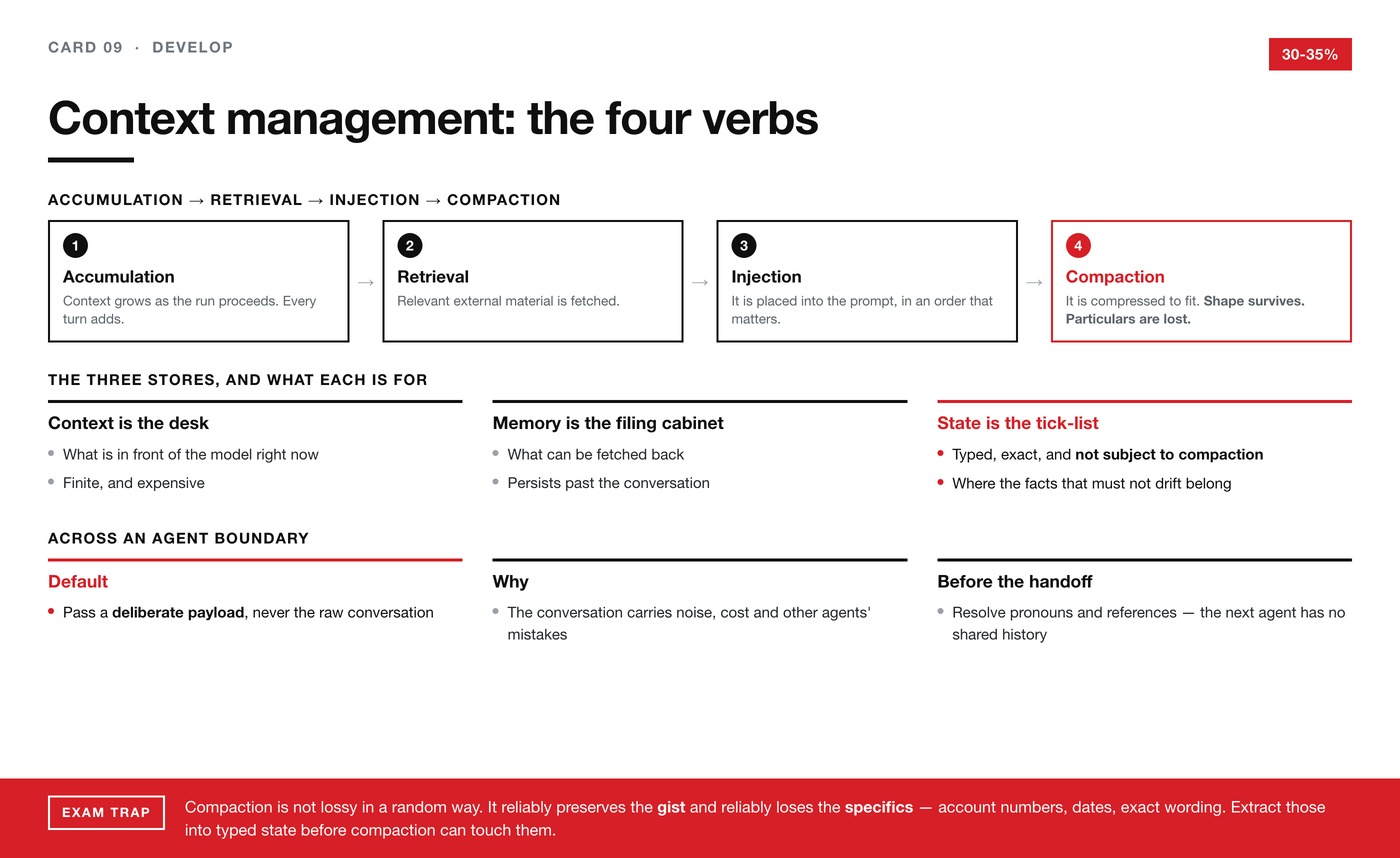
Accumulation, retrieval, injection, compaction — plus the desk, the filing cabinet and the tick-list, and the rule about what to pass across an agent boundary.
Context engineering is one of the two things this exam tests that almost nothing
else does. It is also the area where the vocabulary is worth learning precisely,
because the syllabus uses it precisely.
The four verbs
Accumulation. Context grows as the run proceeds. Every turn adds, every tool
result adds, and nothing removes anything on its own.
Retrieval. Relevant external material is fetched and brought in.
Injection. It is placed into the prompt — and the order matters, because
position affects how much attention a passage gets.
Compaction. It is compressed to fit.
Three of those are additive and one is subtractive, which is why the fourth is
where the interesting failures live.
What compaction actually does
Compaction does not lose information at random. It preserves the shape and loses
the particulars.
After compaction the agent still knows this is a complaint about a delayed order
from a frustrated customer who has been passed around twice. It may no longer know
the order number, the exact date promised, or the precise wording of the commitment
made. And the compacted summary reads perfectly fluently, which is what makes it
hard to spot.
So the design move is to decide, in advance, which facts would cause harm if
altered — and extract those into typed state before compaction can touch them.
Identifiers, amounts, dates, decisions already taken.
Three stores, three jobs
A way of holding the distinction that survives under pressure:
Context is the desk. What is in front of the model right now. Finite and
expensive.
Memory is the filing cabinet. What can be fetched back when needed.
State is the tick-list. Typed, exact, small, and never paraphrased.
A large share of "the agent forgot" problems are really "nobody put that in state".
Across an agent boundary
When agent A hands to agent B, the default should be a deliberate payload — never
the raw conversation.
Passing the whole conversation feels generous and is usually wrong for three
reasons. It carries noise. It carries cost, because every hop re-sends everything
and a five-agent chain sends overlapping context five times. And it carries the
first agent's speculation and dead ends as though they were established fact,
which the second agent has no way to distinguish from findings.
There is also a specific thing to do before the handoff: resolve references.
"It", "they", "that one" are only meaningful with the history that produced them,
and the receiving agent does not have it. An unresolved pronoun crossing a boundary
is the direct cause of the entity-continuity failure covered on the next card.
Why this is worth more than it looks
Almost every failure elsewhere in this guide routes back through here. The context
failures on card 10 are all context-management failures. The cost problem on card
28 is mostly agents re-sending context to each other. Memory isolation on card 5 is
a context question with a compliance consequence.
Get this right and several other problems never appear.
The trap
The instinct when an agent starts losing details is to increase the context window
or move to a model with a bigger one.
That buys time and does not fix anything. Accumulation is unbounded — a longer
conversation will fill any window — so a larger window moves the failure later
rather than removing it. The fix is structural: decide what must not be lost, and
put it somewhere that compaction does not reach.