Card 01 of 44· Foundations
What an agent actually is — and what it is not
The four things question stems confuse — flow, chatbot, copilot, agent — where agents genuinely earn their place, and the three situations where reaching for one is marked wrong.
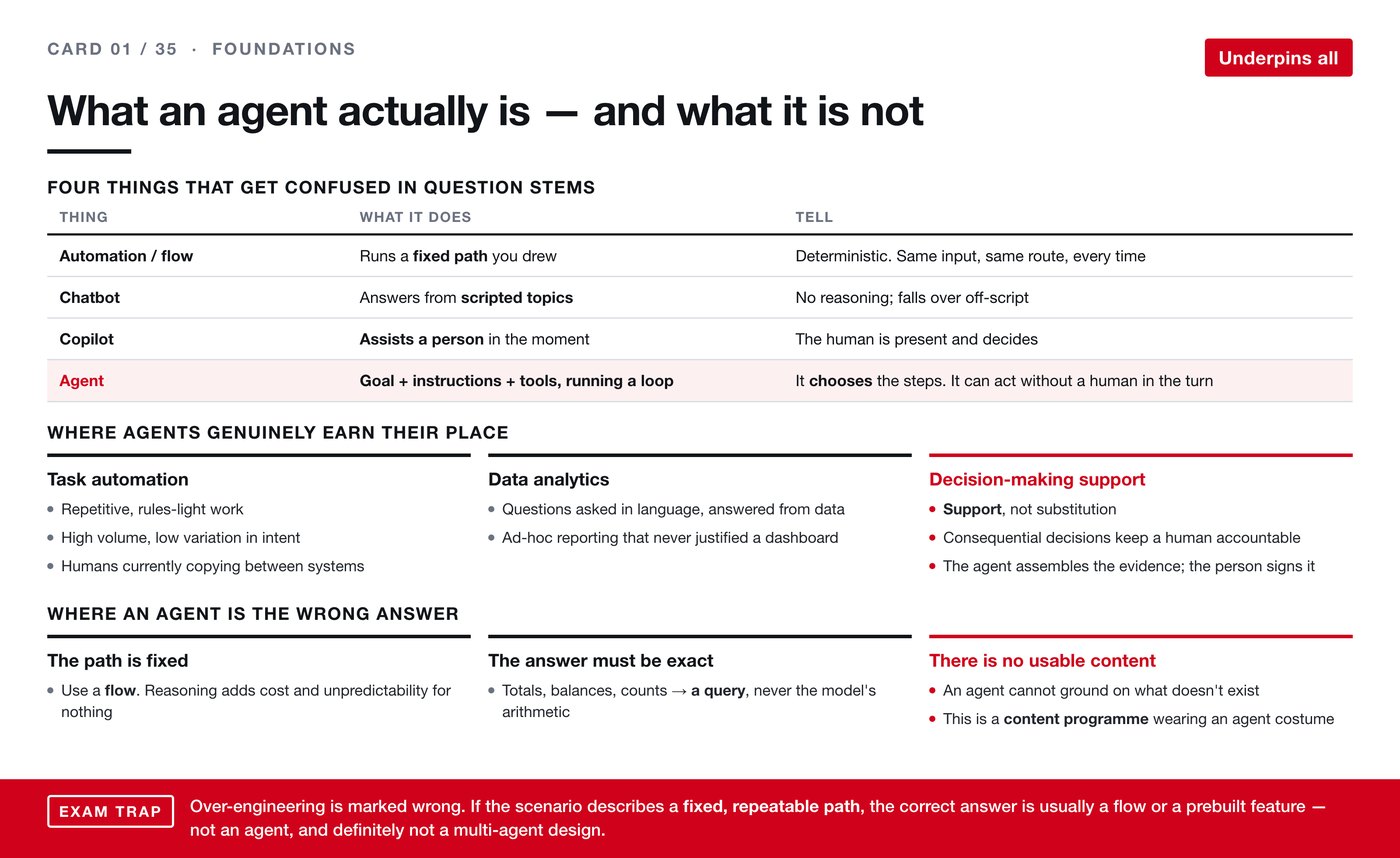
Four things get used interchangeably in conversation, and the exam separates them
deliberately. Getting them apart is the first thing to fix, because almost every
scenario question in the Plan domain is really asking which of these four does
this situation need.
Automation, or a flow, runs a fixed path that somebody drew in advance. It is
deterministic — the same input takes the same route every time. That is a
feature, not a shortcoming. If you can draw the steps on a whiteboard and they do
not change, a flow is the right tool.
A chatbot answers from scripted topics. It does no reasoning, so it falls over
the moment a person goes off-script.
A copilot assists a person while they work. The defining tell is that the human
is present and the human decides. It suggests; you accept or reject.
An agent is a goal, plus instructions, plus tools, running in a loop. The tell
is that it chooses the steps, and it can act without a human in the turn. That
last clause is what makes agents useful and what makes them a governance problem —
the two are the same property viewed from different ends.
Where agents genuinely earn their place
Three situations, and they are worth memorising because the exam rewards
recognising them.
Task automation where the work is repetitive and rules-light, high in volume
and low in variation of intent, and where humans are currently copying things
between systems by hand.
Data analytics where questions are asked in ordinary language and answered
from data — including the ad-hoc reporting that never justified building a
dashboard.
Decision-making support, and the wording matters: support, not substitution.
Consequential decisions keep a human accountable. The agent assembles the
evidence; the person signs it.
Where an agent is the wrong answer
The path is fixed. Use a flow. Reasoning adds cost and unpredictability and
buys you nothing.
The answer must be exact. Totals, balances and counts belong in a query, never
in the model's arithmetic.
There is no usable content. An agent cannot ground on what does not exist. A
project like this is a content programme wearing an agent costume, and it will
fail as an agent project while the real problem goes unaddressed.
Exam trap. Over-engineering is marked wrong. If the scenario describes a
fixed, repeatable path, the correct answer is usually a flow or a prebuilt
feature — not an agent, and definitely not a multi-agent design.
The one line to carry: an agent chooses its steps and can act without a human
in the turn. Everything else on this card follows from that sentence.