Card 02 of 44· Foundations
The Microsoft agentic stack — picking the surface
What each surface is actually for, the four questions that resolve almost every surface scenario, and why "right idea, wrong product" is the distractor pattern to watch for.
Microsoft sells several places you can build an agent, and the exam is fond of
scenarios where the architecture you describe is right but the product you name
cannot do it. So this card is less about features and more about reading a
scenario for the signal that decides the answer.
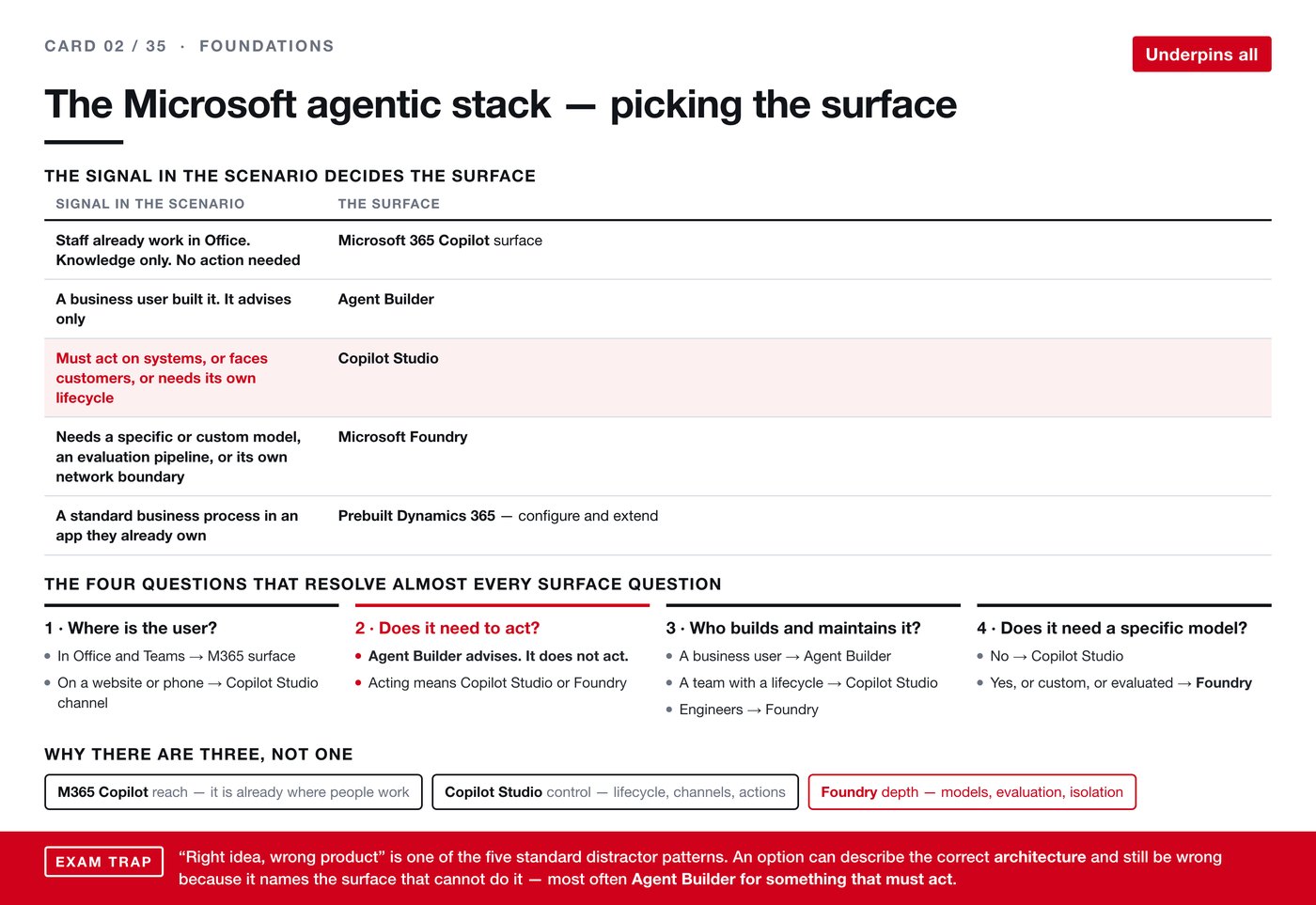
What each surface is actually for
The Microsoft 365 Copilot surface is where you land when staff already work in
Office, the need is knowledge rather than action, and nothing has to be done to a
system. It wins because it is already where people are.
Agent Builder is for something a business user built themselves, and the
critical constraint is that it advises only. It does not act. Remember that
sentence — it is the single most common trap on the card.
Copilot Studio is where you go when the agent must act on systems, or face
customers, or have a lifecycle of its own. Control is what it offers: channels,
actions, and a managed life from build to retirement.
Microsoft Foundry is for a specific or custom model, an evaluation pipeline,
or its own network boundary. Depth, in other words.
Prebuilt Dynamics 365 covers a standard business process inside an application
the customer already owns. Configure and extend rather than build.
The four questions that resolve almost every surface question
Work through these in order and the answer usually falls out.
Where is the user? In Office and Teams points at the Microsoft 365 surface. On
a website or a phone points at a Copilot Studio channel.
Does it need to act? This is the decisive one. Agent Builder advises; it does
not act. Anything that must act means Copilot Studio or Foundry.
Who builds and maintains it? A business user suggests Agent Builder. A team
with a lifecycle suggests Copilot Studio. Engineers suggest Foundry.
Does it need a specific model? No points back at Copilot Studio. Yes, or
custom, or something that must be formally evaluated, points at Foundry.
Why there are three rather than one
Each earns its place on a different axis, and naming the axis is a good way to
show you understand the stack rather than having memorised a table.
Microsoft 365 Copilot gives you reach — it is already where people work.
Copilot Studio gives you control — lifecycle, channels, actions.
Foundry gives you depth — models, evaluation, isolation.
Exam trap. "Right idea, wrong product" is one of the standard distractor
patterns. An option can describe the correct architecture and still be wrong
because it names a surface that cannot do the job — most often Agent Builder
for something that has to act.
The one line to carry: if it must act, it is not Agent Builder. Almost every
surface question turns on that.
Currency (19 Aug 2026). The "Agent Builder advises, it never acts" rule is
narrowing rather than widening. Microsoft Learn still says use Copilot Studio if
you need Actions to integrate external services. But the declarative agent manifest
gained EmailActions and MeetingActions in version 1.8 (July 2026), so
first-party Microsoft 365 actions are now the exception to the rule. See card 44.