Card 21 of 44· Domain 2 · Design
Orchestrating prebuilt agents and Microsoft 365 apps
Find, configure, extend, then build — and why most exam answers land on step two. Plus what to check before proposing Copilot for Sales or Service.
The last card in Domain 2, and it makes explicit the sequence that has been
implied all the way through: use what ships before you build anything.
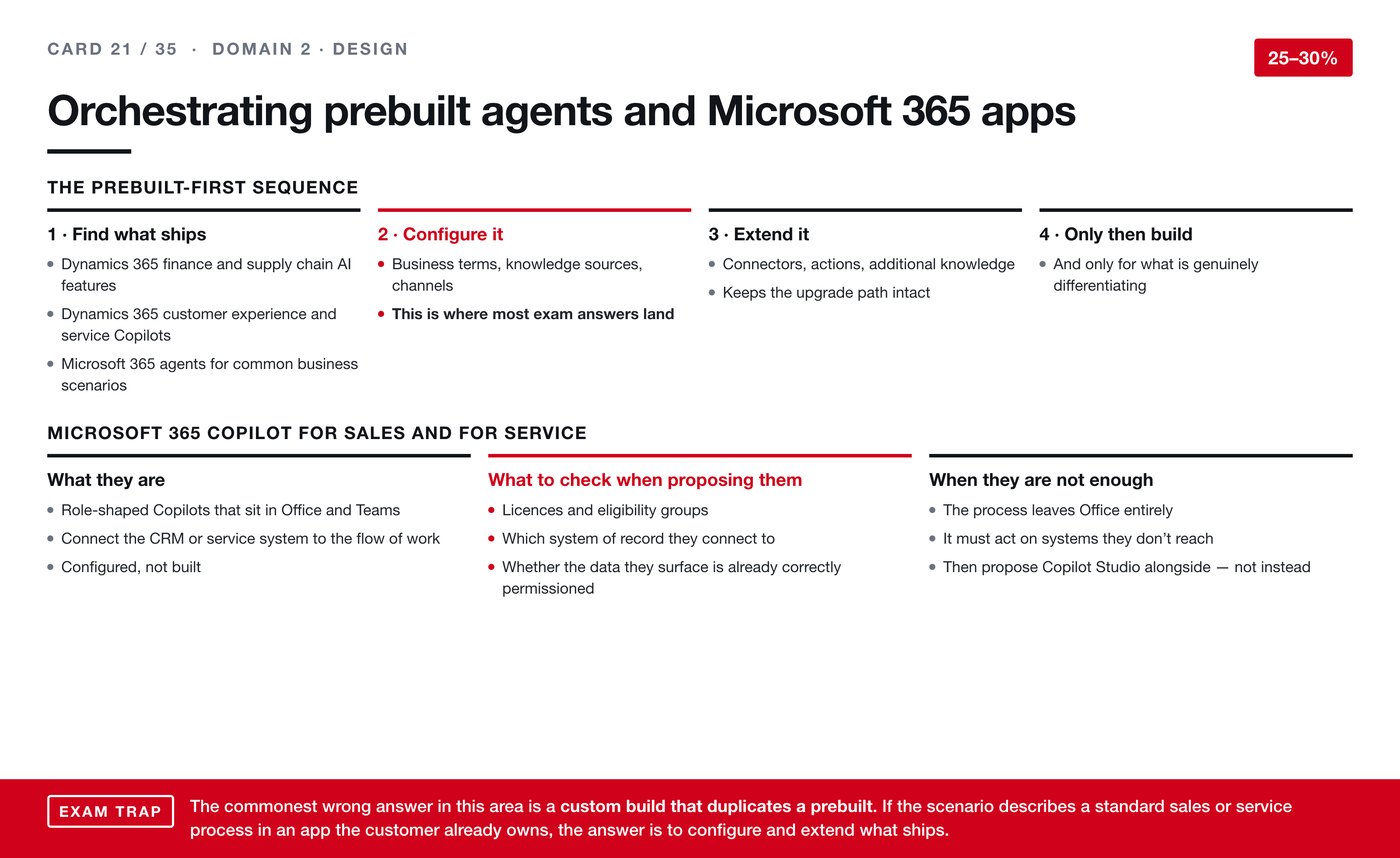
The prebuilt-first sequence
Find what ships. Dynamics 365 finance and supply chain AI features, the
Dynamics 365 customer experience and service Copilots, and the Microsoft 365
agents for common business scenarios. Knowing what already exists is half the
skill.
Configure it. Business terms, knowledge sources, channels. And note the line
on the card: this is where most exam answers land. If you are unsure between
options, the configuration answer is usually the right one.
Extend it. Connectors, actions, additional knowledge. This keeps the upgrade
path intact, which is the property you are protecting.
Only then build, and only for what is genuinely differentiating.
Microsoft 365 Copilot for Sales and for Service
What they are. Role-shaped Copilots that sit in Office and Teams, connecting
the CRM or service system into the flow of work. Configured, not built.
What to check before proposing them. Licences and eligibility groups. Which
system of record they connect to. And whether the data they will surface is
already correctly permissioned — because if it is not, the Copilot will make that
visible on day one.
When they are not enough. The process leaves Office entirely, or it must act
on systems they do not reach. In that case propose Copilot Studio alongside
them, not instead of them.
Exam trap. The commonest wrong answer in this area is a custom build that
duplicates a prebuilt. If the scenario describes a standard sales or service
process in an app the customer already owns, the answer is to configure and
extend what ships.
The one line to carry: find, configure, extend, then build — and most questions
are answered at step two.
That completes Domain 2. Across ten cards the same discipline keeps surfacing:
the shape of an agent decides its governance, deterministic beats generative
wherever the outcome must be identical, and the capable-looking option is usually
the wrong one when a simpler configuration would do.