◆ 01 / getting value out
Getting value out of the AI you already bought
The licences went out months ago and nobody can say what changed. That is rarely a problem with the model. It is that the work was never redesigned around it.
◆ The big picture
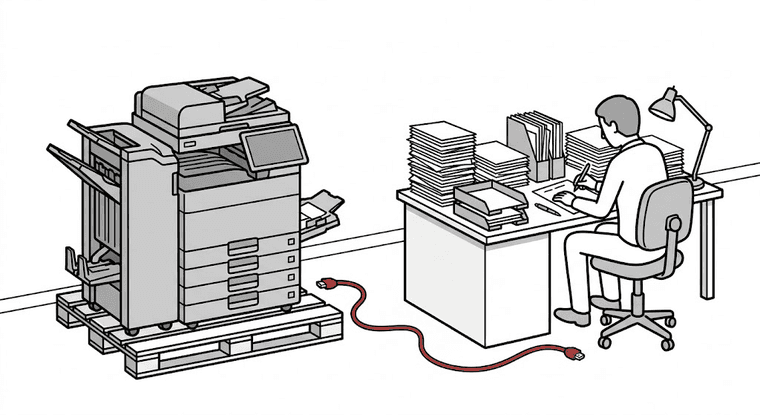
Most companies have bought the AI. They have not bought the change.
The purchase is the easy part, and it is the part that gets attention. Licences are allocated, an announcement goes out, and a launch session is run. Then the work carries on more or less as it did before, because nothing about the work was altered.
A tool laid on top of a process designed for people doing it by hand will produce a modest improvement at best. The process still has the steps that existed to compensate for it being manual. The roles still assume the old division of labour. The training still explains the software rather than the job.
So the value does not fail to appear because the technology underperformed. It fails to appear because buying the tool and changing the work are two different projects, and only one of them was funded.
◆ The problem
The tool was bought. The job was never redesigned.
Ask where the value went and you usually get a discussion about the model, the prompts, or whether a different product would do better. Those are the cheapest things to change, which is why they get changed first.
The expensive thing is the operating model. Who does what now, which steps still need to exist, what people move up to, and how the whole thing is governed once a machine is inside it. That work is slower, it involves people rather than software, and no vendor is incentivised to raise it.
It is also where almost all of the value sits, which is an uncomfortable arrangement for everybody selling something.
◆ The solution
Four ways to treat any piece of work
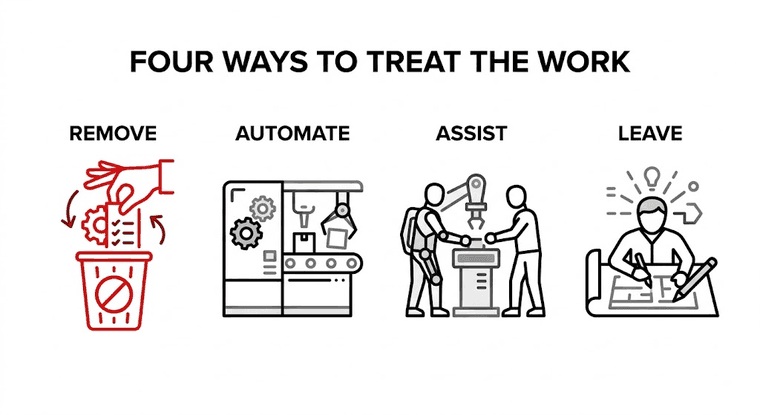
Every activity in a process falls into one of four groups, and naming which is most of the analysis.
Some work should be removed altogether, because it exists to compensate for something that has since been fixed, or for a workaround nobody took out. Some can be automated, because it is high volume and rule-shaped. Some is best assisted, where a person keeps the judgement and a machine does the drafting and searching. And some should be left exactly as it is, because trust or nuance lives there.
The first win is often removal, and no AI is required for it. I would rather take work away than sell you something that does it faster, and that tends to be the moment a client decides whether to trust the rest.
◆ My approach
The five steps, and what each one produces
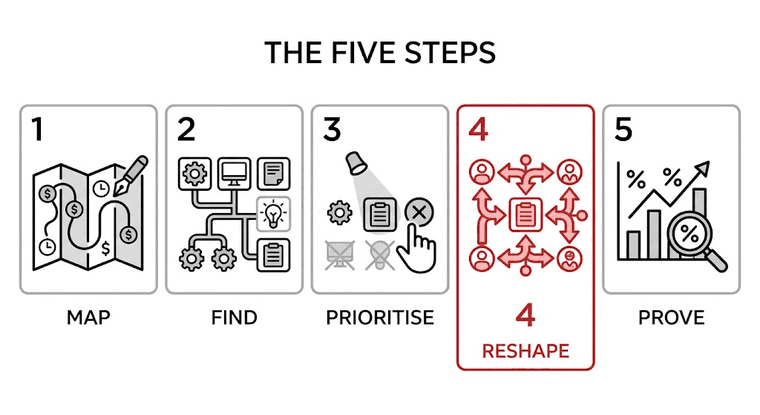
I run the same arc every time, and it is written down so you can see exactly what you are buying.
Map. Before anything about AI, I sit with the function and draw what it produces and what it costs. Five questions on day one, one honest page at the end of it. Most teams have never seen their own process drawn accurately, and that page is usually the first thing they argue about, which is how you know it is right.
Find. Every activity on the map gets tagged into the four groups above.
Prioritise. What each candidate is worth, whether the data is genuinely ready, whether it can be done with what you already own, and whether the team will use it. Then two or three things, and the ones we are killing said out loud. The kill list is the part people remember.
Reshape. The process, who does what now, the training that is about their job rather than the software, and the guardrails that keep it defensible. Laying a faster surface over the existing route is not the same as changing the route.
Prove. Measured before anything changes, because value you did not baseline cannot be proved later. Cost per outcome rather than per token. A named sponsor, and a review that carries on after I have gone.
◆ What stays as it is
Advice that only ever adds is not advice
Keep human judgement where trust, safety and nuance live. Keep the controls, because this raises the stakes rather than lowering them. Keep the domain expertise in your own building, because the point is that you can run this once I have gone.
Keep measuring, too. The review cadence is the part that outlives the engagement, and it is the reason the value does not quietly leak away six months later.
◆ Next
No licences to sell. No delivery team to keep busy.
Nothing here depends on you buying more software or building something larger, which is why I can tell you when the answer is to stop.
Tell me which function is stuck and what it was meant to be doing differently by now. I will tell you what I would actually run, and if a fortnight of your own people would do it better than hiring me, I will say that.