◆ 06 / teach your people
Teaching people AI, from the ground up
Most AI training teaches people to get an answer out. Almost none teaches them to tell when the answer is wrong, which is the part their job actually depends on.

◆ The big picture
Handing someone a tool is not the same as teaching them
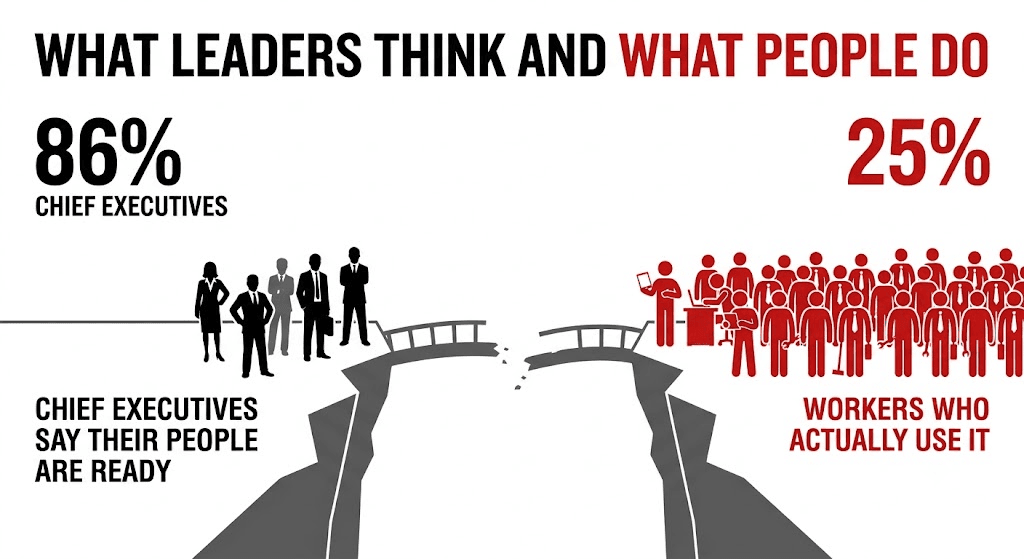
IBM’s 2026 study of more than two thousand chief executives found that around a quarter of workers use AI regularly as part of their job. In the same study, 86% of chief executives believed their people were ready for it.
That distance between what leadership believes and what is happening at the desk is the whole problem in one pair of numbers. The licences went out. The launch email went out. Somewhere between the announcement and the actual work, most people quietly decided this was not for them, or tried it twice, got something confidently wrong, and stopped.
The same study reported that 83% of those chief executives think success depends more on people adopting AI than on the technology. So the diagnosis is not really in dispute. What is missing is a version of teaching that survives contact with a Tuesday.
◆ The problem
Prompting is the easy half and it is the half that gets taught
Walk into most AI training and you will be taught to write a better prompt. Give it a role, give it context, give it a format. That is genuinely useful and it takes about an hour, and it is where the majority of corporate AI training both starts and stops.
It stops in the wrong place. Getting a fluent answer out of a modern model is not hard, and it is getting easier every release. The difficulty has moved entirely to the other side of the exchange, where somebody has to look at a confident, well-written, plausible paragraph and decide whether it is true, whether it is complete, and whether acting on it would be a mistake.
That skill is not a prompting technique. It is domain judgement, applied to a new kind of input, and it is the reason a good AI course for lawyers looks different from a good one for engineers. It also cannot be delivered as a slide, which is inconvenient for the way training is usually procured.
The failure this produces is specific and I see it repeatedly. People who were taught only the easy half either over-trust the output and get burned, or over-correct and check everything by hand, which removes the entire benefit. Both groups then report that the tool did not help.
◆ The four rungs
Four things, and they only work in this order
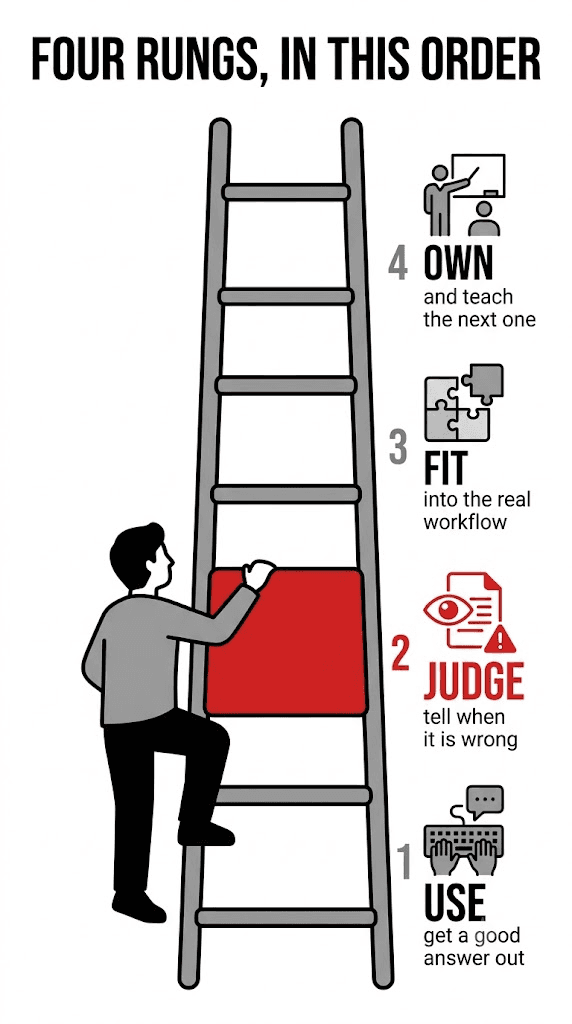
Whatever the audience, the same four capabilities have to arrive in sequence. Skipping a rung is what produces people who can demo it and cannot use it.
- Use. Get a decent result out reliably, on their own work rather than a generic exercise. An hour, and the part everyone already teaches.
- Judge. Tell when the answer is wrong, incomplete, or confidently invented. This is the rung the value sits on, it is the hardest to teach, and it has to be built from their own domain rather than from general advice about hallucination.
- Fit. Put it into the actual workflow, with its real constraints, approvals and systems. Skills that live only in a training environment do not migrate on their own.
- Own. Decide when not to use it, explain that decision to a colleague, and teach the next person. This is the rung that makes the capability outlive the engagement.
◆ How I teach
Plain English first, the real word second
I assume no prior knowledge, and I do not leave a term unexplained. The pattern I use is the plain sentence first and the proper name after it, in brackets: a live window where you type one line and the language runs it immediately, which is called a REPL. People end up with the real vocabulary, which they need in order to read documentation and talk to engineers, without being made to feel stupid for not having arrived with it.
That sounds like a small stylistic choice. It is the difference between somebody who nods through a session and somebody who can look something up afterwards. Unexplained jargon is how you lose a room quietly, and the people it loses rarely say so at the time.
For engineers it is keyboard first, on their machine, with real code they keep. For leaders and approvers it is the shape of the risk and the questions worth asking, because they do not need to write anything and they do need to know when a proposal in front of them is unsound.
And everything is built so it works without me afterwards. Materials people keep, in their language, about their systems.
◆ Being straight about it
The training statistics in this market are mostly unsourced
While preparing this I went looking for the evidence base on corporate AI training, and I want to report honestly what I found, because it affects how much weight anything here should carry.
A cluster of striking figures circulates constantly: that 85% of employees cannot apply their AI training, that there is a precise 61-point gap between access and use, that the skills shortfall is worth trillions. I tried to trace them. They appear almost exclusively on the blogs of companies selling AI training and AI tools, they cite each other, and I could not get any of them back to a primary study I could read. I have not used them here and I would treat them as marketing rather than evidence.
The IBM figures above I have kept because they are published by the organisation that ran the study, with a named report and a stated sample. Even there, the widely repeated framing of an eighty-five per cent access rate producing a sixty-one point gap appears to be a third-party construction rather than something the study says, so I have quoted only the parts attributable to IBM itself.
What I am confident about does not come from this market at all. That people retain what they retrieve rather than what they watch, that skills practised only in a classroom transfer poorly to the job, and that spacing beats a single intensive session, are long-established findings in learning research. They are also why my sessions look the way they do.
I will not promise you a productivity percentage. Anyone quoting one has either measured their own narrow case or is repeating a number from a vendor deck, and you would be right to ask which.
◆ My approach
How I work through it
I find out what people are already doing before I design anything, including the unofficial tools they would rather not mention. Teaching against real current practice beats teaching against a curriculum somebody bought.
Then the four rungs, with most of the time spent on judging rather than prompting, using their documents, their edge cases and the mistakes that would actually cost them something.
I would rather teach twenty people properly than run a webinar for four hundred, and I will say so when the request arrives shaped as the latter.
And I leave the materials behind, written so somebody internal can run the session next time without me.
◆ Next
Where to start if this sounds familiar
If your people have the tools and are not getting value from them, more licences will not fix it and neither will a webinar. The useful first step is finding out which rung they are stuck on, which is usually the second one.
Tell me who the audience is and what they are meant to be doing differently afterwards. I will tell you what I would actually run, and if a short internal session would do it better than hiring me, I will say that.