◆ 05 / govern it
Governing AI inside a corporate organisation
Governance stopped being a policy document the moment your staff could build their own agents. Most of it is now configuration, access and a decision about who is allowed to do what.
◆ The big picture
The policy was written for a world where IT built things
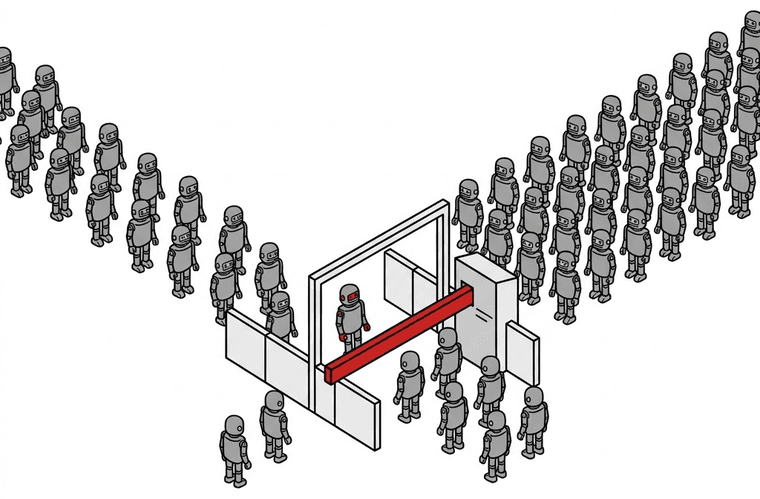
Most AI governance documents assume a shape of organisation that no longer exists. Somebody proposes a system, a committee reviews it, a technical team builds it, and the review happens once, at the start, in a room.
That shape broke when the build button arrived inside the productivity suite everyone already had. A person in finance can now assemble something that reads company documents and answers questions about them, in an afternoon, without raising a ticket. Nobody rebelled. The capability simply appeared inside the licence.
So governance moved. Very little of the useful work is now philosophical, and most of it is a set of specific decisions with specific settings behind them. Who may build. Who may only use. What a thing is allowed to reach. What happens to it when its owner leaves. Those have real answers, and the answers live in admin consoles rather than in a framework.
◆ What just changed
The dates most governance decks still quote are wrong
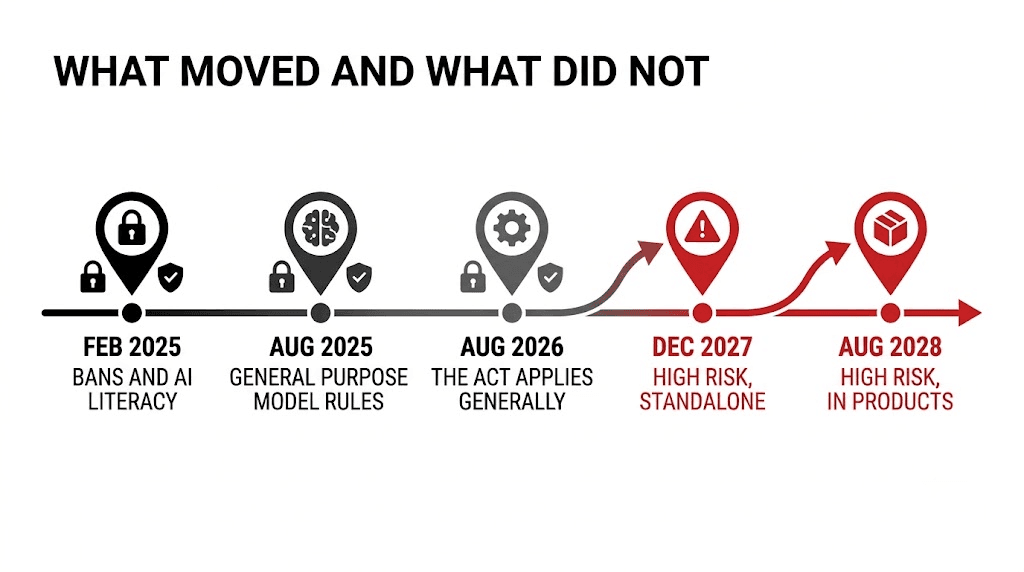
If your AI Act plan says high-risk obligations apply from 2 August 2026, it is out of date, and it went out of date very recently.
The AI Omnibus amending the AI Act was published in the Official Journal on 24 July 2026 as Regulation (EU) 2026/1744. It defers the high-risk obligations. Stand-alone systems in the Annex III categories — employment, education, essential services, law enforcement, migration, administration of justice — move to 2 December 2027. AI embedded in products already covered by Union harmonisation legislation moves to 2 August 2028.
What did not move matters just as much, because the relief is narrower than the headlines suggest. The prohibitions and the AI literacy duty keep their original February 2025 date. The general-purpose model transparency obligations keep August 2025. The Act’s general application still arrived on 2 August 2026. And the Omnibus adds a new prohibition concerning child sexual abuse material and intimate imagery that applies from 2 December 2026, so it is not purely a delay.
I will flag one thing I could not settle. Sources disagree on whether the Omnibus entered into force on the day of publication or three days later. It makes no practical difference to any plan, and I would rather say I could not resolve it than pick the version that reads more confidently.
The wider point is not the dates themselves. It is that this area rewrites itself faster than the advice about it gets updated, so anything you are handed should carry a date and a source you can check.
◆ The problem
Building and using are one setting, and that is the trap
The question almost every large organisation reaches is the same. We want everyone to use agents. We want a much smaller group to build them. How do we do that?
The obvious control does not do it. The blunt tenant switch that looks like it governs agent creation is coupled to consumption, so turning it off takes away the ability to use agents as well, including the ones the vendor ships. Organisations discover this after they flip it, usually loudly.
The separation exists, but it lives somewhere less obvious. Agents built with the lightweight in-suite builder are saved into a Power Platform environment, which means the environment and its security roles are where creation is actually governed. Grant the create permissions to a named group in the relevant environment, route the builder there, and leave consumption switched on for everyone. That produces the split people wanted, and it is invisible from the admin page they were looking at.
Sharing is a separate control again, and a narrower one than it appears. The tenant sharing setting governs only agents made with the in-suite builder, not those built in the full studio. It is an allow-list of who may share, with no per-user block, so restricting a handful of people means pointing it at a group containing everyone else. It also applies to new sharing, which leaves anything already shared exactly where it is.
◆ The four gates
Four decisions, and the settings that carry them
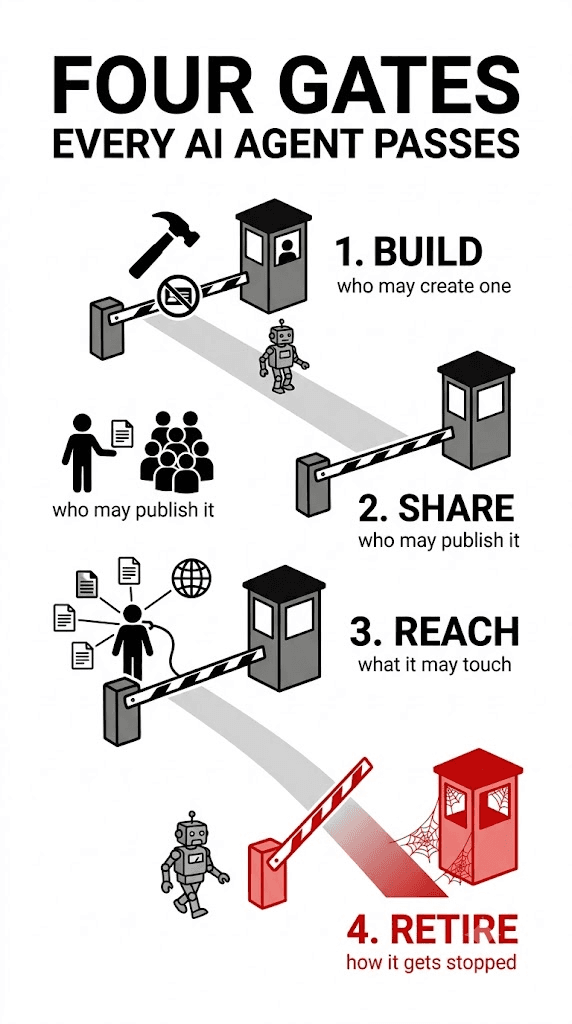
Every agent in an organisation passes through the same four gates. Writing them down in this order tends to end the circular meetings, because each one has an owner and a setting rather than an opinion.
- Build. Who may create an agent at all, as distinct from using one. This is an environment and a security role, not a policy paragraph, and it is the gate people most often think they have closed when they have not.
- Share. Who may publish an agent to other people. Separate from building, governed by a different control, and worth deciding before someone shares a useful thing with the whole company.
- Reach. What the agent can see and what it can do. Reading company documents, calling an external system, or searching the public web are three very different risk decisions that get made as one.
- Retire. How an agent gets stopped. Every organisation has a route for creating them and almost none has a route for ending them, which is how you end up with agents whose owner left last year still answering questions.
◆ The boundary
One toggle decides whether your prompt leaves the building
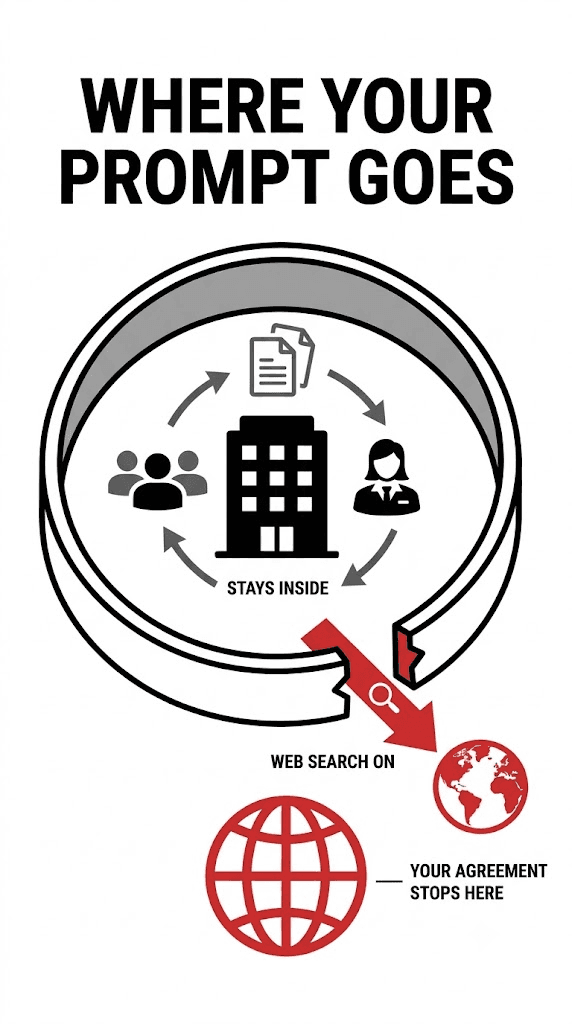
The reach gate deserves its own attention, because the most consequential setting in this whole area is easy to turn on and hard to see the effect of.
When an agent is allowed to ground its answers in public web search, a query derived from the prompt goes out to a search service that sits outside the compliance and geographic boundary the rest of the deployment lives inside. The data protection terms that cover the platform do not cover that hop, and it does not respect the private networking you paid for. For an organisation that chose a region deliberately, that is the single setting most worth understanding before it is switched on rather than after.
Where inference happens is a related decision made at deployment time and rarely revisited. The choice of deployment type determines whether processing can occur anywhere, within a defined multi-country zone, or only in the region you selected. For a UK organisation this is sharper than it looks, because the UK sits outside the European data boundary, so a zone-level commitment is not a UK commitment.
The same question applies to any connector that queries a third-party system at the moment of the prompt rather than indexing its contents in advance. A live query means something derived from the prompt leaves under that provider’s terms. Whether that is acceptable is a decision worth making per connector, with the terms in front of you.
◆ Being straight about it
What I will not claim
I am not a lawyer and this is not legal advice. What I can do is tell you what a setting actually does, what the vendor documentation says on a given date, and where a control stops short of what people assume it covers. Where an obligation turns on a legal judgement about your specific use, that is a question for counsel and I will say so rather than guess.
I will not tell you that a governance framework makes you compliant. Adopting a management standard is a real and useful discipline, and it is not the same thing as meeting a statutory obligation, and the two get conflated in sales conversations constantly.
I will also not pretend the tooling can carry decisions it cannot carry. The controls above govern who may do what. None of them decide whether an agent should exist, whether its answers are good, or whether the process it automates was sensible. Those remain judgements made by people who can be held to them.
◆ My approach
How I work through it
I start by finding out what already exists, because the answer is never zero. Somebody has built something. Usually several people have, and usually it is genuinely useful, which is why heavy-handedness at this point costs you the goodwill you are about to need.
Then the four gates, one at a time, each with a named owner and the actual setting written down next to it. A governance decision that does not resolve to a configuration is an aspiration, and aspirations do not survive contact with a busy quarter.
I try hard to make the permitted path easier than the unofficial one. Governance that only forbids gets routed around by capable people under pressure, and you lose the visibility you were trying to gain.
And I write down what was decided and why, in language your risk and audit people already use, so the next person does not have to reconstruct it from the settings.
◆ Next
Where to start if this sounds familiar
If people are creating agents faster than anyone can approve them, the first useful move is not a policy. It is finding out what exists and closing the build gate properly, which is usually a smaller piece of work than it sounds and is frequently not where people think it is.
Tell me what you have switched on and what you are worried about. I will tell you which gate is actually open, and whether the thing you are worried about is the thing that should worry you.