Card 40 of 40· Currency
What is unstable, and what that means for you
Renamed roles, superseded frameworks, a large preview surface, and a beta exam — plus the one sentence the whole guide is really about.
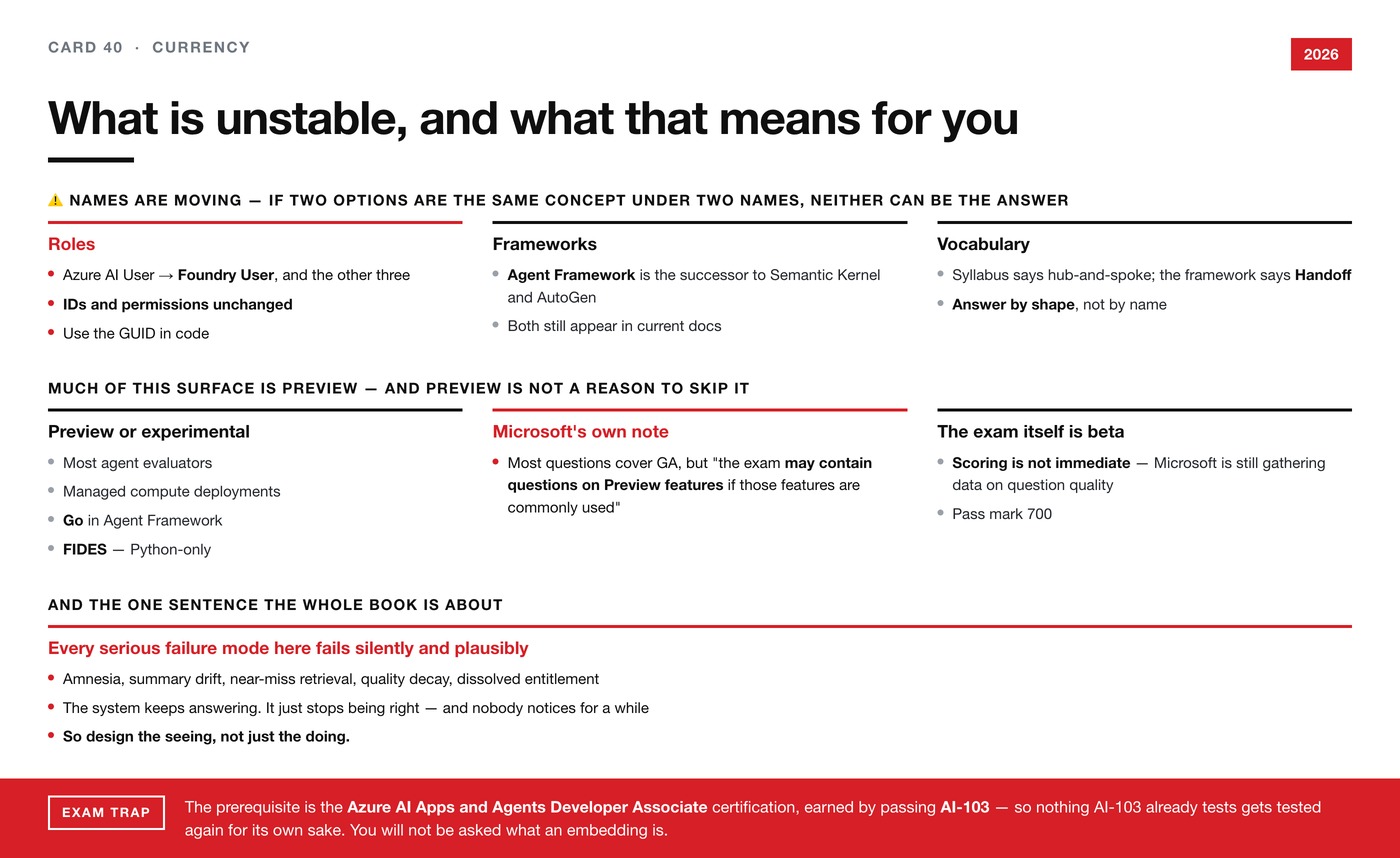
The last card, and it is about the ground moving under you — which for this exam is
a live concern rather than a general observation.
Names are moving
Roles were renamed. Azure AI User became Foundry User, and the other three
alongside it. Microsoft's own note: "The role IDs and core permissions are
unchanged by the rename." Use the GUID in code, because the names are still rolling
out.
Frameworks were superseded. Agent Framework is the successor to Semantic Kernel
and AutoGen, and both predecessors still appear throughout current documentation.
The vocabulary is doubled. The syllabus says hub-and-spoke; the framework says
Handoff. Same pattern, two names.
Which produces a specific kind of question. If two options are the same concept
under two names, neither can be the answer — you are being asked whether you know
they are the same thing. And an option claiming that the rename changed what a role
can do is wrong on its face.
The general defence is: answer by shape, not by name.
Much of this surface is preview
Genuinely a lot of it: most of the agent evaluators, managed compute deployments, Go
in Agent Framework, FIDES.
And Microsoft's own note on the exam says most questions cover generally available
features but "the exam may contain questions on Preview features if those features
are commonly used."
So preview is not a reason to skip something in this subject. In a field moving
this fast, the preview surface is where a good deal of the interesting material
lives, and the exam knows it.
The exam itself is beta
AI-500 is a beta exam. Two practical consequences.
Scoring is not immediate — Microsoft is still gathering data on question quality,
so results come later than you are used to. Plan for that rather than being
surprised by it.
The pass mark is 700, as with every Microsoft exam.
The prerequisite is the Azure AI Apps and Agents Developer Associate
certification, earned by passing AI-103. Which means nothing AI-103 already
tests gets tested again for its own sake — you will not be asked what an embedding
is.
And the one sentence the whole guide is about
Every serious failure mode in this material fails the same way.
Sliding-window amnesia. Summary drift. Near-miss retrieval. Quality decay. Dissolved
entitlement. A tool that succeeded and was ignored. A budget that alerted a day too
late. A permissions model that drifted from its source.
None of them raises an error. The system keeps answering. It stays fluent, stays
confident, stays fast. It just stops being right — and nobody notices for a while,
because there is nothing to notice.
Which is why so much of this exam is about evaluation, tracing, monitoring, drift
detection and audit trails rather than about building. Building an agent that works
is not the hard part any more.
So design the seeing, not just the doing.
The trap
Revising the architecture chapters because they feel the most expert-level.
Architect is 15–20% — the smallest domain on the paper. Develop is 30–35% and
Evaluate/optimize/monitor is 20–25%. Over half this exam sits after the design is
decided, which is not an accident of weighting. It is the exam telling you where
the difficulty in this work actually is.