Card 17 of 40· Develop
Human-in-the-loop
Approval, override and edge cases — and why reversibility, not confidence, decides where the gate goes.
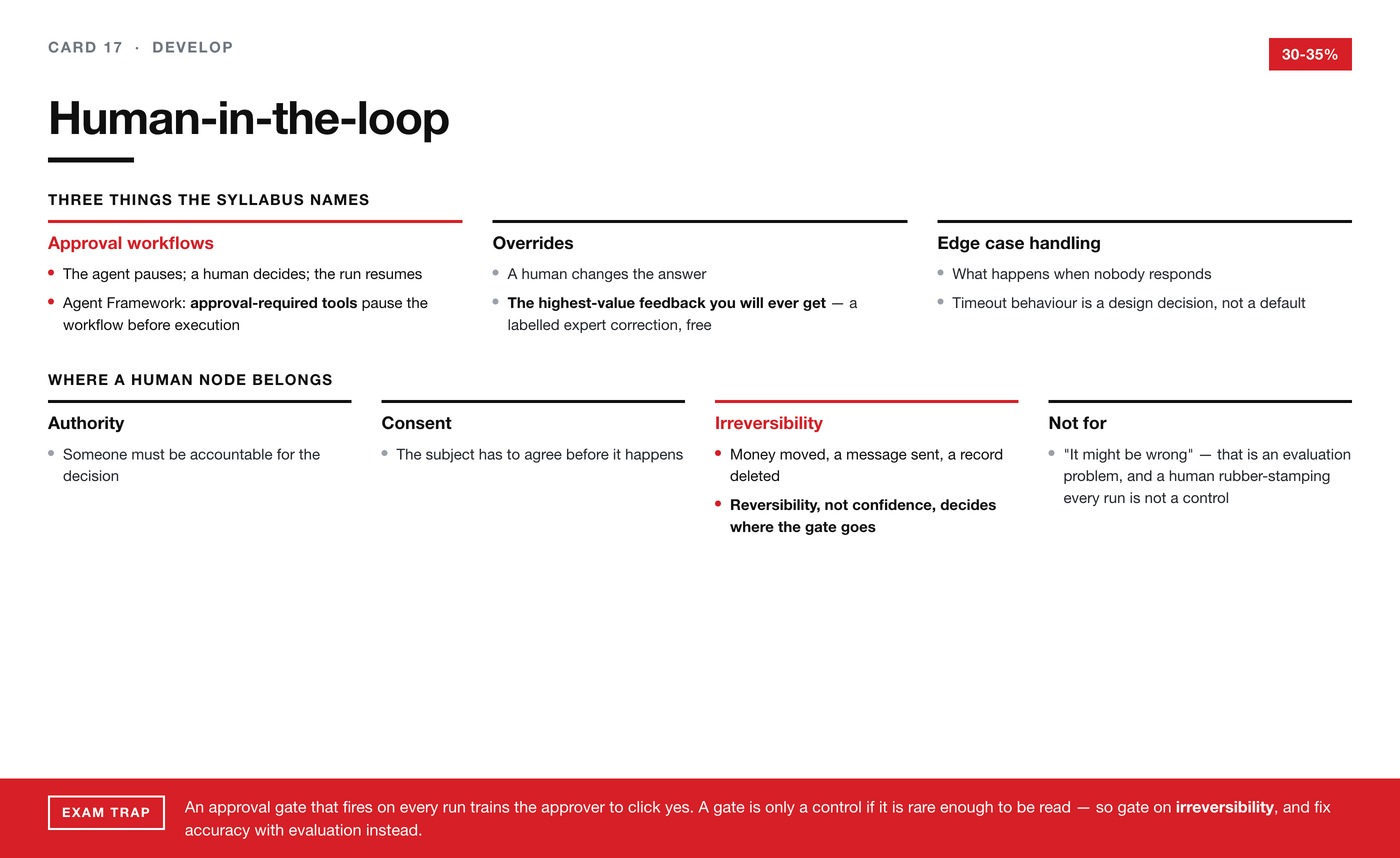
The syllabus asks for human-in-the-loop processes "including approval workflows,
overrides, and edge case handling". Three things, and they are doing quite different
jobs.
The three
Approval workflows. The agent pauses, a human decides, the run resumes. Agent
Framework supports this directly — orchestrations can use approval-required
tools that pause the workflow for human review before execution.
That "before execution" is the important part. An approval that happens after the
action is a notification.
Overrides. A human changes the answer. Worth treating as a first-class feature
rather than an escape hatch, because — see below — it is the most valuable feedback
you will ever get.
Edge case handling. What happens when nobody responds. Timeout behaviour is a
design decision, not something to discover in production. Does the run fail? Escalate
further? Proceed with a safe default? Somebody has to choose, and if nobody chooses
the framework will choose for you.
Where a human node genuinely belongs
Three situations, and one non-situation.
Authority. Somebody has to be accountable for the decision, and accountability
cannot be delegated to a system.
Consent. The subject of the action has to agree before it happens.
Irreversibility. Money moved, a message sent to a customer, a record deleted.
And the one that is not a reason: "it might be wrong." That is an evaluation
problem. A human rubber-stamping every run is not a control — it is a cost, and a
misleading one, because it produces an audit trail that looks like oversight.
So the rule is: reversibility, not confidence, decides where the gate goes. How
sure you are about the agent is an argument for more evaluation. How hard the action
is to undo is the argument for a human.
Overrides are the best feedback in the system
An override is a labelled expert correction, produced continuously, at no marginal
cost, on exactly the cases where the system was wrong.
You would pay a great deal for that dataset if you had to commission it. Most teams
throw it away — the human fixes the answer, the customer is served, and nothing
records what was changed or why.
Capture them. They feed the evaluation set, the improvement backlog, and any
fine-tuning you eventually do. And when overrides start clustering around one case
type, that cluster is a defect report written by your own users.
The trap
An approval gate that fires on every run trains the approver to click yes.
This is the failure mode that makes human-in-the-loop look like theatre. Ten
approvals a day get read. Four hundred get approved in a batch by someone who has
stopped looking, and the organisation now has a control that produces evidence of
oversight without producing oversight.
A gate is only a control if it is rare enough to be read. Which means gating on
irreversibility rather than on uncertainty is not just conceptually cleaner — it is
the thing that keeps the gate working.