Card 33 of 44· Master cards
The decision tables — everything condensed
Picking the surface, the agent shapes, orchestration, grounding, the model ladder and the money — all of it in the tables you would want the morning of the exam.
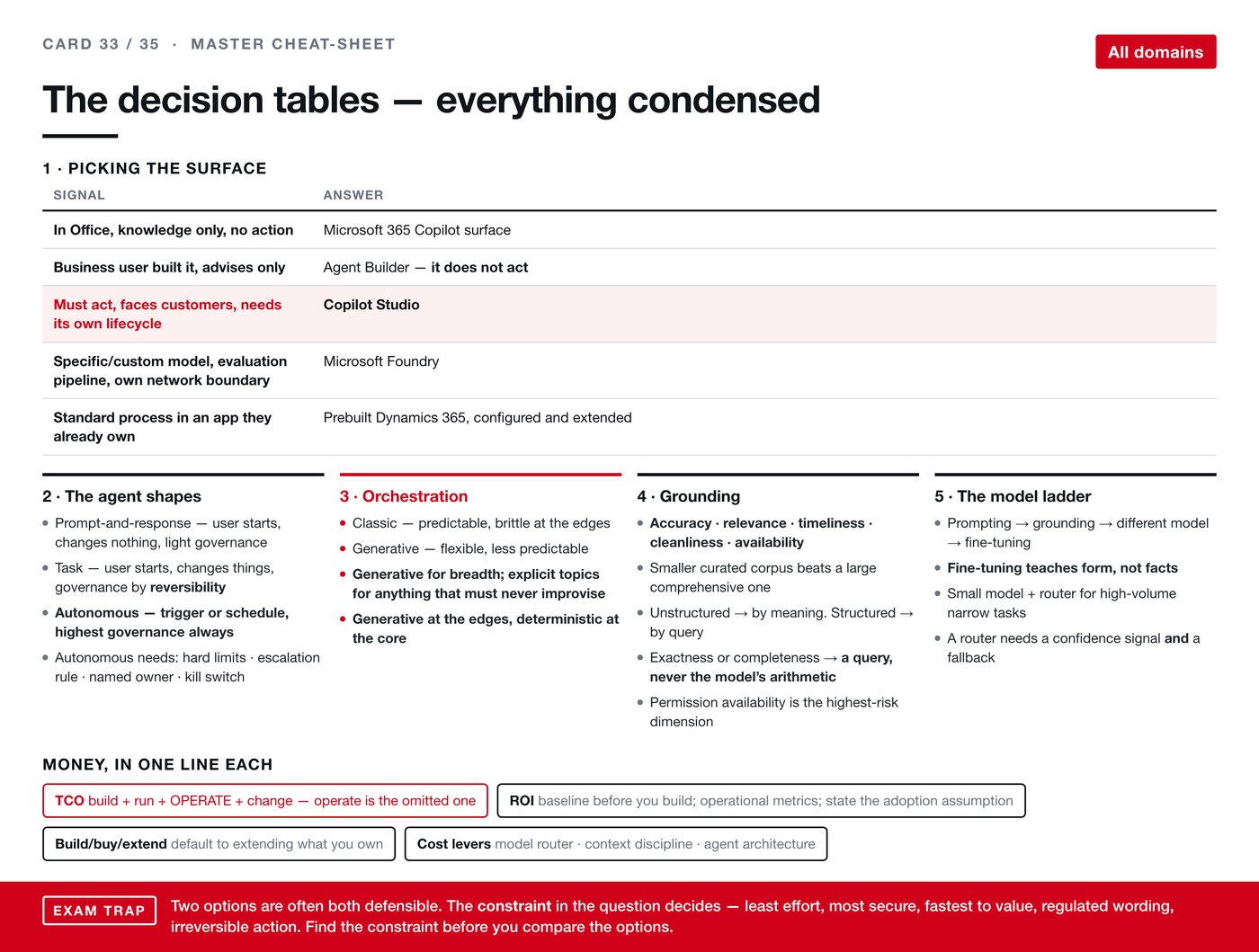
The first of three master cards. Everything from the earlier thirty-two,
condensed into the tables you would want in front of you the morning of the exam.
Picking the surface
In Office, knowledge only, no action → the Microsoft 365 Copilot surface.
A business user built it and it advises only → Agent Builder, which does not
act.
Must act, faces customers, needs its own lifecycle → Copilot Studio.
Specific or custom model, evaluation pipeline, own network boundary →
Microsoft Foundry.
A standard process in an app they already own → prebuilt Dynamics 365,
configured and extended.
The agent shapes
Prompt-and-response: the user starts it, it changes nothing, governance is light.
Task: the user starts it, it changes things, and governance follows
reversibility.
Autonomous: a trigger or schedule starts it, and governance is highest always.
Autonomous needs all four — hard limits, an escalation rule, a named owner, a kill
switch.
Orchestration
Classic is predictable and brittle at the edges. Generative is flexible and less
predictable.
Generative for breadth, explicit topics for anything that must never improvise.
And the pattern underneath it all: generative at the edges, deterministic at the
core.
Grounding
The five dimensions: accuracy, relevance, timeliness, cleanliness, availability.
A smaller curated corpus beats a large comprehensive one. Unstructured content is
retrieved by meaning, structured data by query. Anything needing exactness or
completeness comes from a query, never the model's arithmetic. And permission
availability is the highest-risk dimension of the five.
The model ladder
Prompting → grounding → a different model → fine-tuning.
Fine-tuning teaches form, not facts. A small model with a router suits
high-volume narrow tasks. And a router needs a confidence signal and a
fallback, or it is a quality cut nobody agreed to.
Money, in one line each
Total cost of ownership is build plus run plus operate plus change —
operate being the one everybody omits.
Return on investment needs a baseline before you build, operational metrics,
and the adoption assumption stated out loud.
Build, buy or extend: default to extending what you already own.
Cost levers: the model router, context discipline, and agent architecture.
Exam trap. Two options are often both defensible. The constraint in the
question decides — least effort, most secure, fastest to value, regulated
wording, irreversible action. Find the constraint before you compare the
options.
The one line to carry: when two answers both look right, you have not yet
found the constraint the question is really testing.