Card 29 of 44· Domain 3 · Deploy
Responsible AI in practice
What each of the six principles demands of an architect, the question to ask of every control, and why fairness measured in aggregate has not been measured at all.
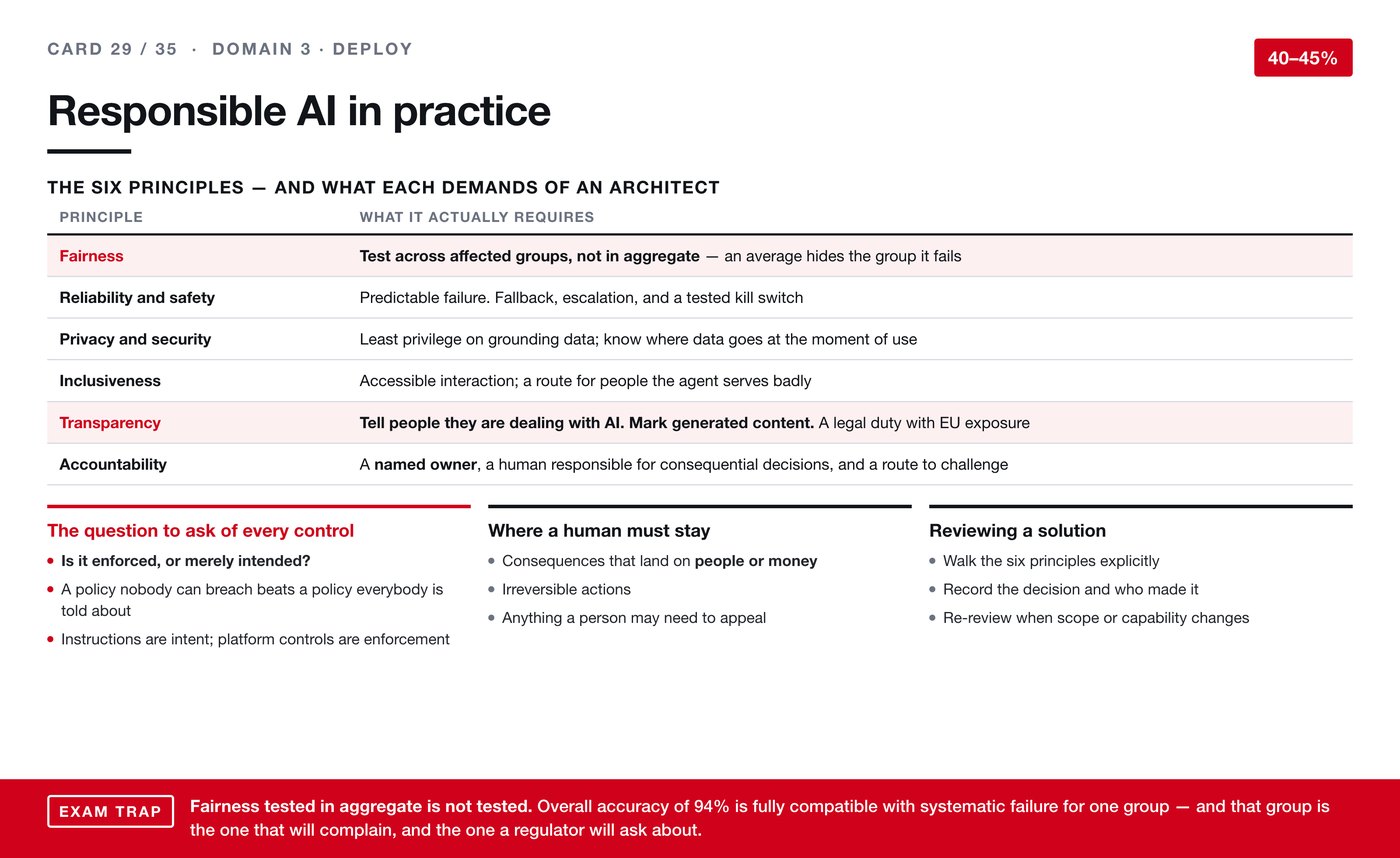
The six principles are easy to recite and harder to act on. This card turns each
into something an architect has to actually do.
The six, and what each demands
Fairness. Test across affected groups, not in aggregate. An average hides the
group it fails.
Reliability and safety. Predictable failure. Fallback, escalation and a tested
kill switch — tested being the word that separates a control from an intention.
Privacy and security. Least privilege on grounding data, and knowing where
data goes at the moment of use rather than where it is stored at rest.
Inclusiveness. Accessible interaction, and a route for the people the agent
serves badly. Every system serves somebody badly; the question is whether they
have anywhere to go.
Transparency. Tell people they are dealing with AI, and mark generated
content. This is a legal duty where there is EU exposure, not a courtesy.
Accountability. A named owner, a human responsible for consequential
decisions, and a route to challenge.
The question to ask of every control
Is it enforced, or merely intended?
A policy nobody can breach beats a policy everybody is told about. Instructions
are intent; platform controls are enforcement. That distinction has run through
this whole exam, and it lands hardest here — a responsible-AI commitment that
depends on people choosing to comply is a statement of hope.
Where a human must stay
Consequences that land on people or money. Irreversible actions. And anything a
person may need to appeal — because an appeal against a decision nobody made is
not an appeal.
Reviewing a solution
Walk the six principles explicitly rather than assuming them. Record the decision
and who made it. And re-review when scope or capability changes, since an agent
that gained a connector is not the agent that was approved.
Exam trap. Fairness tested in aggregate is not tested. Overall accuracy of
94% is fully compatible with systematic failure for one group — and that group
is the one that will complain, and the one a regulator will ask about.
The one line to carry: ask of every control whether it is enforced or merely
intended, and be honest about the answer.