Card 27 of 44· Domain 3 · Deploy
ALM — the minimum viable setup
The seven things a defensible lifecycle contains, the four parts that actually make up an agent, and why promoting the definition alone reproduces the look but not the behaviour.
Application lifecycle management for agents, and a definition of what an agent
actually consists of that turns out to matter more than it first appears.
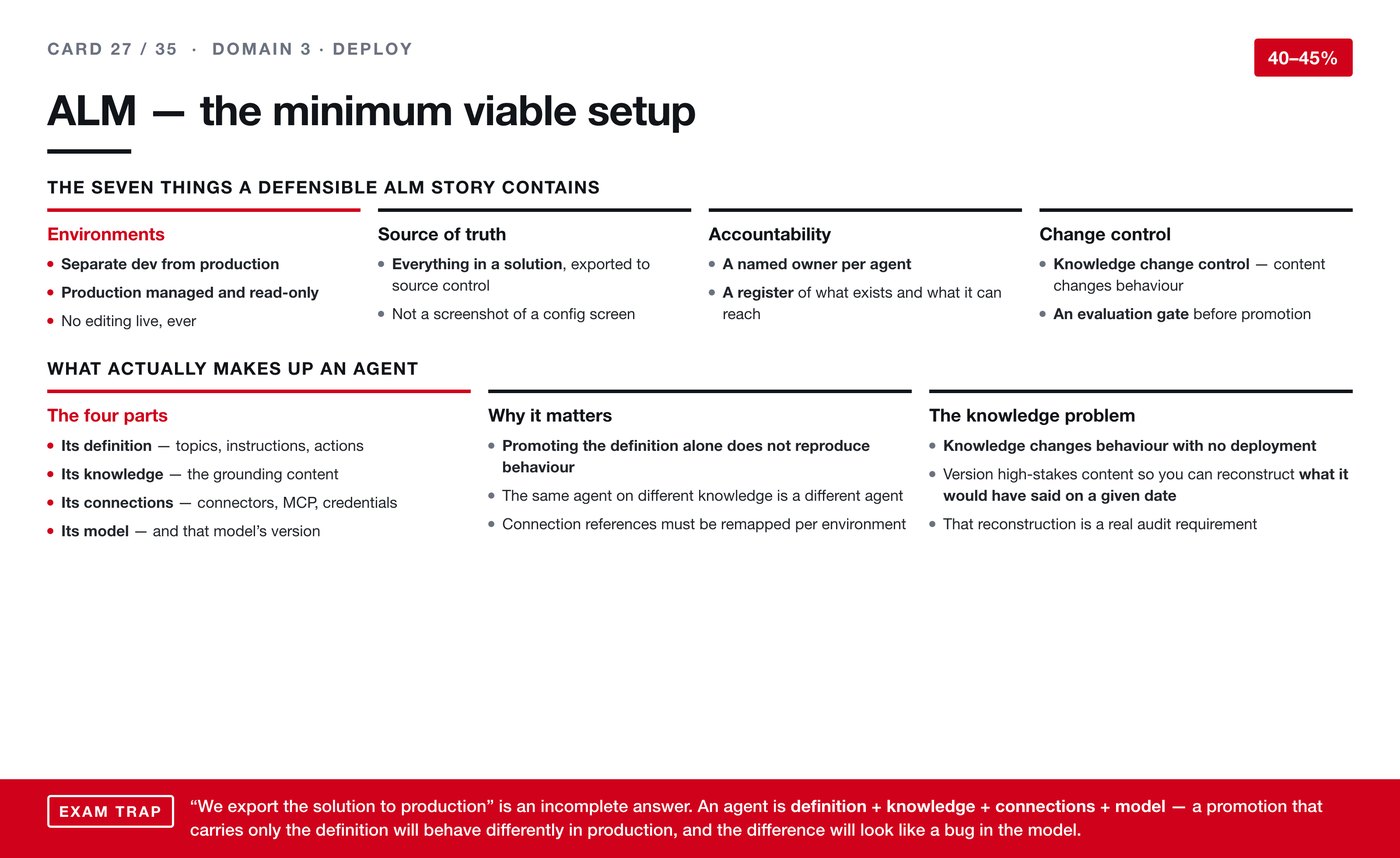
The seven things a defensible setup contains
Environments. Separate development from production. Production managed and
read-only. No editing live, ever — and that last one is the rule most often broken
in practice, because editing live is so convenient.
Source of truth. Everything in a solution, exported to source control. Not a
screenshot of a configuration screen, which is how a surprising number of
organisations record what they built.
Accountability. A named owner for each agent, and a register of what exists
and what it can reach.
Change control. Knowledge change control, because content changes behaviour.
And an evaluation gate before promotion.
What actually makes up an agent
Four parts, and the exam tests whether you know all of them.
Its definition — topics, instructions, actions.
Its knowledge — the grounding content.
Its connections — connectors, MCP, credentials.
Its model — and that model's version.
Why that matters
Promoting the definition alone does not reproduce the behaviour.
The same agent pointed at different knowledge is a different agent. Connection
references have to be remapped per environment. And if the model version differs
between environments, so will the answers.
This is why an agent that behaved perfectly in test can misbehave in production
with nothing apparently changed. Nothing about the definition changed; three other
things did.
The knowledge problem
Knowledge changes behaviour with no deployment, so version high-stakes content in
a way that lets you reconstruct what the agent would have said on a given
date.
That reconstruction is a real audit requirement, not a nicety. When somebody asks
why a customer was told something six months ago, the answer has to be
recoverable.
Exam trap. "We export the solution to production" is an incomplete answer. An
agent is definition plus knowledge plus connections plus model — a promotion
that carries only the definition will behave differently in production, and the
difference will look like a bug in the model.
The one line to carry: an agent is four things, and promoting one of them
moves the appearance of the agent without moving the agent.
Currency (19 Aug 2026). Because agent evaluations are GA and can be triggered from a
connector or REST API, gating a release on an evaluation run is now buildable rather
than aspirational. Worth putting into your ALM design explicitly. See card 44.