Your Brain Can't Tell the Difference
These are stories about one strange, hopeful fact: the mind you rehearse in private becomes the life you live in public.
These are stories about one strange, hopeful fact: the mind you rehearse in private becomes the life you live in public.
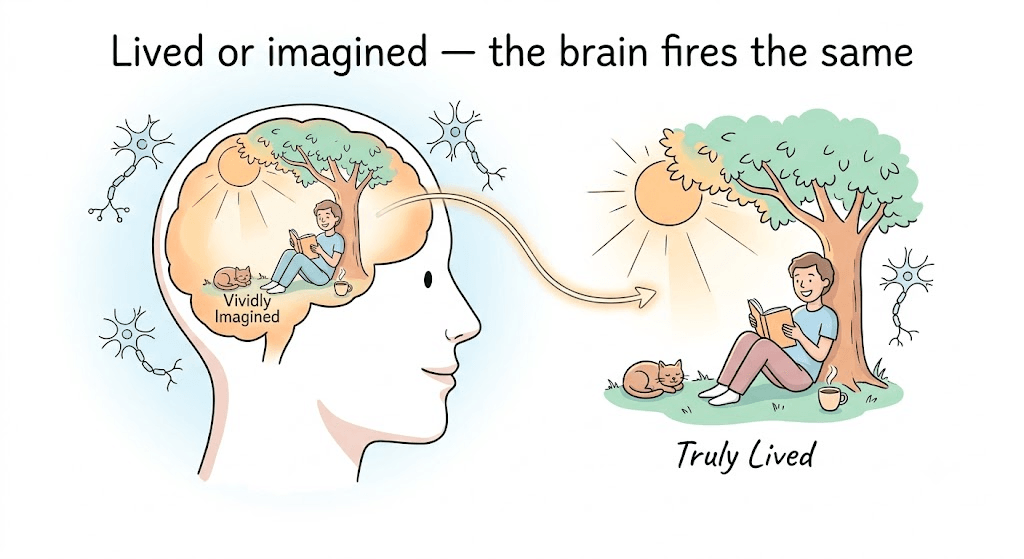
Close your eyes for a second and picture biting into a lemon. The sourness, the sting at the back of your jaw. If your mouth watered even a little, you just proved something remarkable. There was no lemon. Only a thought — and your body answered as if it were real.
That small trick is the doorway to one of Dr. Joe Dispenza's most practical teachings. The brain does not draw a hard line between an experience you live and one you vividly imagine. It fires on both. And what fires together, wires together.
Which means you are already rehearsing your life every single day. The only question is whether you know what you're practising.
The story of a ten-million-dollar cheque
The Story of a Broke Comedian on a Hill
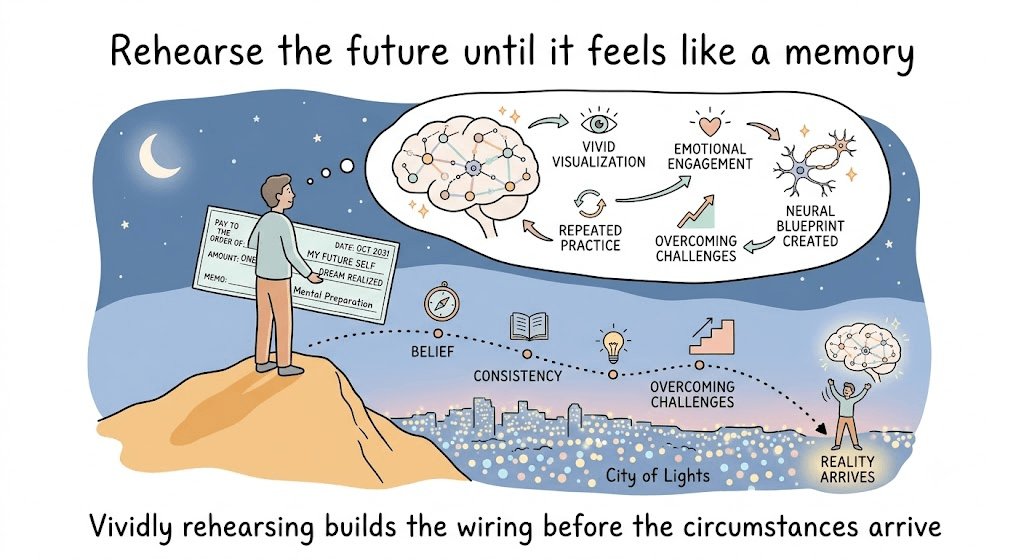
In 1990, a young Canadian comedian used to drive his beat-up Toyota up to the top of Mulholland Drive at night. He was broke. He'd park, look out over the lights of Los Angeles, and imagine directors who wanted to work with him and people who admired his work.
One night he did something odd. He wrote himself a cheque for ten million dollars, "for acting services rendered," and dated it Thanksgiving 1995. He put it in his wallet and let it fade there.
The comedian was Jim Carrey. Just before that Thanksgiving, he found out he'd be paid ten million dollars for Dumb and Dumber. He didn't magic the money out of the air. But for five years he had rehearsed being a man that money came to — and he kept showing up as that man until the world agreed.
This is mental rehearsal. You run the future in your mind so often, and so richly, that your brain builds the wiring for it before the circumstances arrive. By the time the moment comes, you've already been there a thousand times.
The teaching: "You don't rise to the level of your hopes. You fall to the level of what you've rehearsed."
The story of the pianists who never touched a key
The Story of Two Rooms at Harvard
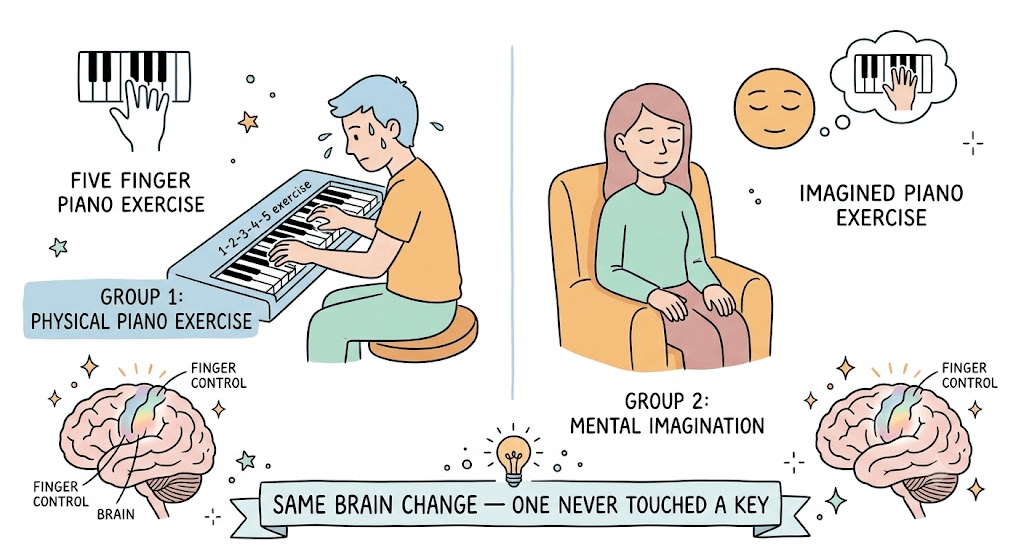
In 1995, a neuroscientist named Alvaro Pascual-Leone ran an experiment at Harvard that should be taught in every school. He took people who couldn't play piano and split them into two groups.
The first group practised a simple five-finger sequence on a real piano, two hours a day, for five days. The second group sat in front of the same piano and never moved a muscle. They only imagined playing the sequence — the finger positions, the timing, the feel of the keys.
After five days, he scanned their brains. The group who physically practised had grown the region that controls those fingers. That was expected. The shock was the other group. The people who only imagined playing had grown almost exactly the same brain region — by the same amount.
Their hands had done nothing. Their minds had done everything. The brain built the map for a skill it had never physically performed, because to the brain, focused imagination is experience.
The teaching: "Your brain changes to match your attention, not your circumstances. Where the mind goes, the wiring follows."
The story of the finger that got stronger by doing nothing
The Story of a Muscle and a Thought
If the mind can rewire the brain, can it reach further — into the body itself?
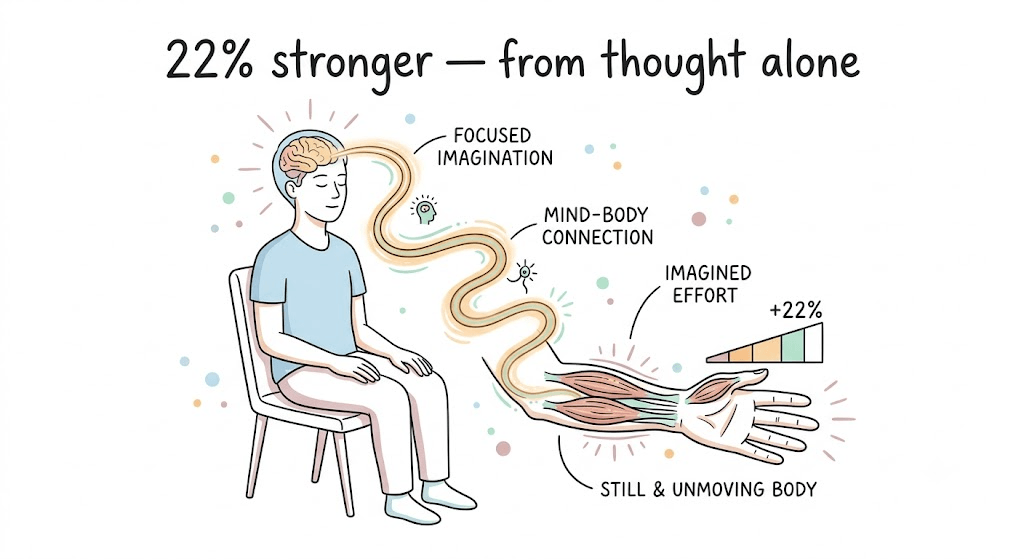
In the 1990s, a researcher named Guang Yue set out to test something that sounds impossible. He asked a group of volunteers to build muscle strength without ever exercising. For weeks, they simply sat still and imagined contracting a finger muscle as hard as they could. No weights. No movement. Just the intention, fired over and over.
When he measured them afterward, the imagined-exercise group had increased their strength by around 22 percent. A muscle got stronger because a mind kept insisting it was working.
This is the part that unsettles people. We treat the body as a stubborn machine that only responds to physical effort. But the body is eavesdropping on the mind constantly. Rehearse tension, and it tenses. Rehearse calm, and it softens. Rehearse a future, and it starts preparing the biology to live there.
The teaching: "The body doesn't know the difference between the life you're living and the life you keep insisting on. It just gets ready for whichever one you rehearse."
The story of the rehearsal you're already running
The Story of a Sunday Night
Here's the twist Dispenza points to, and it lands harder than any lab study.
It's Sunday evening. Nothing has actually gone wrong. But you're already tense about Monday — the inbox, the meeting, the person who drains you. In your mind you play the difficult conversation before it happens. You feel the frustration in your chest. You rehearse the version of yourself who is anxious, defensive, small.
You've just spent an hour in mental rehearsal. You did it with total focus, rich detail, real emotion. You practised, one more time, the exact person you say you want to stop being.
This is the uncomfortable gift in Dispenza's work. Most of us are already expert mental rehearsers. We just aim the skill backwards. We replay old hurts and rehearse feared futures until the brain wires them in as who we are — and then we call it "just being realistic."
The good news hiding inside the bad news: the mechanism is neutral. The same tool that built your worry can build something else. You were never bad at visualising. You were only practising the wrong scene.
The teaching: "You are not stuck with your personality. You are stuck with your rehearsals. Change what you practise in private, and the stranger in the mirror slowly becomes someone you chose."
The story of the twenty minutes that rewire you
The Story of the Quiet Hour Before the World Wakes
There's a reason Dispenza asks people to close their eyes each morning before they touch their phone.
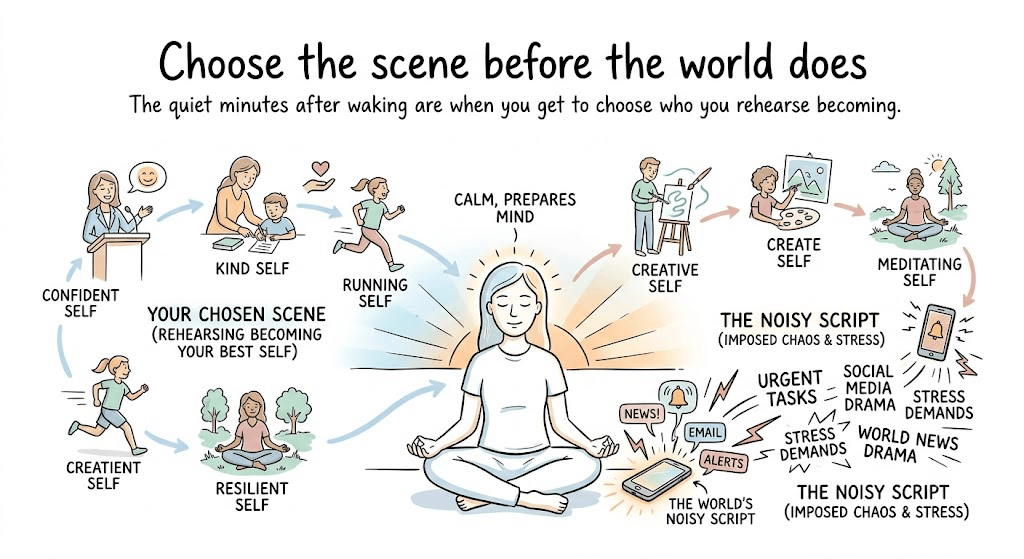
The moment you reach for the phone, the world hands you its script — the news, the messages, the old identity waiting in the inbox. You start the day by rehearsing yesterday. But in that quiet window just after waking, the gate is open. You get to choose the scene.
So you sit. You picture the version of you moving through the day with a calm you haven't earned yet — patient in the meeting, kind under pressure, unhurried. You don't just watch it like a film. You try to feel it, because the feeling is what convinces the body it's real. You rehearse the future until it feels like a memory.
In my own tradition this isn't new at all. It's sankalpa — a clear intention held with devotion. It's dhyana — sustained, single-pointed attention. The sages called it steadying the mind; the neuroscientists call it self-directed neuroplasticity. Same practice. Two languages. Both saying: the inner life is not a passive mirror of the outer one. It's the workshop where the outer one is built.
The teaching: "The twenty minutes of morning rehearsal may be the most important work you do all day. It's the only time you get to write the script before the world reads it to you."
One last thought
None of this is magic, and it isn't a promise that a cheque in your wallet pays itself. The lemon didn't appear in your mouth. Jim Carrey still had to show up, fail, and keep showing up. The pianists' brains changed, but they still had to sit at the keys.
What the science offers is quieter and more useful than magic. It says the rehearsal counts. The private, invisible practice you run in your own head is not idle. It is laying track. It is building the person who then walks into the room.
So the question was never whether you can rehearse a new life. You already rehearse one, every day, without noticing. The only question left is the one you get to answer tomorrow morning, in the quiet, before the phone.
Which life are you going to practise?
No comments yet — be the first to add to the discussion. Comments appear after they’re reviewed.
Want more insights?
Subscribe to get the latest articles delivered straight to your inbox.