The model is the easy part
Everyone is watching the model. New benchmark, new release, new leaderboard — the timeline lights up every few weeks. We argue about which one is smartest this month.
Stories about the quiet layer around AI — the harness — that decides whether your agents win or wander.
Everyone is watching the model. New benchmark, new release, new leaderboard — the timeline lights up every few weeks. We argue about which one is smartest this month.
Meanwhile, the engineers getting real work out of AI have stopped staring at the model. They are building the thing around it. The context it sees. The tools it can reach. The rules that catch it when it is wrong. The memory it keeps between sessions.
That layer has a name now: the harness. And it is turning out to be where the actual engineering lives — and where the edge is. Let me tell you a few stories about why.
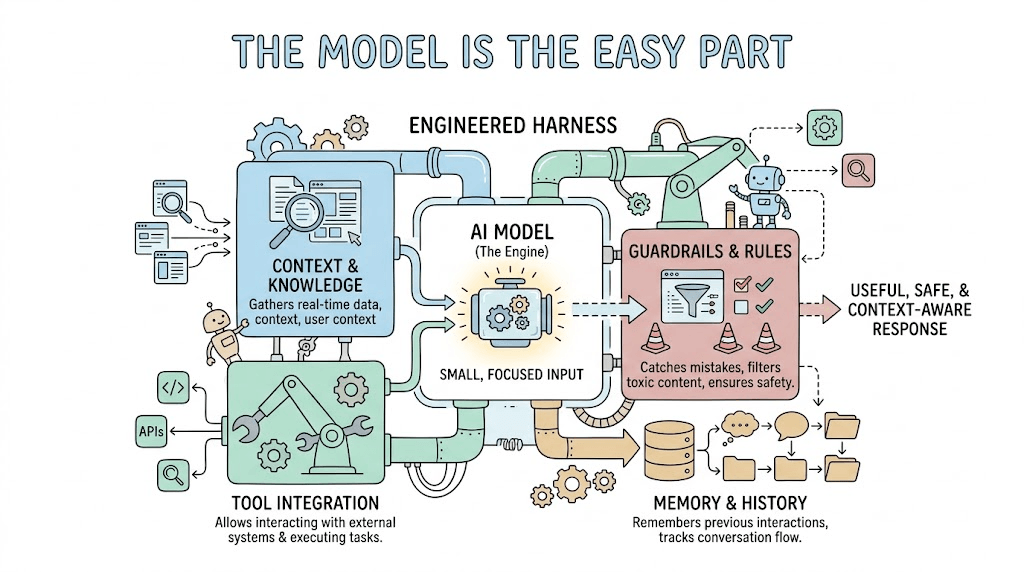
The model is one input, not the whole machine
Two engineers open the same week with the same model. Same Claude, same subscription, same laptop.
By Friday, one has shipped a clean feature with tests. The other has a graveyard of browser tabs and a half-broken branch. Each blamed their "prompting." Neither of them touched the model. The model was identical.
What differed was everything around it. One had set up project rules, a test step the agent had to pass, a few small tools, and notes the agent could read. The other typed into an empty box and hoped.
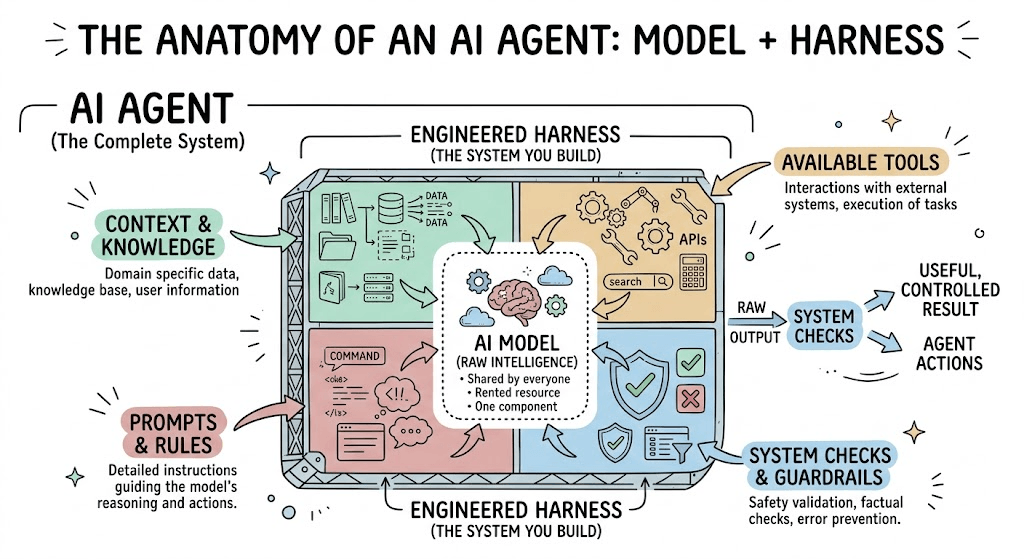
There is a simple way to say this. An agent is not a model. An agent is a model plus a harness — the whole system of context, tools, prompts, and checks that surrounds it. The model brings the raw intelligence. The harness decides whether that intelligence turns into something useful.
The teaching: "The model is rented, and shared by everyone. The harness is the part you build — so it is the part that makes the results yours."
The leak that gave the secret away
In early 2026, the source code for Claude Code leaked. Every tech channel rushed to the new features and the hot takes.
One engineer I had been following, IndyDevDan, read it differently. His take was almost boring, and exactly right: the leak proves the harness is the product.
Think about it. Claude Code grew from nothing to billions in revenue faster than almost any product in history. A great model sits underneath it — but great models are everywhere now, and getting cheaper by the month. What people actually pay for is the harness: the orchestration, the tools, the caching, the skills, the control over what the model does.
"Without the agent harness," he put it, "there are no agents, and no agentic engineering." The model is the engine. The harness is the car you can actually drive.
The teaching: "Models are becoming a commodity. The system you wrap around one is the moat — and it is a moat you can dig yourself."
What the model cannot see
An agent fixes a bug with total confidence. The explanation reads beautifully. The fix is wrong.
Anyone who has worked with these tools knows this moment. The model sounds sure. But it does not really understand your system — it predicts text, one token at a time, with no true picture of your architecture or your intent. Left alone, it will sail right past the kind of mistake that matters.
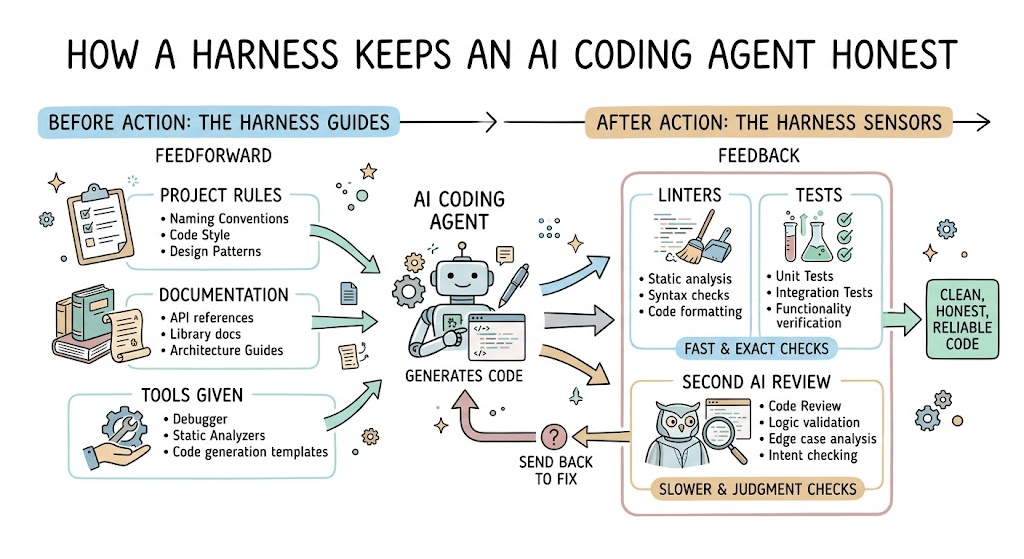
This is the job the harness does. Martin Fowler describes it as two halves. Guides that steer the agent before it acts — your rules, your docs, the tools you hand it. And sensors that catch it after it acts — linters, tests, a second agent that reviews the work. Some checks are quick and exact, like a test suite. Others are slower and judgment-based, like an AI reviewer reading for over-engineering.
OpenAI runs custom linters that scan for drift. Stripe wires checks into a pre-push hook. None of that is the model. All of it is the harness, quietly refusing to let a confident wrong answer through.
The teaching: "The model supplies the answer. The harness decides whether the answer is allowed to ship."
The four dials, and the room they sit in
A live demo. Three teams of agents building in parallel. Two of them go silent — the open-source models behind them just stop responding.
I watched IndyDevDan hit this on camera. Instead of the run collapsing, he shrugged. He could swap those models out, or add a fallback that rotates to a working one. Why so calm? Because he owned the harness. The thing that broke was a part he controlled.
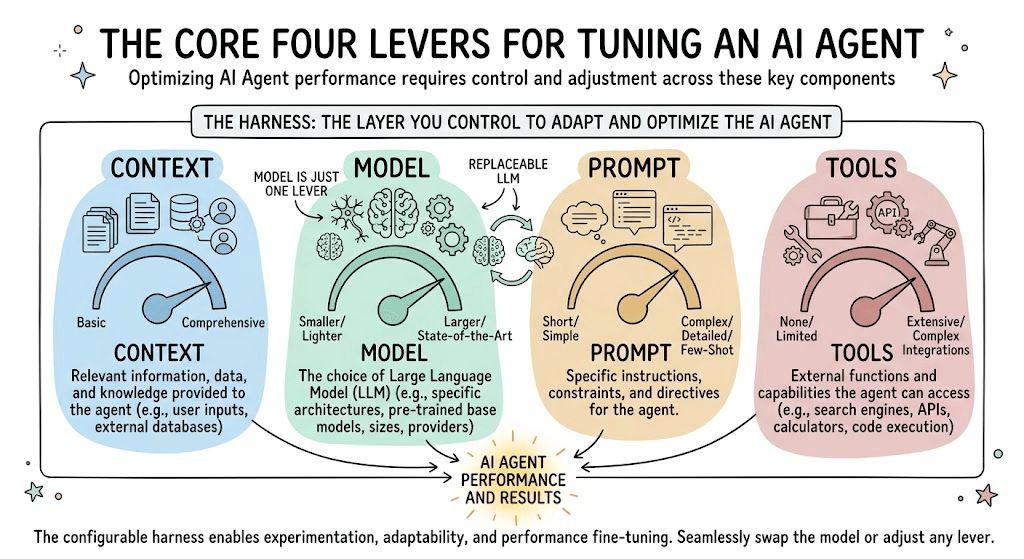
He talks about the "core four" — the four things you actually tune on any agent. Context, model, prompt, tools. Notice the model is one of four, not the whole list. And to truly control all four — to swap a model, reshape the context, share one skill across many agents — you need control of the layer they live in. The harness is the room. The core four are the dials on the wall.
The teaching: "When the model is just one dial you can turn, a model that fails stops being a crisis and becomes a config change."
Agents that remember beat agents that forget
It is late. Sarah's agent just spent two hours untangling a tricky migration. She closes the terminal. The lesson evaporates with the session.
Next week, same problem, same two hours. The agent is brilliant and amnesiac. Every conversation starts from zero.
The fix is part of the harness too: memory. Give each agent a small file it owns — a running mental model of what it has learned about your system — and have it load that file when it wakes up. IndyDevDan's specialized agents keep their own notes, a few thousand tokens each, updated as they work. He does not micromanage it. He just gave them a place to remember, and a short rule for how.
I feel this one personally. The setup I use writes its own lessons to memory between sessions, so it stops re-learning the same things. An agent that compounds what it knows pulls away from one that starts fresh every time — a little further, every week.
The teaching: "Intelligence you do not save, you pay for again. Memory is how an agent gets better instead of just getting used."
You are the bottleneck
Here is the uncomfortable line from that same engineer: "It is not the models. It is not the tools. It is you."
It stung because it is true. When the model is this capable, the limit is not the model anymore. The limit is whether you can build the system that puts it to work.
So the shift is this. Stop hand-prompting one task at a time. Start moving your own judgment — your rules, your steps, your taste — into the harness. Into system prompts, skills, reusable workflows, checks. Build the system that builds the thing, instead of building the thing by hand. Do that, and last week's two-hour job becomes one command you can run again tomorrow.
The teaching: "The leverage moved. It used to be how well you code. Now it is how well you build the system that codes."
The quiet layer that decides everything
The model gets the headlines. It deserves some of them — none of this works without the intelligence underneath. But the model is shared, rented, and changing under your feet every month.
The harness is the part you own. It is where your context lives, where your rules catch mistakes, where your agents remember and specialize. It is slower to build and it does not trend on launch day. It is also, more and more, the whole game.
People are starting to call this harness engineering — the next layer after prompt engineering and context engineering. Whatever we name it, the move for 2026 is the same: build trust in your agents, then scale what they can carry.
The teaching: "Pick the best model you can. Then remember it is the easy part — the harness around it is where your real work, and your real edge, will live."
No comments yet — be the first to add to the discussion. Comments appear after they’re reviewed.
Want more insights?
Subscribe to get the latest articles delivered straight to your inbox.