Microsoft's Blueprint for Enterprise AI: What the Unified Data Platform Actually Means
Microsoft's Cloud Adoption Framework now includes a complete reference architecture for AI-ready data. Here's what every layer does, why the non-technical decisions come first, and what this means for teams building production AI.
Most enterprise AI projects fail not because of the model or the tooling, but because the data underneath is ungoverned, undefined, and untrustworthy. Microsoft's Cloud Adoption Framework unified data platform architecture is designed to solve exactly that — not by adding more data engineering, but by establishing clear organizational ownership before any technology gets chosen. This post walks through every layer of that architecture and explains what it actually means in practice.
1. Data Domains — The Non-Technical Decision That Determines Everything
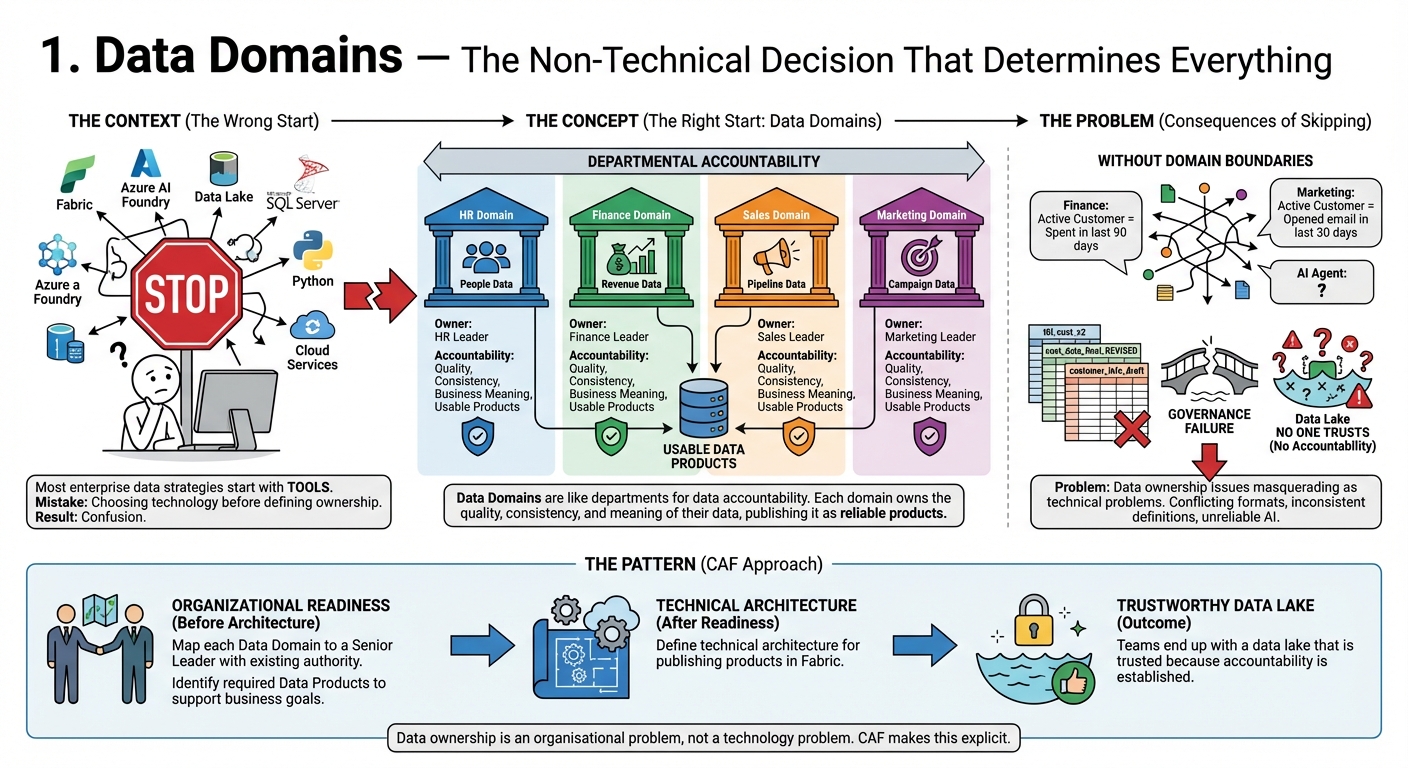
The context: Most enterprise data strategies start with tools — "we're moving to Fabric" or "we're deploying Azure AI Foundry." The CAF unified data platform architecture makes a different starting point explicit: before you choose any technology, you must define who owns what data and why. These ownership boundaries are called data domains.
The concept: Think of data domains like departments in a company, but for data accountability. HR owns the people data. Finance owns the revenue data. Sales owns the pipeline data. Each domain is responsible for the quality, consistency, and business meaning of the data it produces — and for publishing that data as usable products for the rest of the organisation. If HR doesn't agree on what "employee" means, no amount of engineering can fix the AI agents that consume it.
The problem: Without domain boundaries, data governance becomes an enforcement problem. Teams pull data in conflicting formats. Column names like tbl_cust_v2 proliferate. The finance team has one definition of "active customer," the marketing team has another, and the AI agent gives different answers depending on which table it happened to query first. This isn't a Fabric problem or a Copilot problem — it's a data ownership problem, and it can only be solved organisationally.
The pattern: The CAF is explicit: start with organizational readiness before architecture. Map each data domain to a senior leader who has existing authority over that business area. Identify what data products that domain must produce to support stated business goals. Only then define the technical architecture for how those products will be published in Fabric. Teams that skip this step end up with a data lake that no one trusts because no one is accountable for what's in it.
2. Microsoft Fabric and Fabric IQ — From Data Platform to Intelligence Platform
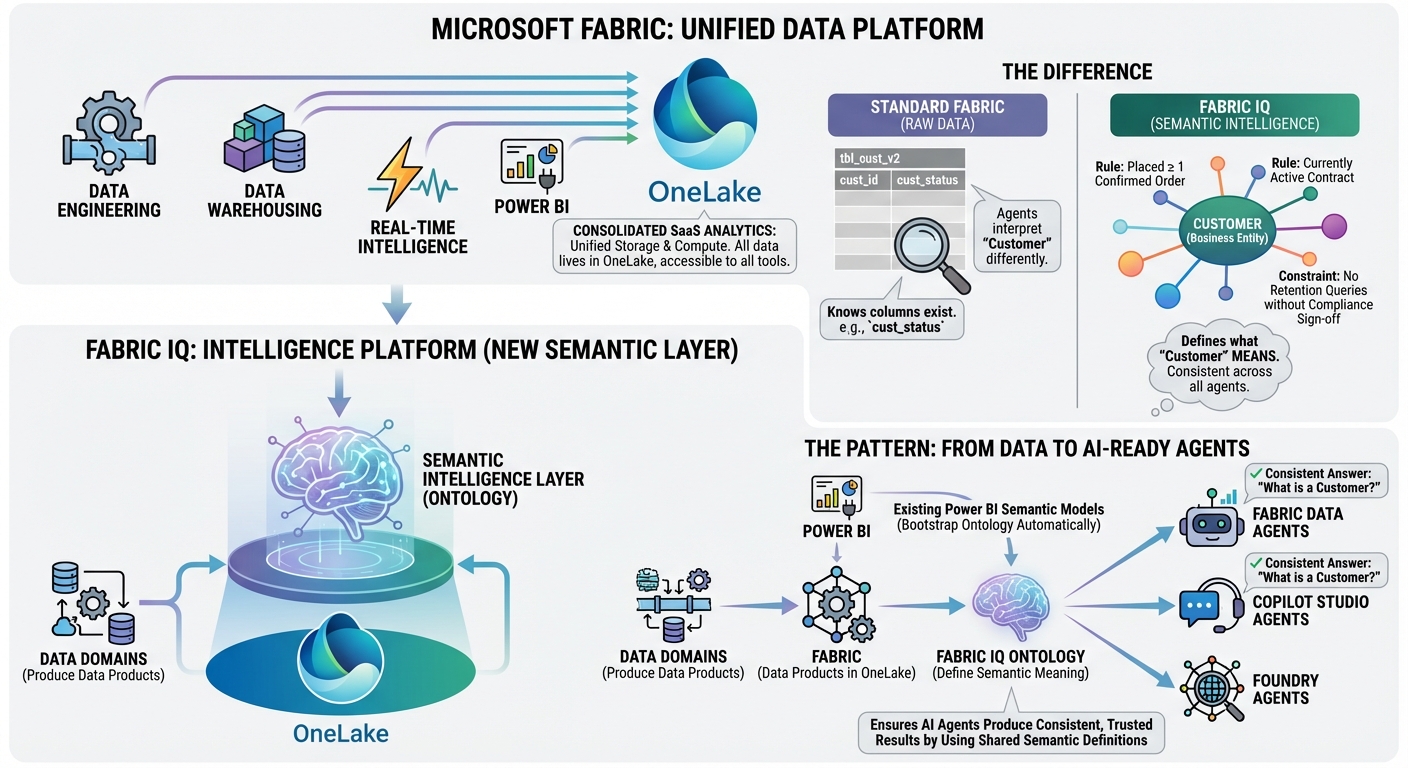
The context: Microsoft Fabric is a unified SaaS analytics platform that consolidates data engineering, data warehousing, real-time intelligence, and Power BI into a single product backed by a single data lake called OneLake. Most enterprises have heard of Fabric. Fewer have heard of Fabric IQ — a new workload announced at Microsoft Ignite 2025 that fundamentally changes what Fabric is for.
The concept: Standard Fabric gives you unified storage and compute — one place where all your data lives, accessible to all your tools. Fabric IQ adds a semantic intelligence layer on top. The difference is this: standard Fabric knows that there is a table called tbl_cust_v2 with a column called cust_status. Fabric IQ knows that "Customer" means a business entity that has placed at least one confirmed order, is currently in an active contract, and should never be surfaced in retention campaign queries without a compliance sign-off. The data is the same. The intelligence about the data is completely different.
The problem: AI agents built on raw data produce inconsistent results because different agents interpret the same columns differently. Each team rebuilds definitions in their own prompts. A "Customer" in the marketing agent prompt is not the same as a "Customer" in the finance agent prompt — and discrepancies become visible and embarrassing. Fabric IQ's Ontology defines entity types, properties, business rules, and relationships once, then wires those definitions directly to actual data in OneLake. Every agent that uses the Ontology gets the same answer to "what is a Customer?"
The pattern: Fabric IQ doesn't replace data engineering — it sits on top of it. The path is: data domains produce data products in Fabric → data teams build or import Ontologies that give those products semantic meaning → AI agents (Fabric data agents, Copilot Studio agents, Foundry agents) consume data through the Ontology layer. Existing Power BI semantic models can bootstrap an Ontology automatically, preserving investment. Organisations that have already built strong BI semantic models are closer to AI-ready data than they realise.
3. The Three IQ Layers — Why Enterprise AI Needs Three Kinds of Knowledge
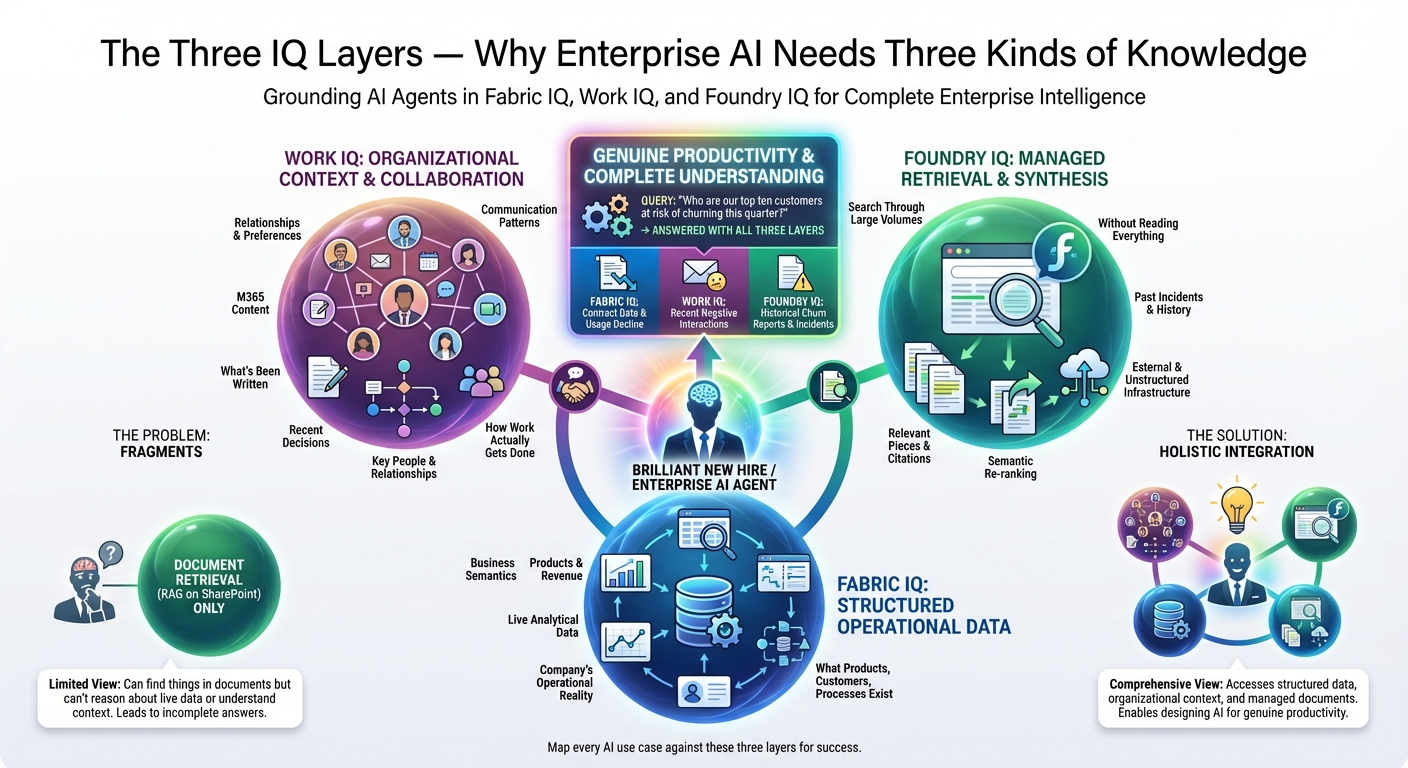
The context: The architecture introduces three distinct intelligence layers — Fabric IQ, Work IQ, and Foundry IQ — each grounding AI agents in a different type of enterprise knowledge. Understanding what each one covers, and what each one doesn't, is essential for designing AI solutions that actually answer the right questions.
The concept: Imagine an enterprise agent as a new senior hire. To be useful on day one, they need three things: knowledge of the company's operational data (what products, customers, revenue, processes exist — that's Fabric IQ), knowledge of how work actually gets done (who the key people are, what's been written, what decisions have been made recently — that's Work IQ), and the ability to search through large volumes of documents and retrieve the relevant piece without reading everything themselves — that's Foundry IQ. A brilliant new hire with access to only one of these three is frustrating. Access to all three is where genuine productivity starts.
The problem: Most AI deployments are grounded in one type of knowledge — usually document retrieval (RAG on SharePoint). This produces agents that can find things in documents but can't reason about live operational data or understand organisational context. An agent asked "who are our top ten customers at risk of churning this quarter?" needs all three: structured data on contracts and usage (Fabric IQ), knowledge of recent account interactions from emails and meetings (Work IQ), and the ability to pull relevant historical documentation from past incidents (Foundry IQ).
The pattern: Fabric IQ handles structured operational and analytical data with consistent business semantics. Work IQ handles organisational collaboration knowledge — relationships, communication patterns, preferences, and content from M365. Foundry IQ is the managed retrieval infrastructure that can query across both, plus unstructured external data, with automatic semantic re-ranking and citations. Teams designing enterprise AI solutions should map every intended agent use case against these three layers and ensure they have a grounding strategy for each type of knowledge that use case requires.
4. Microsoft Purview — Governance That Follows Data, Not Data That Follows Governance
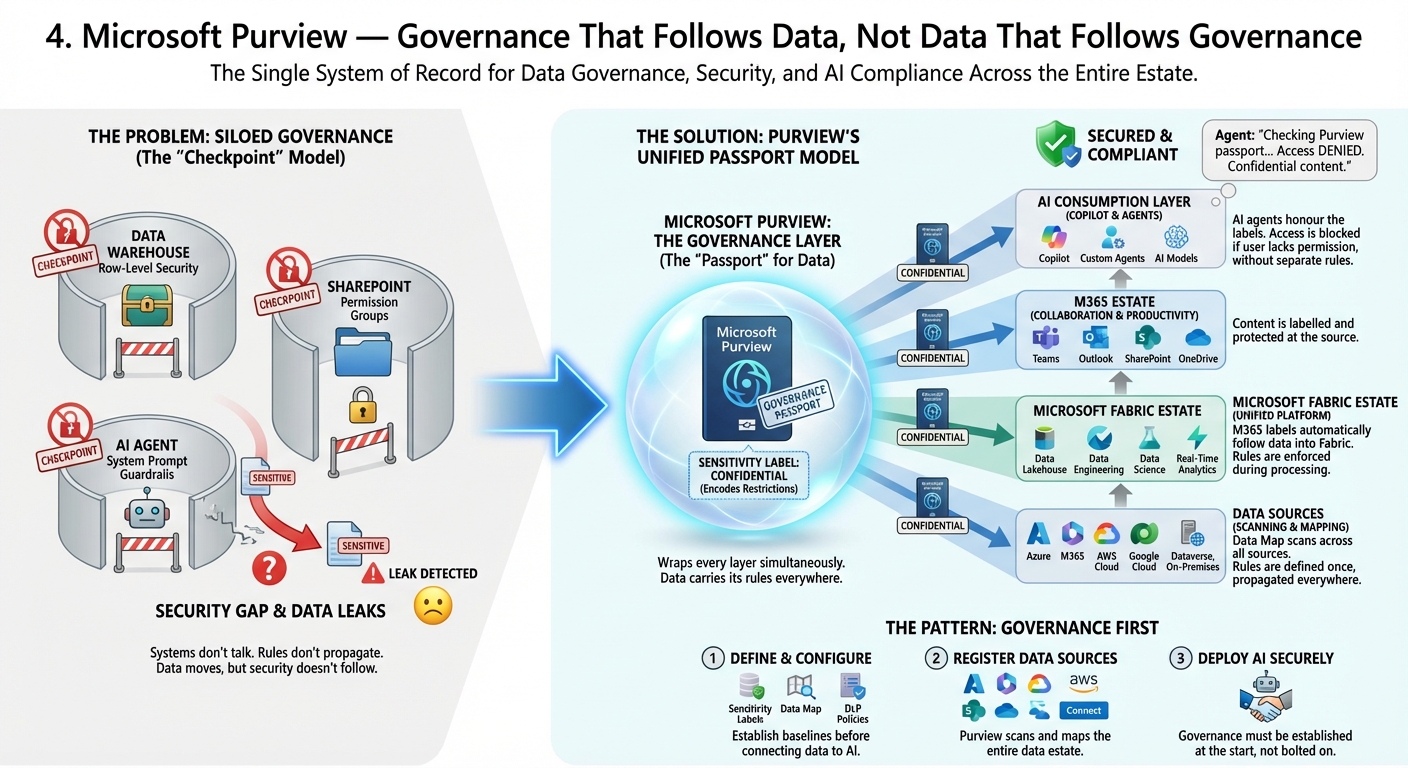
The context: Microsoft Purview is the governance and compliance layer in this architecture — but "governance" undersells what it actually does here. Purview wraps every layer of the unified data platform simultaneously: the data sources at the bottom, the Fabric estate in the middle, the M365 estate, and the AI consumption layer at the top. It is the single system of record for who can see what, what is sensitive, and what the AI is allowed to do with it.
The concept: Most governance programmes work like a checkpoint at the border: data enters a system and gets labelled. Purview works differently — like a passport that data carries with it everywhere. A file labelled "Confidential" in SharePoint keeps that label when its content is moved into Fabric. When a Fabric data agent queries that data, the label is checked. If the user asking the question doesn't have permission to see Confidential content, the agent doesn't return it — not because of a separate security rule, but because the label itself encodes the restriction and every layer of the Microsoft stack honours it.
The problem: Without a unified governance layer, each tool enforces access in isolation. The data warehouse has row-level security. SharePoint has permission groups. The AI agent has its own system prompt guardrails. These systems don't talk to each other, which means a sensitive file correctly restricted in SharePoint might be accessible to an agent through a storage connector that no one remembered to lock down. Purview's Data Map scans across Azure, M365, AWS, Google Cloud, Dataverse, and on-premises systems simultaneously and propagates governance rules across all of them.
The pattern: For teams deploying AI: configure Purview governance baselines before connecting data to any agent. Define sensitivity labels, set up the Data Map, register data sources, and configure DLP policies for Copilot and agents. Sensitivity labels defined in M365 automatically follow data into Fabric when moved correctly. The CAF recommendation is explicit — governance must be established at the start of the programme, not bolted on after. Every organisation that discovered a data leak through their AI agent could trace it to a governance gap that existed before the agent was built.
5. Microsoft Agent 365 — Governing AI Agents the Way You Govern Employees
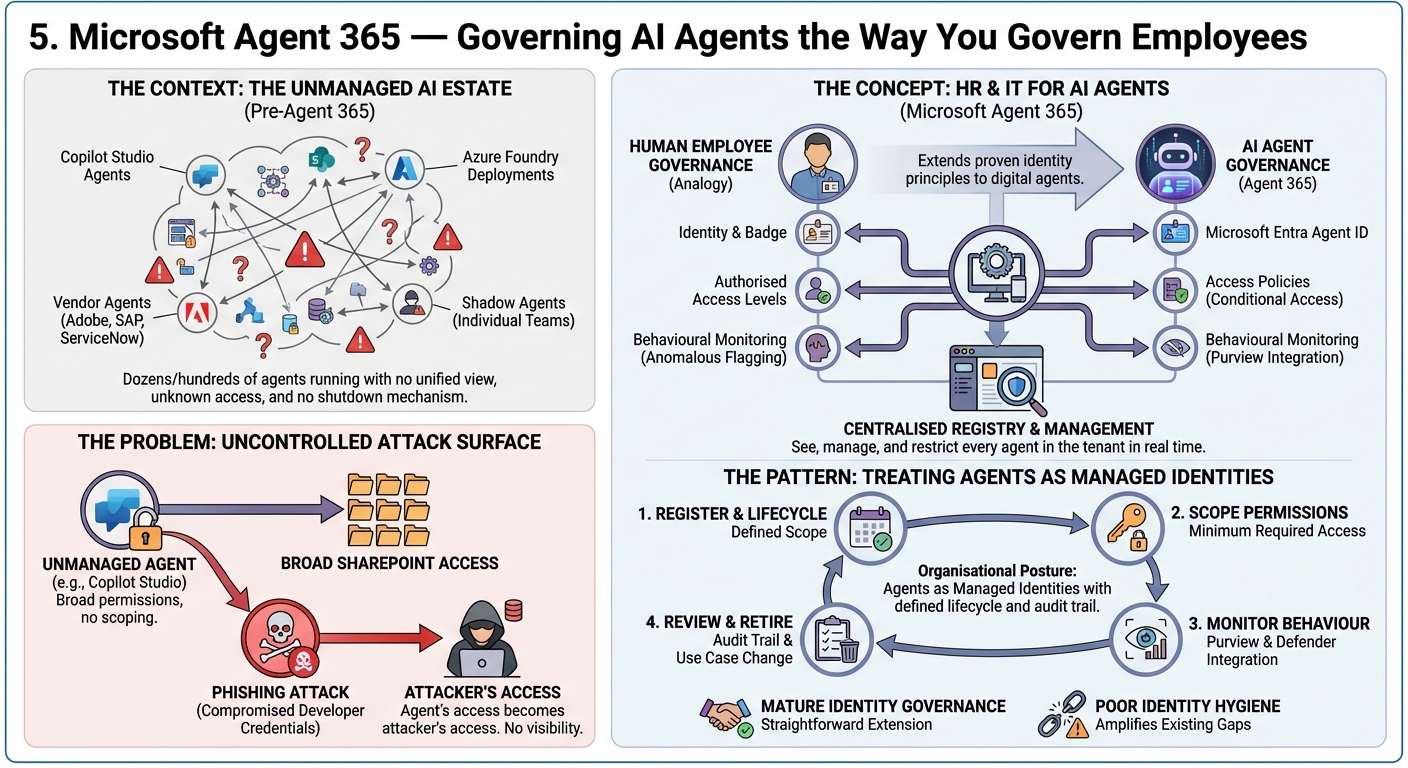
The context: As enterprise AI deployments mature, organisations are running dozens or hundreds of agents — built in Copilot Studio, deployed through Azure Foundry, sourced from vendors like Adobe, SAP, and ServiceNow, and sometimes spun up by individual teams with no central visibility. Until late 2025, there was no unified way to know what agents were running, what they could access, or how to shut one down. Microsoft Agent 365, announced at Microsoft Ignite 2025, is designed to change this.
The concept: Think of Agent 365 as the HR and IT systems combined — but for AI agents. Every new employee gets an identity, a badge, a set of authorised access levels, and monitoring systems that flag anomalous behaviour. Agent 365 does the same for AI agents: every agent gets a Microsoft Entra Agent ID, access policies enforced by conditional access, behavioural monitoring through Purview, and a centralised registry where security teams can see and manage every agent in the tenant. An agent that starts accessing data it shouldn't can be automatically restricted in real time — the same way a compromised user account can be blocked.
The problem: Without central agent governance, the enterprise AI estate becomes an uncontrolled attack surface. A team deploys a helpful Copilot Studio agent with broad SharePoint access because no one thought carefully about scoping permissions. Six months later, a phishing attack compromises the credentials of a developer with admin rights to that agent. The agent's access becomes the attacker's access. Agent 365's registry — including "shadow agent" detection for unregistered agents already running in your tenant — makes this attack surface visible for the first time.
The pattern: The organisational posture Agent 365 enables is: treat every AI agent as a managed identity with a defined scope, lifecycle, and audit trail. Agents are registered before deployment, permissions are scoped to the minimum required, agent behaviour is monitored against Purview and Defender integration, and agents are reviewed and retired when the use case they were built for changes. Organisations already running mature identity governance programmes for human users will find the extension to agents straightforward. Organisations that haven't established identity hygiene will find agent governance amplifies exactly the same gaps.
The question that matters
The CAF unified data platform architecture is not primarily a technology roadmap — it is an organisational accountability framework with technology built on top. Every AI outcome that appears on the diagram is downstream of a governance decision: who owns what data, what does it mean, who can see it, what agents are running, and who is accountable when something goes wrong. The technology — Fabric, Purview, Agent 365, the IQ layers — is sophisticated and genuinely powerful. But it only works as well as the organisational decisions that preceded it. The question for enterprise leaders evaluating this architecture: which of those decisions has your organisation already made, and which ones are still being deferred?
Sources: Microsoft Cloud Adoption Framework, Fabric IQ Overview, Foundry IQ Overview, Microsoft Agent 365, Microsoft Ignite 2025
No comments yet — be the first to add to the discussion. Comments appear after they’re reviewed.
Want more insights?
Subscribe to get the latest articles delivered straight to your inbox.