Eight Stories That Will Rewire Your Mind
Dispenza's most powerful ideas — not as theory, but as stories you'll actually remember. From emotional addiction to the quantum field, told the way the brain learns best.
Dr. Joe Dispenza is a neuroscientist, researcher, author, and international lecturer who has spent over two decades studying the science of change — how the brain, mind, and body can be rewired to create a new reality. He is best known for his books Breaking the Habit of Being Yourself (2012), You Are the Placebo (2014), and Becoming Supernatural (2017), which blend quantum physics, neuroscience, and epigenetics to explain why most people keep recreating the same life — and how to break free from it. His work is particularly focused on neuroplasticity, elevated emotions, and the power of meditation to reshape personality and biology.
These are not summaries. They are stories — one for each of Dr. Joe Dispenza's core ideas. Read them slowly. The brain learns through narrative, not bullet points.
1. Your Personality Creates Your Personal Reality
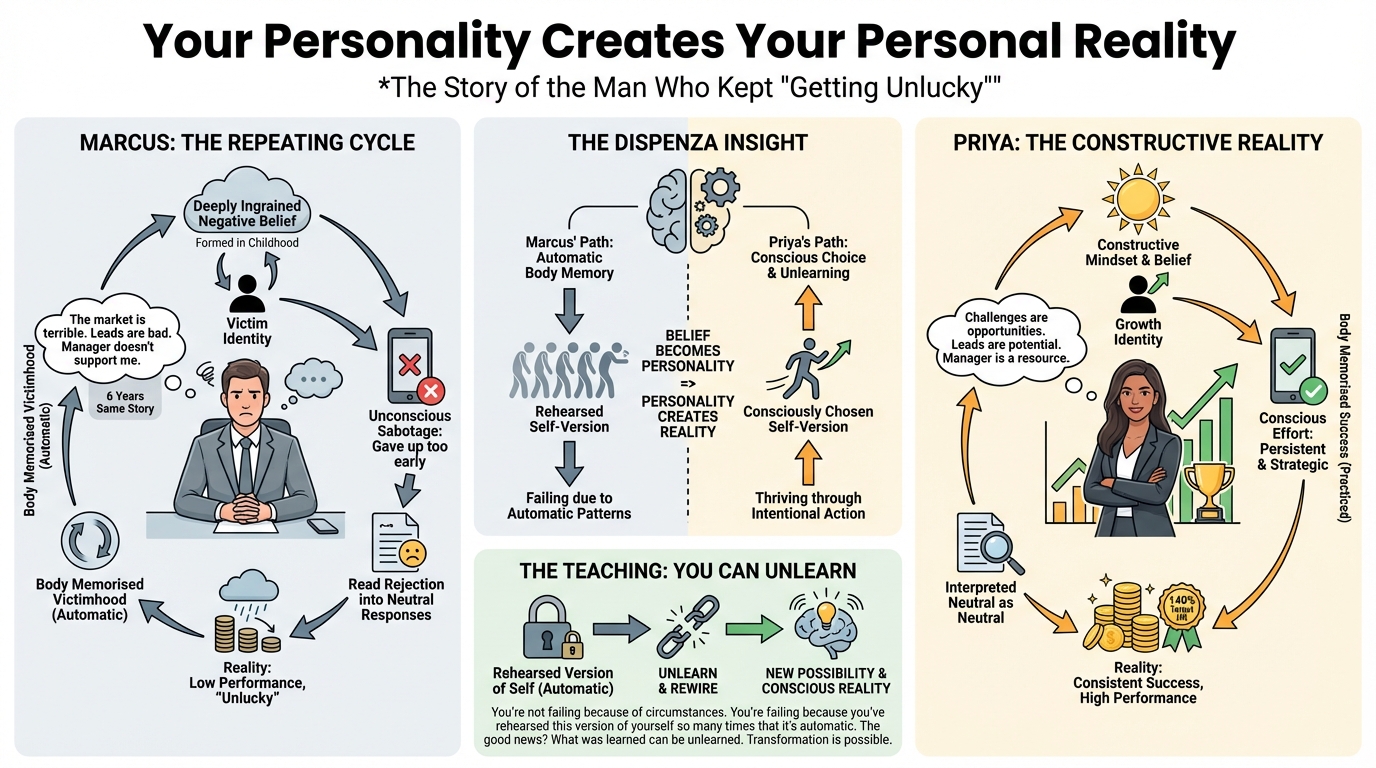
The Story of the Man Who Kept "Getting Unlucky"
Marcus was a brilliant sales director. Every year he'd say the same thing: "The market is terrible this year. My leads are bad. My manager doesn't support me." He'd been saying it for six years. Different companies. Same story.
His colleague Priya, in the same market, same leads, same manager, consistently hit 140% of target.
Dispenza would say this isn't about talent or luck. Marcus had a deeply ingrained belief — formed in childhood, probably — that he was someone things happened to. That belief became his personality. And his personality kept creating the same personal reality. He'd unconsciously sabotage calls. Give up one call too early. Read rejection into neutral responses. Not because he was weak. Because his body had memorised being a victim.
The teaching: You're not failing because of circumstances. You're failing because you've rehearsed this version of yourself so many times that it's automatic. The good news? What was learned can be unlearned.
2. The Thinking-Feeling Loop — Emotional Addiction
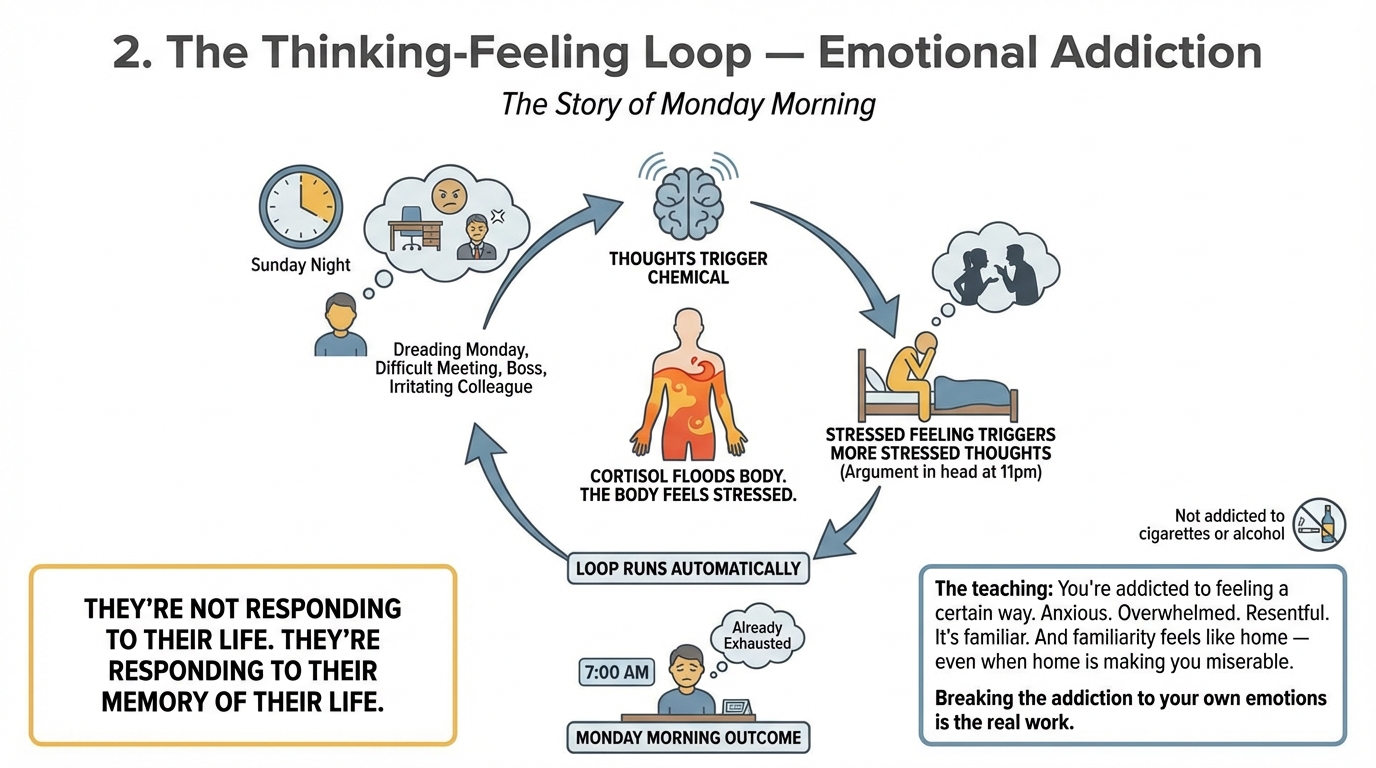
The Story of Monday Morning
Close your eyes and think about this person. It's Sunday night. They're already dreading Monday. They lie in bed thinking about the difficult meeting, the unreasonable boss, the colleague who irritates them.
Those thoughts trigger a chemical — cortisol floods the body. The body feels stressed. That stressed feeling triggers more stressed thoughts. By 11pm they've had an entire argument in their head with someone who isn't in the room. By morning they wake up already exhausted — before the day has begun.
Here's the twist Dispenza reveals: they're not actually responding to their life. They're responding to their memory of their life. The body has no idea it's Sunday night. It's just receiving chemical signals that match the thought. And over years, this loop runs automatically. They don't even choose it anymore. It just fires.
The teaching: You're not addicted to cigarettes or alcohol. You're addicted to feeling a certain way. Anxious. Overwhelmed. Resentful. It's familiar. And familiarity feels like home — even when home is making you miserable. Breaking the addiction to your own emotions is the real work.
3. Neuroplasticity — The Brain That Rewrites Itself
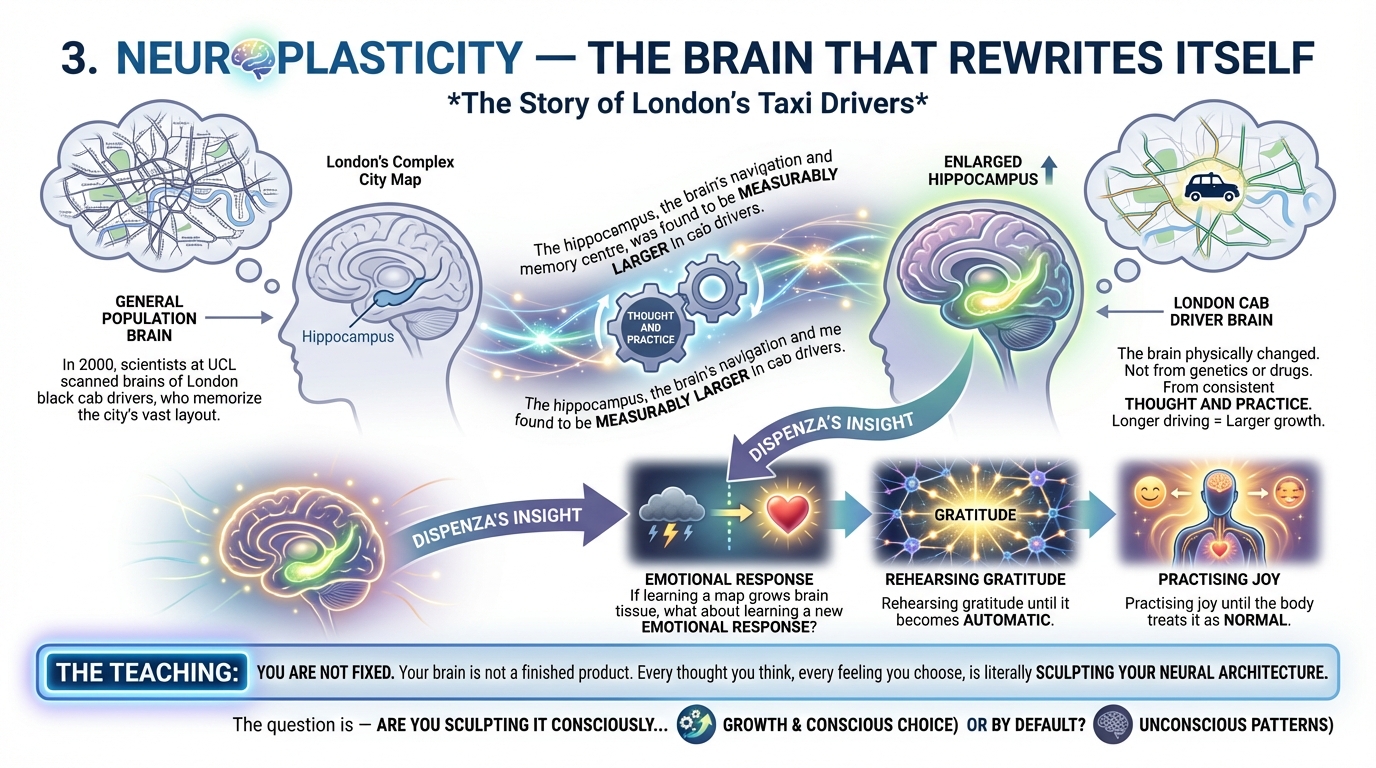
The Story of London's Taxi Drivers
In 2000, scientists at UCL did something extraordinary. They scanned the brains of London black cab drivers — people who had to memorise every street, shortcut, and landmark in one of the world's most complex cities.
What they found: the hippocampus — the brain's navigation and memory centre — was measurably larger in cab drivers than in the general population. And the longer they'd been driving, the larger it was.
The brain had physically changed. Not from genetics. Not from drugs. From thought and practice.
Dispenza takes this further. If learning a map can grow new brain tissue, what about learning a new emotional response? What about rehearsing gratitude until it becomes automatic? What about practising joy until the body treats it as normal?
The teaching: You are not fixed. Your brain is not a finished product. Every thought you think, every feeling you choose, is literally sculpting your neural architecture. The question is — are you sculpting it consciously or by default?
4. The Three Brains — Thinking, Doing, Being
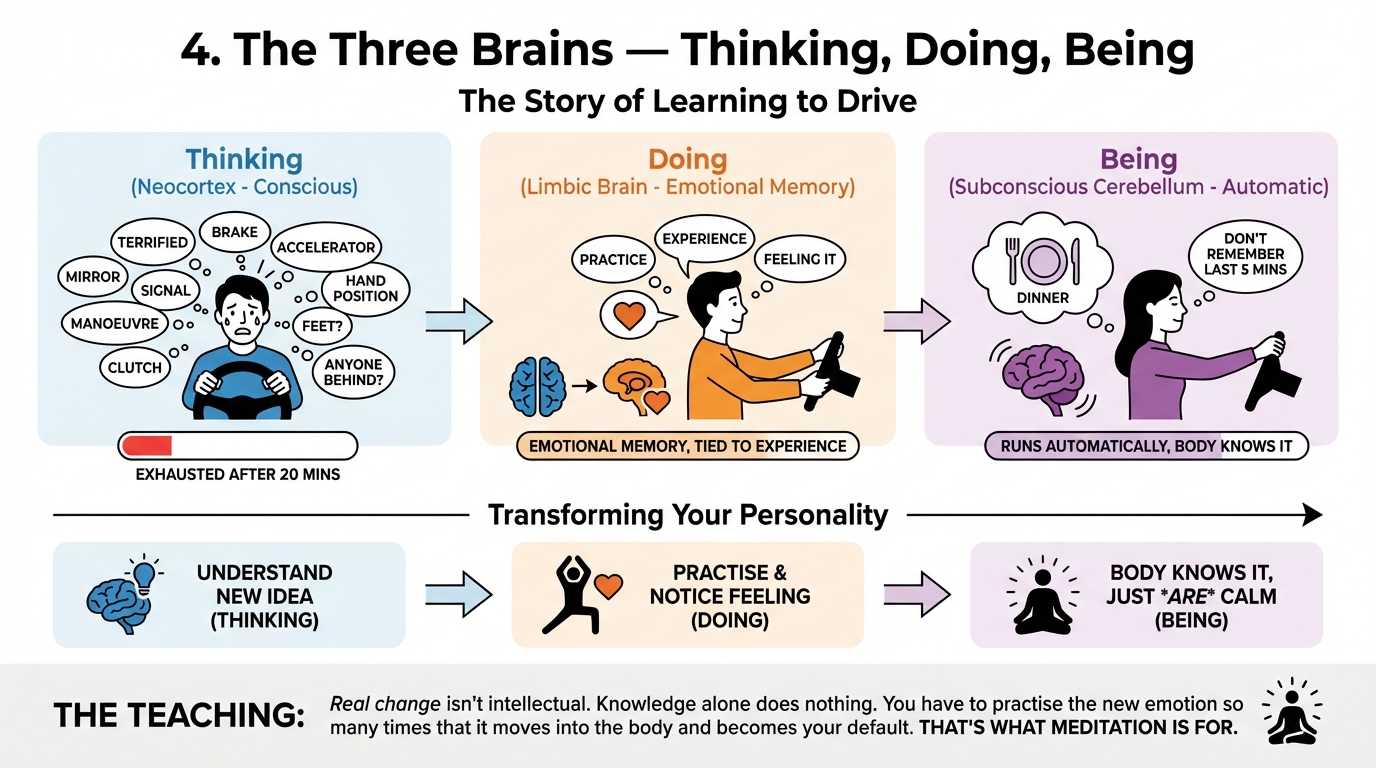
The Story of Learning to Drive
Remember the first time you sat behind a steering wheel?
You were terrified. Mirror. Signal. Manoeuvre. Clutch, brake, accelerator. Hand position. Where are my feet? Is anyone behind me? Every single action required conscious thought. You were exhausted after 20 minutes.
Now? You drive while thinking about dinner. You don't remember the last five minutes of motorway. Your hands know what to do before your conscious mind processes the situation.
What happened? The knowledge moved from your neocortex (conscious thinking brain) into your limbic brain (where it became emotional memory, tied to experience) into your cerebellum (the subconscious, where it now runs automatically).
Dispenza says this is the exact same process for transforming your personality. First you understand the new idea (thinking). Then you practise it and notice how it feels (doing). Eventually your body knows it without your mind needing to remind it (being). You stop trying to be calm. You just are calm.
The teaching: Real change isn't intellectual. Knowledge alone does nothing. You have to practise the new emotion so many times that it moves into the body and becomes your default. That's what meditation is for.
5. Mental Rehearsal — The Athletes Who Didn't Move a Muscle
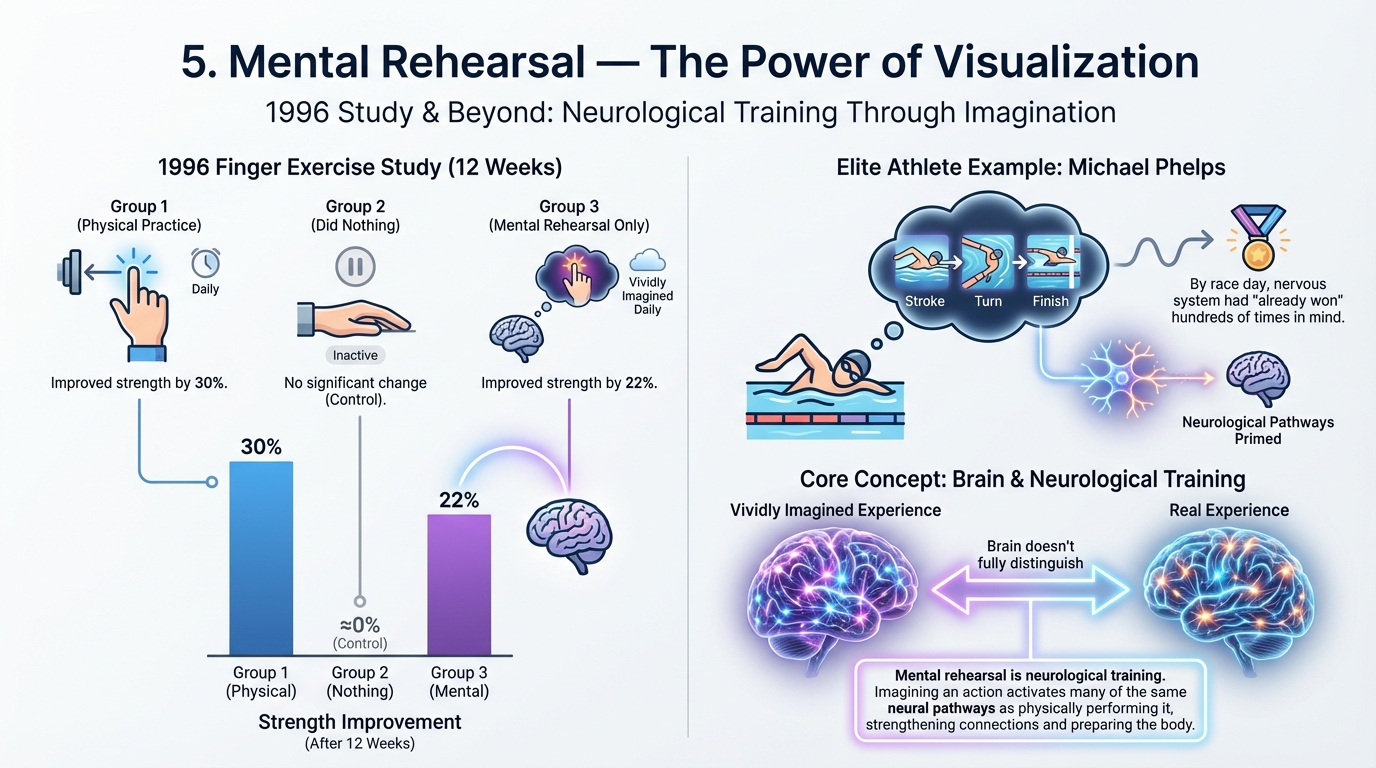
The Story of the Basketball Study
In 1996, researchers at Cleveland Clinic divided people into three groups and had them do a finger exercise for 12 weeks.
Group 1 physically practised the exercise. Group 2 did nothing. Group 3 only imagined doing the exercise — vividly, in their minds, every day.
After 12 weeks: Group 1 improved strength by 30%. Group 2: no change. Group 3 — who never moved a finger — improved by 22%.
The brain doesn't fully distinguish between a vividly imagined experience and a real one. When you imagine something with enough clarity and emotion, the same neural circuits fire as if it actually happened.
Olympic athletes have known this for decades. Before a race, Michael Phelps would "watch the video" in his mind — every stroke, every turn, the exact feeling of the water — so many times that by the time he stood on the starting block, his nervous system had already won the race hundreds of times.
The teaching: Mental rehearsal isn't wishful thinking. It's neurological training. When you sit in meditation and vividly experience yourself being calm, confident, and joyful — you are literally wiring those states into your nervous system. The body begins to believe it.
6. Survival vs. Creation Mode
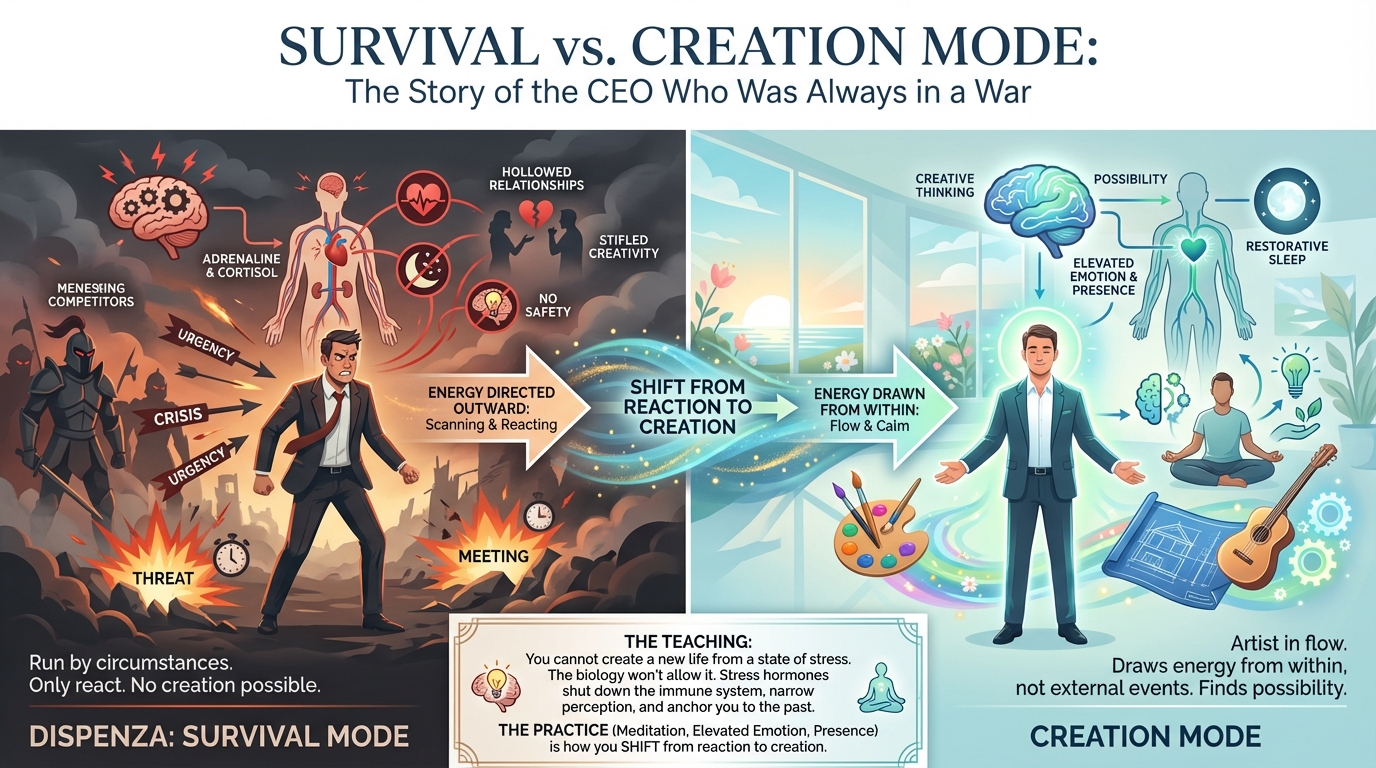
The Story of the CEO Who Was Always in a War
There was a CEO — let's call him David — who was genuinely brilliant. But he ran his company like a battlefield. Every competitor was an enemy. Every quarter was a crisis. Every meeting had an urgency. He was always on, always vigilant, always preparing for the next threat.
His body was flooded with adrenaline and cortisol — the stress hormones. Great for short bursts. Devastating over years. His sleep deteriorated. His relationships hollowed out. His creative thinking, paradoxically, got worse — because creativity requires safety, and his nervous system never felt safe.
Dispenza calls this survival mode. In survival mode, all your energy is directed outward — scanning for threats, reacting to the environment. You are run by your circumstances. You can't create from this place. You can only react.
Creation mode is the opposite. It's the state of the artist in flow. The leader who walks into a chaotic room and somehow calms it. The person who faces the same difficult circumstances as everyone else and still finds possibility. They've learned to draw their energy from within, not from external events.
The teaching: You cannot create a new life from a state of stress. The biology won't allow it. Stress hormones shut down the immune system, narrow your perception, and keep you anchored to the past. The practice — meditation, elevated emotion, presence — is how you shift from reaction to creation.
7. Elevated Emotions and Heart Coherence
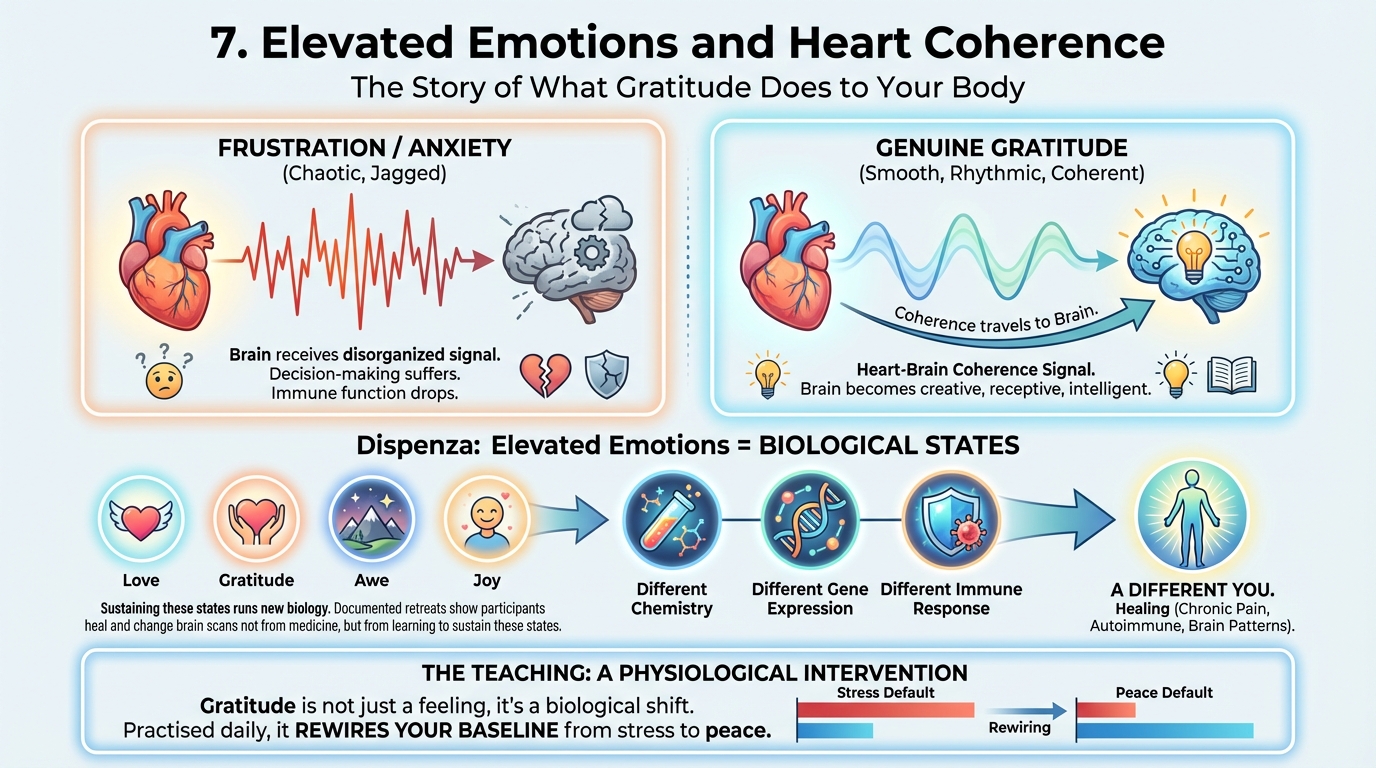
The Story of What Gratitude Does to Your Body
HeartMath Institute has spent 30 years measuring what happens to the heart when people feel different emotions.
When someone feels frustration or anxiety, the heart rate variability pattern looks chaotic — jagged, incoherent. The signal the heart sends to the brain is disorganised. Decision-making suffers. Immune function drops.
When the same person shifts to genuine gratitude — not performed gratitude, but the real felt sense of thankfulness — the HRV pattern becomes smooth, rhythmic, coherent. This coherence signal travels from the heart to the brain and literally puts the brain into a more creative, receptive, intelligent state.
Dispenza builds on this: elevated emotions — love, gratitude, awe, joy — are not just feelings. They are biological states. When you sustain them, you are running a different chemistry. Different gene expression. Different immune response. A different you.
His retreats document this — participants who heal chronic pain, reverse autoimmune conditions, change brain scan patterns — not from medicine, but from learning to sustain elevated emotional states.
The teaching: Gratitude is not a nice thing to feel occasionally. It is a physiological intervention. Practised daily, it rewires your baseline. Instead of stress being your default, peace becomes your default.
8. The Meditation — What You're Actually Doing in Those 30 Minutes
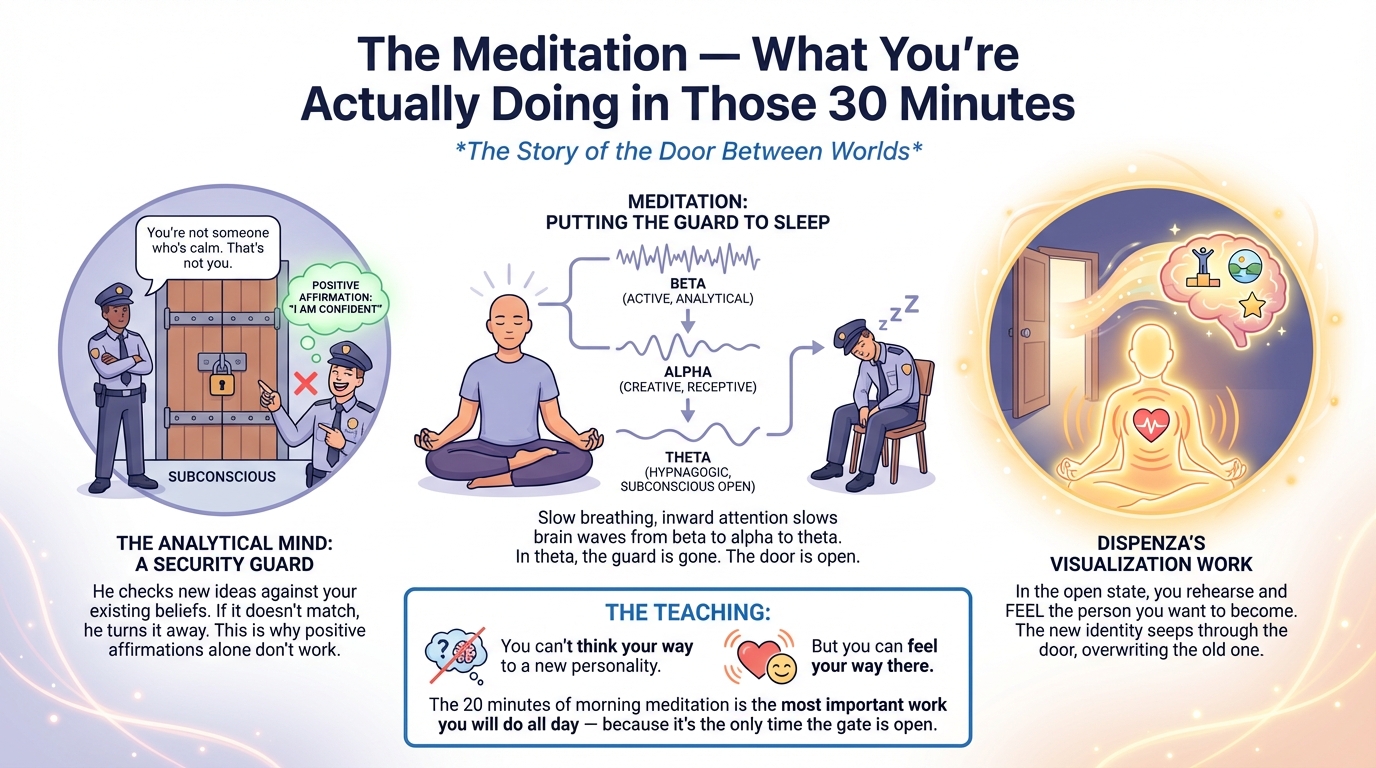
The Story of the Door Between Worlds
Imagine your analytical mind is like a security guard standing at the door of your subconscious. Every new idea has to get past him. He checks it against everything you already believe. If it doesn't match your existing identity, he turns it away. "You're not someone who's calm." "You've never been confident." "That's not you."
This is why positive affirmations alone don't work. You say "I am confident" and the security guard laughs.
Meditation, when done properly, puts the security guard to sleep.
As you slow your breathing, close your eyes, and bring your attention inward, your brain waves slow from beta (active, analytical) to alpha (creative, receptive) to theta (the hypnagogic state — the edge of sleep where the subconscious is fully open). In theta, the guard is gone. The door is open.
This is when Dispenza's visualisation work happens. In that open state, you rehearse being the person you want to become. You feel it. You experience it. You let the body respond as if it's real. And gradually — day by day — the new identity seeps through the door and begins to overwrite the old one.
The teaching: You can't think your way to a new personality. But you can feel your way there. The 20 minutes of morning meditation is the most important work you will do all day — because it's the only time the gate is open.
No comments yet — be the first to add to the discussion. Comments appear after they’re reviewed.
Want more insights?
Subscribe to get the latest articles delivered straight to your inbox.