You don't own the intelligence you rent
In three months the ground shifted: the labs build the models, the hyperscalers rent you the whole stack. What that means for UK sovereignty, resilience and control.
These are five short stories from the last ninety days — about what really happens when a country wires its work to someone else's machine.
In April, HM Revenue and Customs handed Microsoft Copilot to twenty-eight thousand staff. Not for playing around. For real work, at the "Official Sensitive" level, with a plan to reach fifty thousand. Around the same time, NHS England began rolling Copilot out to more than five hundred thousand people, aiming to finish by October.
This is the biggest bet on borrowed intelligence the UK public sector has ever made. And almost nobody stopped to ask the quiet question underneath it.
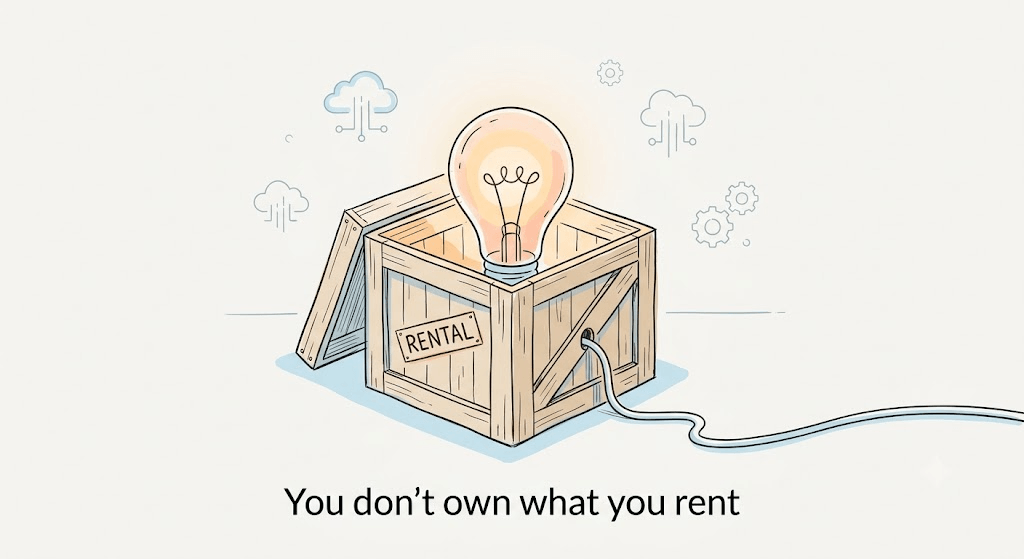
When you "adopt AI" like this, what are you actually adopting? Not a model you own. Not a machine you control. You're renting a stack — the model, the compute, the plumbing — from a handful of American companies. The last three months made that clearer than ever. Here's what changed, and why it matters if you care about the UK keeping hold of its own future.
The month Britain went all in
Picture a caseworker in a Whitehall office. In March she wrote her own letters. By May, Copilot drafted them for her.
Multiply her by half a million and you have the NHS. Add HMRC, add the departments lining up behind them, and you have a country quietly rebuilding how it works around a single supplier's assistant.
Nobody chose this in one big decision. It happened one licence at a time. A team saves a few minutes here. A manager cuts a backlog there. The productivity is real — I'll come back to how real. And once it's baked into the day, it stops feeling like a tool you switched on. It starts feeling like electricity. Something that was simply always there.
That's the moment worth noticing. Not the launch. The moment the thing becomes invisible. Because you can only weigh a dependency clearly before you're inside it.
The teaching: "Adopting AI isn't buying a tool. It's renting a stack — and the rent is quietest right before it's due."
The people who make the models, and the people who rent them out
In June, two companies filed to go public within a week of each other. Neither has ever made a profit.
OpenAI filed confidentially for a stock market listing, eyeing a valuation near a trillion dollars. Anthropic filed roughly a week earlier, fresh off a raise that valued it around $965 billion. Leaked accounts showed OpenAI making about $13 billion in a year — and losing around $21 billion doing it. The growth is astonishing. The economics are held up by investors, not customers.
Watch what these firms are becoming. They build the models. They are less and less the ones who hand them to you. That job is going to Microsoft, Amazon and Google — the clouds that now sit between the model-makers and everyone else.
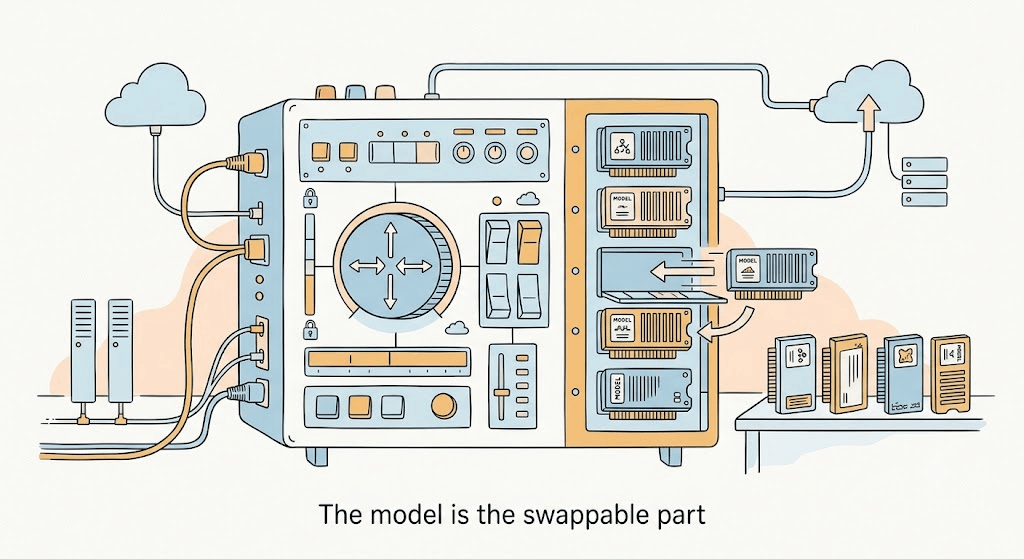
Microsoft is the clearest example. It used to be "the OpenAI company." Now it sells almost everyone's models. Anthropic's Claude went generally available inside Microsoft's Foundry in late June, sitting on the same shelf as OpenAI, xAI's Grok, Meta's Llama and more. Microsoft also launched its own in-house models, and quietly slid one of them into GitHub Copilot. Copilot itself now routes your question across different models — it even has a "Model Council" that asks two of them and compares the answers.
Read that again. The model answering you might not be the one you picked. A router picks it. Which sounds convenient, and is — until you realise the thing you depend on can change underneath you without you ever being told.
The teaching: "The model is now the least sticky part of the deal. The provider's control panel is the real lock — and the model you rely on is often chosen by a router, not by you."
Where your data actually sleeps at night
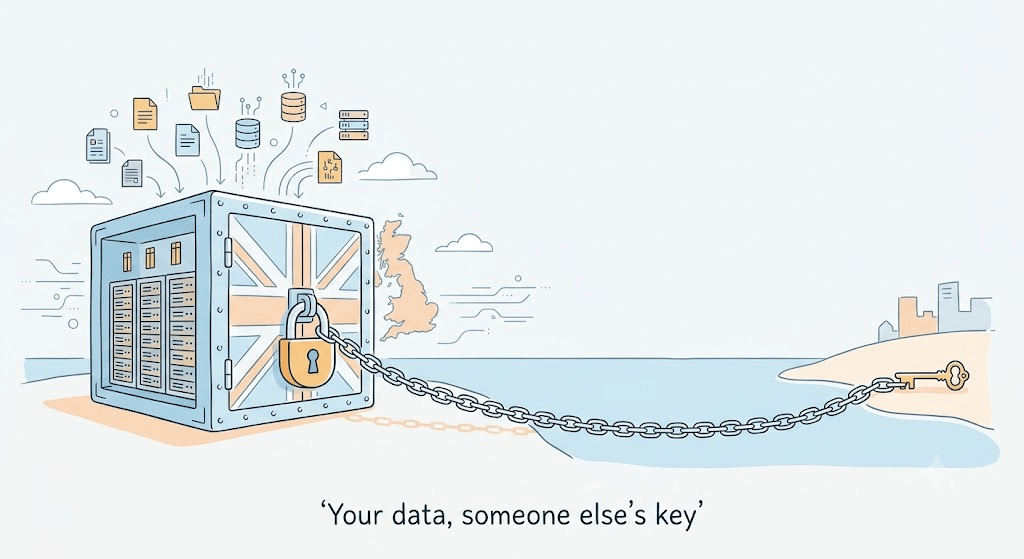
A UK council uploads a sensitive document to a cloud that keeps its data "in the UK." A US court, with a warrant, could still compel the American provider to hand it over — because who controls the data matters more than where it sits.
So let's be precise, because this point gets overstated. It doesn't happen every day. It needs a criminal warrant, not open access, and against UK data it is rare. But the door is real, and it's a door of company law, not geography. A US law — the CLOUD Act — lets US authorities compel an American company to produce data it controls, wherever in the world that data is stored. A UK data centre doesn't close that door.
Microsoft won't pretend otherwise. Asked by the French Senate in 2025 whether it could guarantee French data would never reach US authorities, its own lawyer answered: "No, I cannot guarantee it." It told Scottish police the same about UK policing data. And most UK public bodies now run on these American clouds — around 95% of them, rising to 99% once you count the software built on top.
And the UK sits in an awkward gap. It's not inside the EU's "Data Boundary," the arrangement that keeps European data in Europe. There is no special "UK government" version of Azure the way there is in the United States. So a British organisation gets a contract that says "UK region," but not the deeper protection people assume comes with it. For the most secret work, the rule still holds: it stays off commercial public cloud entirely.
Then there's the physical layer — the buildings and the power. Most of Britain's data centres cluster along the M4 west of London, from Slough out toward Reading, Swindon and Bristol. The government is spending real money to build sovereign muscle: a £500 million Sovereign AI Unit, the Isambard-AI supercomputer in Bristol, a £1.1 billion hardware plan announced in June. Good moves. But demand is outrunning them. Around 140 data-centre projects are queued to plug into the grid, asking for roughly 50 gigawatts of power — more than the whole country's peak demand. Some are told they may wait until the 2030s. One flagship US project, "Stargate UK," was reportedly paused, with much of its headline funding described as hypothetical.
So you can pour concrete and buy chips in Britain. That still doesn't make the intelligence British — not while the models, the tools and the law all belong to someone else.
The teaching: "Sovereign compute is not sovereign control. Owning the building means nothing if the model, the software, and the courts sit in another country."
The Tuesday the Copilot didn't show up
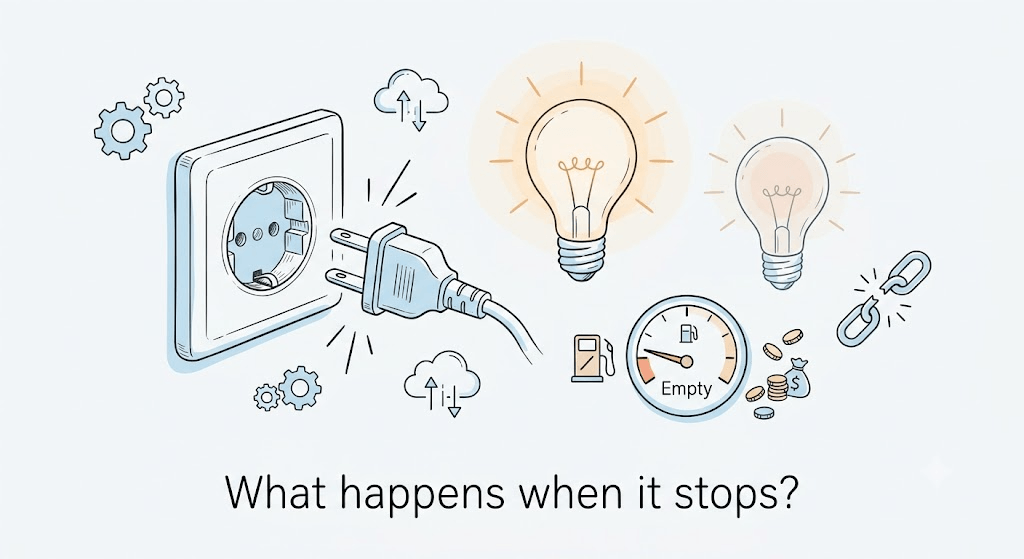
On the first of June, Microsoft Copilot went dark for about five hours. Across offices, people opened the tool out of habit — and stared at a blank box.
Here is the trap, and it's the part that keeps me up. The productivity is genuine. In a controlled study, developers using GitHub Copilot finished a task about 56% faster. In a call centre, agents handled 14% more. So companies do the sensible thing: they bank the gain. They redesign the work. They hire fewer people. The efficiency stops being a bonus and becomes the baseline.
And then the supply gets tight. Uber burned through its entire 2026 AI budget in four months and had to cap each tool at $1,500 a month. Tesla now limits staff to $200 of outside AI a week. Google told Meta, one of the largest companies on earth, that it simply couldn't spare the capacity it wanted. When compute is scarce, access gets rationed — and you don't set the ration.
The deeper cost is human. When the tool vanishes — an outage, a price cap, a rate limit — can your people still do the work the old way? The evidence says: less and less. An MIT study measured weaker brain engagement in people who leaned on AI to write, and called it "cognitive debt." An Anthropic experiment found learners who leaned on AI scored 50% on understanding, against 67% for those who worked it out by hand. The muscle wastes when you stop using it. And it wastes fastest in the juniors who never built it in the first place.
The teaching: "The deeper you bake it in, the more it costs to live without it. Efficiency you can't switch off isn't efficiency. It's exposure."
The question that matters more than which model
Two organisations adopt the same AI. One asks "how fast can we roll it out?" The other asks "could we turn it off on a bad day and keep running?" Only one of them is actually in control.
The trap of the next six months isn't picking the wrong model. Models are getting cheaper and more alike by the month. The trap is renting a whole stack and only later finding that the cost of leaving lives in your data plumbing, not your model choice. A UK survey caught this perfectly: two-thirds of businesses say they want off US cloud — and only 15% have actually moved. The gap between wanting to leave and being able to is the lock.
So what does control actually look like? Three moves, none of them exotic.
First, keep the model swappable but own the things around it — your data, your search index, the way you measure quality. Put a gateway in front of the models so switching is a setting, not a rebuild. Keep a smaller open model warm somewhere you control, especially for regulated or sensitive work.
Second, govern the spend before it governs you. The discipline even has a name now — "AI FinOps" — and it has gone from a niche worry to something 98% of teams say they track. Set budgets. Tier access. Learn your true costs before a supplier's rate limit teaches you the hard way.
Third, practise losing it. Run an "AI-off" drill the way you'd run a fire drill. Keep critical skills exercised, especially in your newest people. Write down how the work gets done in degraded mode. And treat the UK's own sovereign compute — the Sovereign AI Unit, Isambard-AI — as a hedge you keep ready, not a bet you wait on.
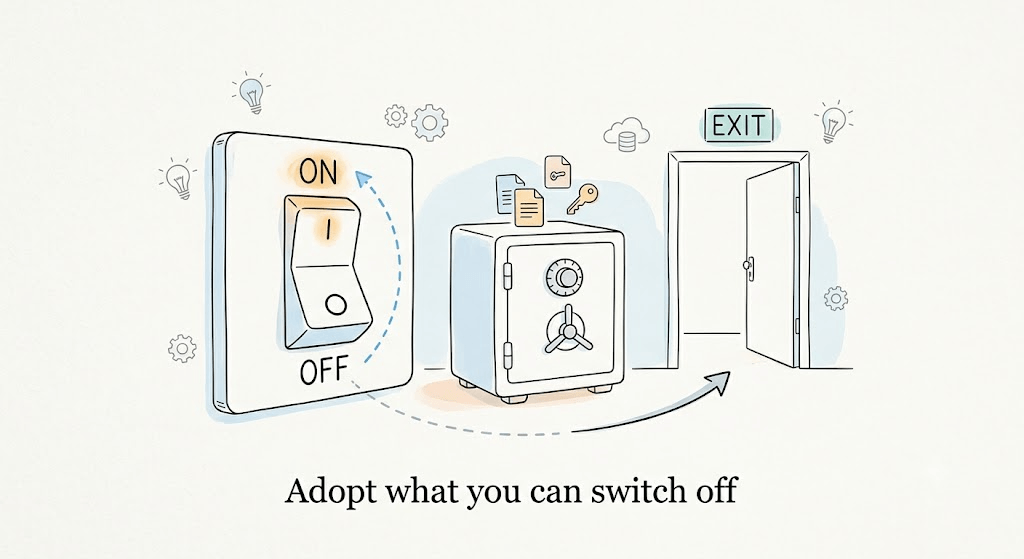
None of this means slowing down. It means adopting in a way you could reverse. The winning posture was never maximum adoption. It's adoption you can throttle, switch, or unplug without the business stopping.
The teaching: "Don't ask how fast you can adopt AI. Ask whether you could turn it off. Own your data and your exits — rent everything else, and never let the cheapest model become the most expensive contract to leave."
No comments yet — be the first to add to the discussion. Comments appear after they’re reviewed.
Want more insights?
Subscribe to get the latest articles delivered straight to your inbox.