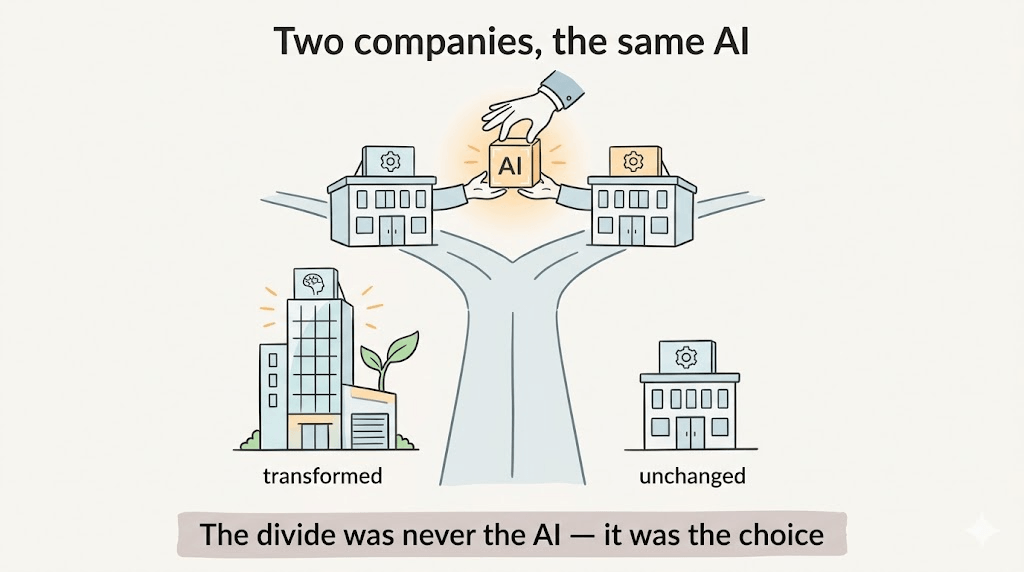
Two companies bought the same AI. A year later, only one had changed.
These are stories about a quiet split happening inside companies right now — between the ones who treat AI as a tool, and the ones who treat it as a new way to work.
These are stories about a quiet split happening inside companies right now — between the ones who treat AI as a tool, and the ones who treat it as a new way to work.
Picture two companies. Same industry, same size, same week. Both buy the same AI. Both are genuinely excited.
A year later, one of them looks completely different. Its people work in ways that would have been impossible before. Its processes that used to take weeks now take minutes. It has shipped products its competitors can't copy. The other company? It has a chatbot on its website and a summariser in its inbox. Useful. Tidy. But the company underneath is exactly the same as it was.
Same model. Same money. Opposite outcomes. Anthropic, in its guide for enterprise leaders, calls this the thinking divide — and the thing that decides which side you land on isn't the AI at all. It's how big you let yourself think. Here are the stories of the companies that crossed it.
The analyst who stopped pulling data
It's a Tuesday at L'Oréal. A market analyst opens her laptop. For years, this is the part of the day she dreaded — pulling the same numbers from four different systems, stitching them into a spreadsheet, formatting it, and only then, finally, getting to the actual thinking.
Today she just asks. In seconds, the answer comes back — not a generic answer, but one shaped by L'Oréal's own categories, its own reporting standards, the way this company measures things. She skips straight to the part only she can do: working out what the numbers mean.
L'Oréal sells across 150 countries, and its data was as scattered as its products. So it built an internal platform on Claude — a system of fifteen-plus specialised agents that turns plain-English questions into real answers. The result is not a demo. It serves 44,000 people a month, handles 2.5 million messages, and hits 99.9% accuracy on conversational analytics. "Our auto-evaluation capabilities, such as LLM-as-a-judge, have proven many times the superiority of Claude models," says Thomas Menard, who leads the agentic platform there.
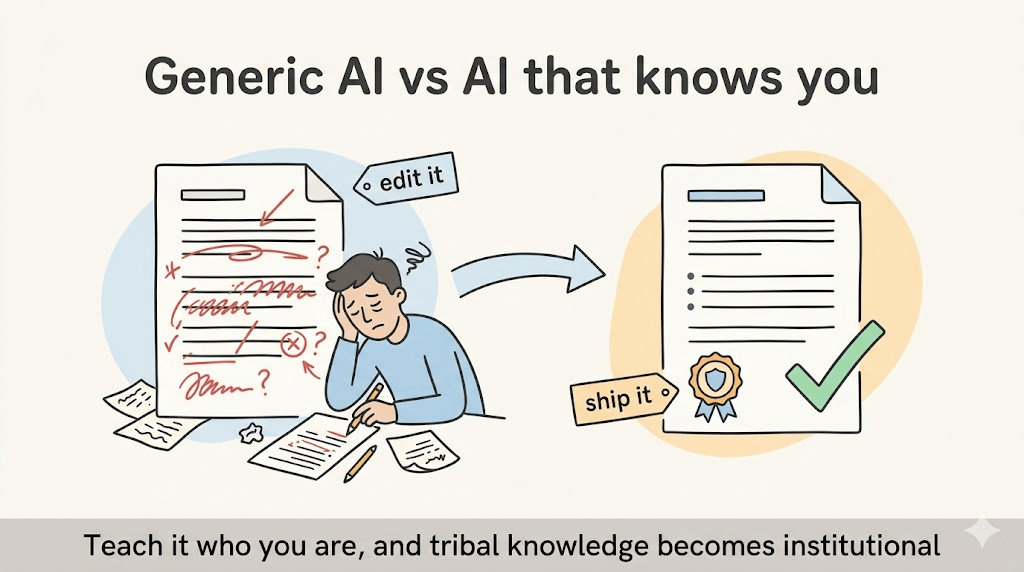
Notice what actually changed. The analyst didn't get a faster spreadsheet. She got her afternoons back — for judgement, the thing the company actually pays her for. And the knowledge of how to read L'Oréal's data, which used to live in a few experts' heads, now lives in the system, available to every new hire on day one.
The teaching: "Generic AI drafts a document. AI that knows how your company works drafts a document your team can ship. The difference is whether you taught it who you are — and that turns knowledge that was tribal into knowledge that's institutional."
The support queue that taught itself
A rider opens the Lyft app, something's gone wrong with a trip, and they tap for help. Not long ago, this was the start of a bad half hour — a thirty-to-forty-minute wait, an agent juggling four other people, a copy-pasted reply that didn't quite fit the actual problem.
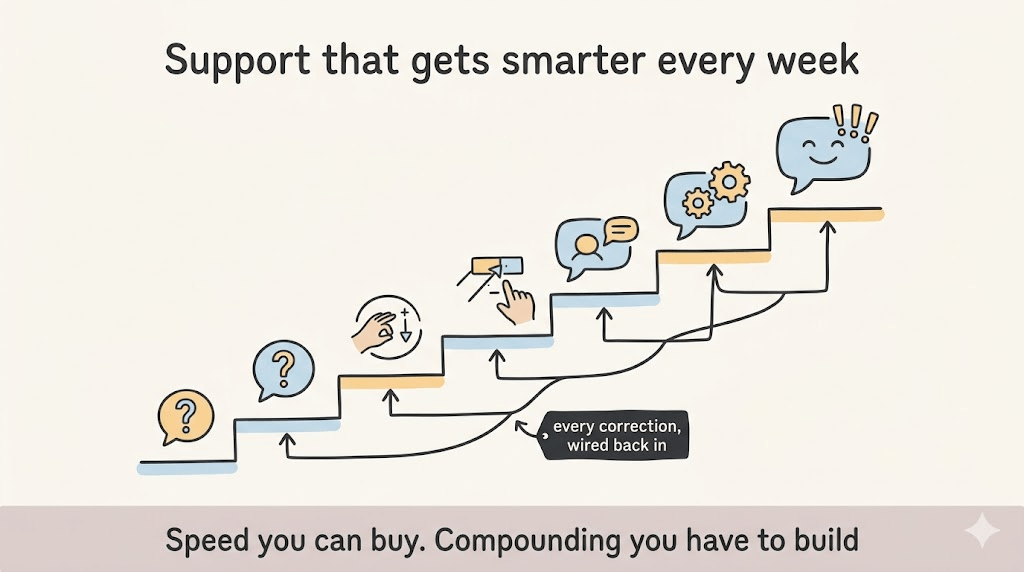
Now the answer comes in seconds, by name, aware of what actually happened on that specific ride. And here's the part that matters most: it gets better every week.
Lyft operates across six continents and thousands of cities, and its support had hit a wall — long waits, burnt-out agents, a robotic experience nobody wanted. It put Claude at the centre. Resolution time fell by over 87%. Decision-making accuracy rose by more than 30%. But the deeper shift was structural. Every time a human expert reviewed and refined an answer, that lesson fed back into the system — so the next answer, and every answer after it, started from a higher baseline.
That's the thing most people miss about doing this well. A manual process starts from scratch every single time. A compounding one doesn't. Lyft's experts stopped being a bottleneck for volume and started pouring their judgement into the hard cases — which is how the savings funded Lyft Silver, dedicated one-on-one support for older riders. The robots took the boring work so the humans could do the human work.
The teaching: "Speed you can buy. Compounding you have to build. The organisations pulling ahead aren't the ones whose AI is fastest today — they're the ones whose AI is a little smarter every week, because every expert correction is wired back in."
The wall every great AI product hits
An engineer at a regulated company has a brilliant idea for an AI product. Technically superior. Clearly better than anything out there. She builds the prototype. It works. And then it dies — not in the market, but in a compliance review, because making it work meant letting customer data step outside the company's security perimeter, even for a second.
This is the wall, and almost nobody sees it coming. In industries built on trust — finance, healthcare — data security and compliance aren't features you add later. They're the ground you have to build on. A product that can't live inside your existing trust boundary is a product that never ships, no matter how good it is.
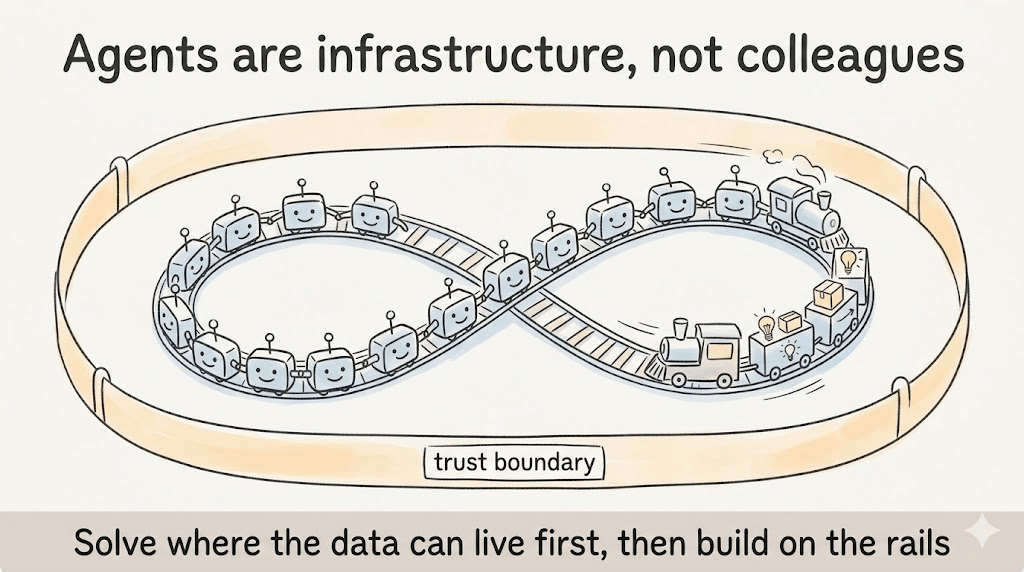
Rakuten understood this, and made a structural choice because of it. Rather than have its best engineers spend weeks maintaining the plumbing under every agent, it adopted Claude's managed agents and offloaded the execution layer entirely — so the team could pour its talent into the experience instead. The results read like a different company: major product releases now ship every two weeks instead of once a quarter, and initial critical errors dropped 97% in the pilot. A single product manager now builds pipelines across multiple clouds and runs monitoring agents — work that was simply out of reach before.
The reframe Rakuten lands on is the quiet revolution in the whole guide. The agents aren't future colleagues. They aren't competitors coming for jobs. They're infrastructure — the thing through which the company now accelerates everything it builds. You don't worry about whether the electricity is your colleague. You just build on it.
The teaching: "In a regulated business, the trust boundary is the first design constraint, not the last. Solve where the data is allowed to live before you fall in love with what the product can do — and once you do, stop treating the agents as staff. They're the rails the whole company now runs on."
Why the knowledge has to leave people's heads
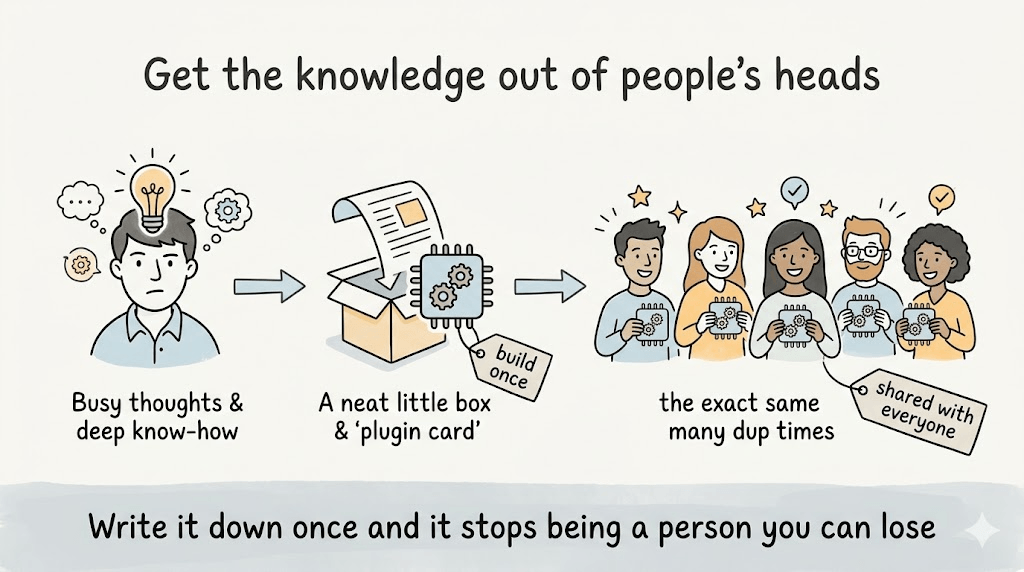
There's a person at every company — let's call him David — who just knows how things are done. How the sales pitch really works. Which clause in the contract always gets flagged. The unwritten rules. When David is in the room, everything is smoother. When David is on holiday, everyone feels it.
Every company runs on a hundred Davids, and all of their knowledge is trapped where it's hardest to reach: inside their heads. The shift the leading companies make is to get that knowledge out — encoded once, so it belongs to everyone.
That's what Anthropic built Claude Cowork and plugins to do. A plugin is just a package of a team's hard-won expertise — its standards, its tools, its way of working — built once and shared across the whole organisation. The legal team's Claude knows the review playbook. The finance team's Claude knows the reporting standards. And it's not limited to one company's cleverness: Anthropic open-sourced eleven of these to start. Novo Nordisk used the same idea to take clinical study documentation from ten-plus weeks to ten minutes. RBC built an agentic system now serving 2,200 advisors who manage $689 billion in assets.
The marginal cost of sharing what David knows is basically zero. The marginal value is enormous. That's the whole game: the best practice of your single best person becomes the default for every person.
The teaching: "The knowledge that makes your company good is mostly trapped in a few people's heads. Write it down once — into a plugin, a skill, a shared system — and it stops being a person you can lose and becomes infrastructure you can build on."
Don't wait until you have the perfect plan
Somewhere right now, a smart executive is doing the most reasonable-sounding thing in the world: waiting. Waiting until the AI strategy is complete. Until every risk is mapped, every use case ranked, every department aligned. It feels responsible. It is, quietly, the most expensive mistake of all.
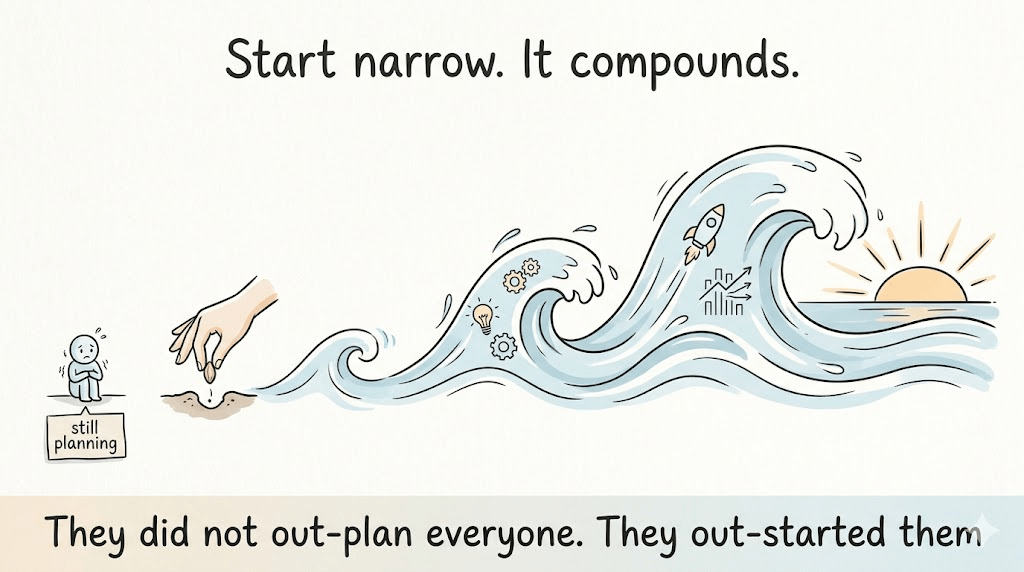
Because the companies that pulled ahead didn't start with a perfect plan. They started narrow. They picked one team, one process, one place where the pain was obvious and the success was easy to measure — gave Claude enough context to do real work — and measured the result honestly. Then they did it again.
The guide lays out a simple shape: spend the first weeks just deciding what success even looks like. Run a small champion pilot for a couple of months in real workflows, not sandboxes. Then scale — and here the magic shows up, because every team that comes online benefits from the knowledge the last one already encoded. The second wave moves faster than the first. The third faster still. Advantage that compounds is advantage that's very hard to catch.
You don't need a perfect plan. You need a specific starting point, a number that tells you whether it worked, and the honesty to learn from what happens next.
The teaching: "The companies winning with AI didn't out-plan everyone. They out-started them. A narrow project you finish and measure beats a grand strategy you're still polishing — because the advantage compounds, and the compounding starts the day you begin."
The real divide
Step back from the five stories and they're all the same story, told in different rooms. An analyst who got her judgement back. A support queue that learns. A company that found the wall before it wasted a year. A hundred Davids whose knowledge finally escaped their heads. An executive who stopped waiting.
None of it was about having a better model. Both companies in our opening had the same one. The divide was never the AI. It was a choice — to treat it as a tool you bolt on, or as a new floor you build the whole company on top of.
The unsettling part is that the gap doesn't stay still. Every week, the company that chose transformation encodes a little more of itself, and its AI gets a little smarter, and its next project starts a little higher than the last. The tool stays a tool. The floor keeps rising.
The teaching: "Adoption puts a tool in front of your people. Transformation changes what your people can do. The first is a purchase. The second is a decision — and it's the only one that compounds."
No comments yet — be the first to add to the discussion. Comments appear after they’re reviewed.
Want more insights?
Subscribe to get the latest articles delivered straight to your inbox.