Microsoft just quietly stopped calling it a Copilot
These are the stories from two weeks in which Microsoft changed the metaphor it had built its whole AI strategy on — and you can read its entire roadmap in that one swapped word.
These are the stories from two weeks in which Microsoft changed the metaphor it had built its whole AI strategy on — and you can read its entire roadmap in that one swapped word.
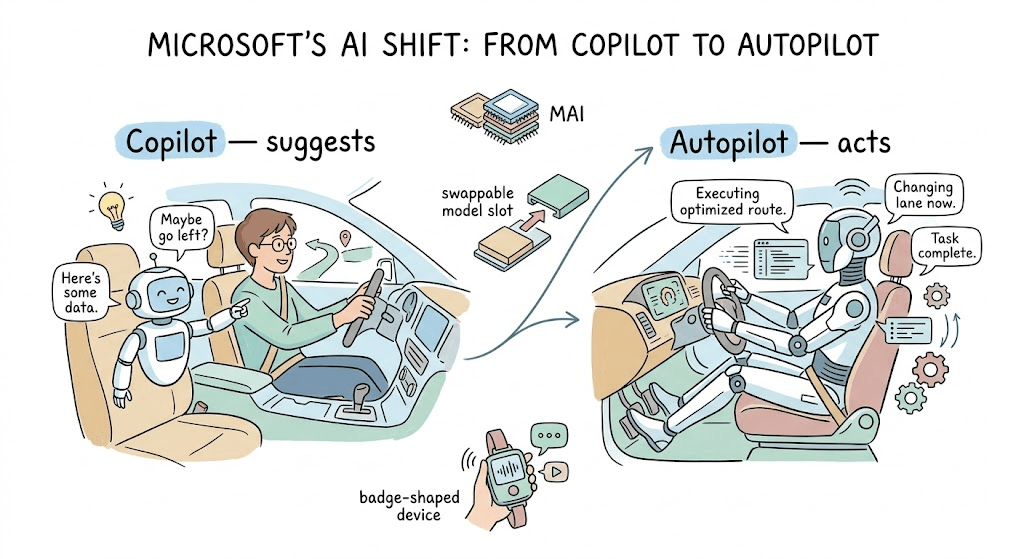
For three years, the word was Copilot. It was a careful, almost humble word. A copilot sits in the right-hand seat. It reads the map, suggests the heading, catches your mistakes — but your hands stay on the controls. That metaphor sold a billion dollars of comfort to nervous enterprises. The human is always flying.
Then, on June 2nd at Build 2026, Microsoft introduced something it deliberately did not call a Copilot. It called it an Autopilot. And in the same fortnight it unveiled its own family of AI brains, a buffet of rival models inside Word, and a vision of a computer that isn't a computer. Four announcements, one direction of travel. Let me tell them as four short stories.
The day the assistant stopped waiting to be asked
It's 8:40am. Priya hasn't opened her laptop yet. By the time she does, three things have already happened that she didn't ask for.
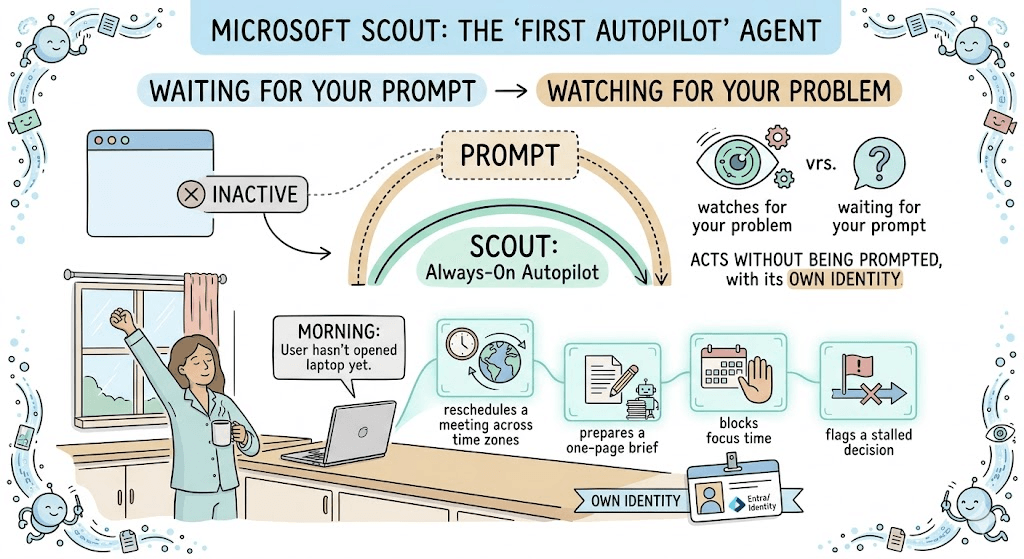
A meeting with a Tokyo supplier has been rescheduled to a slot that's civilised for both ends. A one-page brief on a customer she's seeing at eleven is sitting in her inbox, pulled together from six months of email threads. And a decision that quietly stalled two weeks ago — nobody chasing it, everybody assuming someone else was — has been flagged back to the surface.
Priya didn't prompt any of this. That's the entire point. Microsoft's new agent, Scout, is what the company is calling its "first Autopilot" — and it defines the category in one sentence: "Autopilots are always-on agents that work autonomously, with their own identity, and act on your behalf."
Read that slowly, because every clause is a departure. Always-on — it runs whether or not you've opened a chat window. Autonomously — it doesn't wait for a prompt. With their own identity — Scout has its own login, its own Entra account, not yours borrowed. Act on your behalf — it doesn't suggest the email, it can send it. Scout lives across Teams, Outlook, OneDrive and SharePoint, and reaches out through your desktop to your browser, your local files, and external tools. It schedules across time zones, blocks focus time for the deliverable you forgot was due Friday, and watches for the decisions that go quiet.
Copilot answered questions. Scout does the work between the questions. That is not a feature update. That is a different seat in the cockpit.
The teaching: "A Copilot waits for your prompt. An Autopilot watches for your problem. The gap between those two verbs is the whole next decade of software."
Microsoft stopped renting its intelligence and started growing its own
Picture a tenant who has paid rent on the same flat for years. Good flat, great location. But every month the cheque goes to someone else, and the landlord sets the rules. One day the tenant quietly buys the building next door and starts moving in.
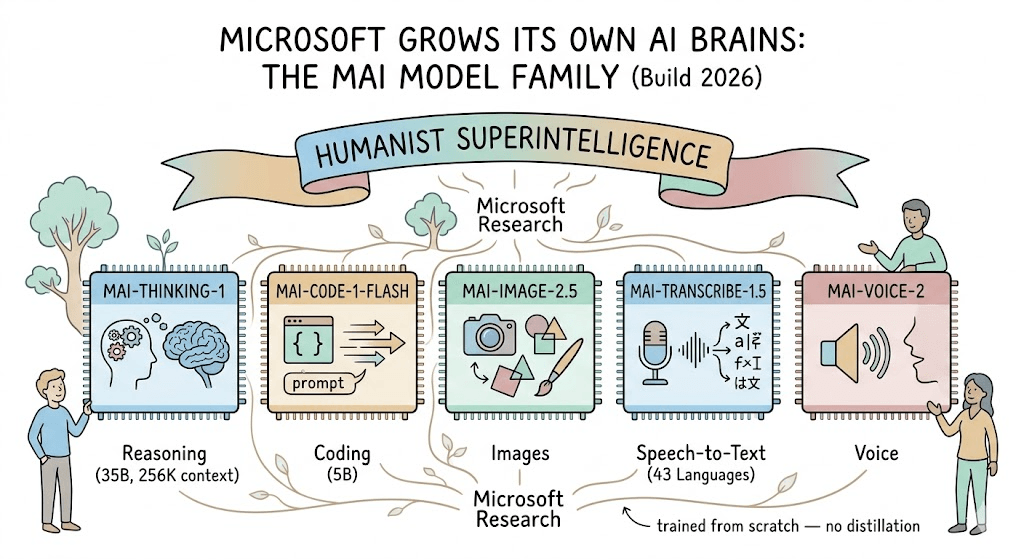
For years, the intelligence inside Copilot was largely rented from OpenAI. Useful, powerful — and someone else's. At Build 2026, Microsoft's AI Superintelligence Team moved into the building next door. It launched MAI, a family of its own models, and the flagship tells you how serious the move is.
MAI-Thinking-1 is Microsoft's first reasoning model: a 35-billion-active-parameter mixture-of-experts design with a 256K context window. The detail that matters most is how it was made. Microsoft says it was trained from scratch, with no distillation — it didn't learn by copying a bigger model's homework. On the AIME 25 maths benchmark it scored 97%. On the brutally practical SWE Bench Pro, which measures real software-engineering tasks, it hit 52.8%, and Microsoft says independent raters preferred its answers to Sonnet 4.6's. These are Microsoft's own numbers, not yet independently reproduced — but the ambition is unmistakable.
It doesn't stop at reasoning. There's MAI-Code-1-Flash, a tiny 5-billion-parameter coder that Microsoft is making a default inside VS Code and the GitHub Copilot CLI, claimed to be cheaper to run than Haiku 4.5. There's MAI-Image-2.5, already live generating pictures inside PowerPoint. There's MAI-Transcribe-1.5 for speech across 43 languages, and MAI-Voice-2 for synthesis, shipped with watermarking and anti-cloning baked in. A whole stack, top to bottom, with Microsoft's name on it.
And the banner over all of it is a phrase the company clearly chose with care: Humanist Superintelligence — which it defines as "state of the art AI capabilities that are explicitly designed to serve people and organizations, and not to replace them."
The teaching: "You never truly own the thing you only rent. Microsoft just decided that the brain inside its products was too important to keep borrowing."
The strange new luxury of choosing your own mind
Two analysts get the same impossible task on the same Monday: turn a messy quarter of data into a board deck by Wednesday. They open the same app. They reach for different brains.
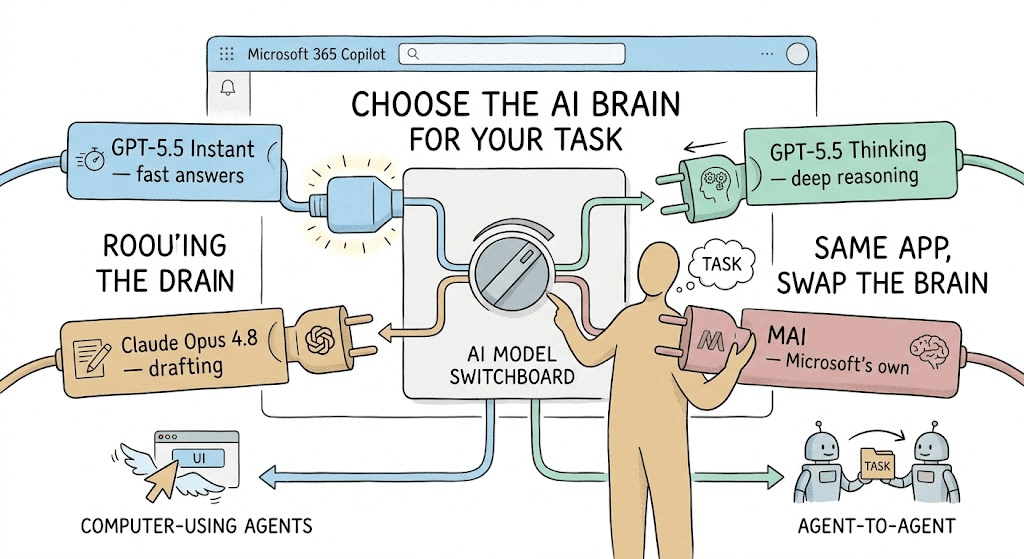
Here is the part that would have sounded absurd two years ago. Inside Microsoft 365 Copilot, you can now pick which company's frontier model does your thinking. In May, Microsoft added OpenAI's GPT-5.5 Instant for fast, everyday answers and GPT-5.5 Thinking for slow, multi-step reasoning — both confirmed in the official release notes on May 19th. Alongside them, per Microsoft's own Copilot blog, sits Anthropic's Claude Opus 4.8. And soon, Microsoft's own MAI models will be in the mix too.
So the first analyst routes her board deck through a reasoning model that plans the structure before writing a word. The second leans on Claude to draft the prose, then a fast model to clean it. Same software. Same data. Different minds for different moments. Microsoft has stopped trying to sell you the model and started selling you the switchboard.
The plumbing underneath got an upgrade too. In Copilot Studio, computer-using agents — bots that actually click around an interface like a person would — reached general availability, as did agent-to-agent communication, where one agent can hand a task to another and wait for the result. The single assistant is becoming a small, coordinated team.
The teaching: "The winning platform isn't the one with the smartest model. It's the one that lets you swap the model out on Tuesday and never notice on Wednesday."
A computer you wear, with no apps to open
A field nurse clips a small device to her lapel at the start of a shift. It's not a phone. There's no home screen, no grid of icons, nothing to launch. She just talks, and the right interface appears for exactly as long as she needs it, then dissolves.
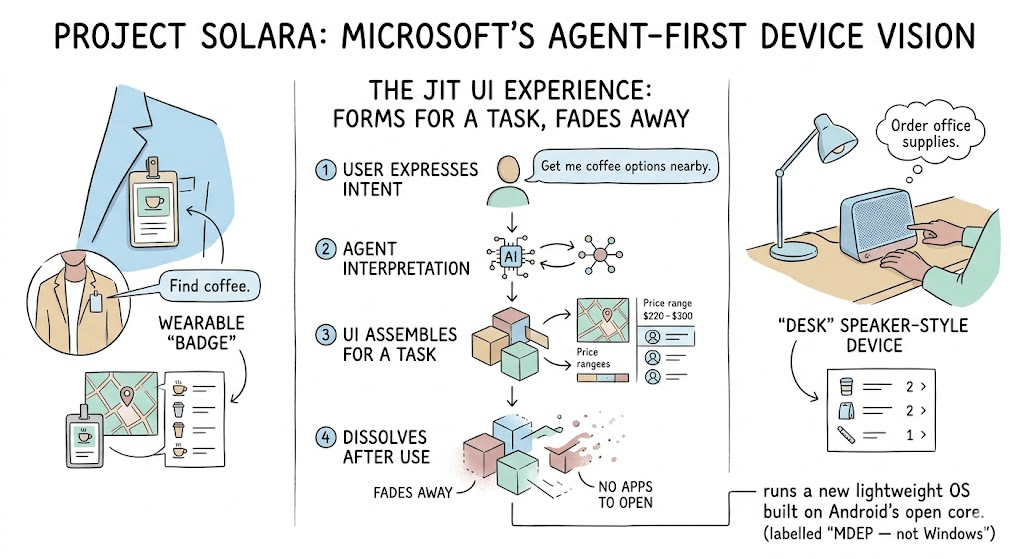
That nurse's badge is the idea behind Project Solara, the most futuristic thing Microsoft showed all fortnight. Solara is a platform for "agent-first" devices — hardware designed from scratch for a world where you don't open apps, you express intent and let agents act.
The detail that made people sit up: Solara doesn't run Windows. It runs a new, lightweight operating system built on top of Android's open-source core, which Microsoft calls MDEP — the Microsoft Device Ecosystem Platform. Microsoft, the company whose entire identity is Windows, sketched a future device that leaves Windows behind. It showed two concept gadgets — a pocketable Badge and a Desk speaker — and described "just-in-time UI," where the screen assembles itself around the task instead of forcing the task into fixed apps. An external pilot is coming with names like Best Buy, CVS Health, Levi's and Target.
It's a concept, not a product you can buy. But concepts are how a company tells you where it actually thinks the puck is going.
The teaching: "The app was a container for human attention. When the agent does the opening, the clicking and the closing, the container quietly disappears — and so does the screen you thought you couldn't live without."
The fine print is where the future actually lives
An IT administrator at a mid-sized firm reads the Scout announcement twice. The first read is excitement. The second read is the job.
Because here is the unglamorous truth underneath the keynote sparkle: Scout is not a button you flip on for everyone Monday morning. It's in private preview, limited to "Frontier" organizations, marked experimental. Switching it on means enrolling in that program, configuring Intune device policy, collecting an explicit opt-in attestation, and holding a GitHub Copilot license. This is software wearing a hard hat.
And that caution is the most interesting thing about it. An agent that acts on your behalf is only trustworthy if you can see exactly what it did and stop it before it does harm. So Microsoft gave Scout its own Entra identity rather than letting it impersonate you — meaning every action it takes is logged as Scout's, not yours. Its credentials are scoped and redacted from logs. It inherits your organisation's existing access controls, asks a human before anything sensitive, and obeys Purview's data-loss-prevention rules and sensitivity labels.
That list reads like a wishlist, and the gap between a keynote demo and a governed rollout is where most of this year's real work will happen. But notice what it signals. The hard problem of autonomous AI was never can it act. It was can you trust it to act, and prove what it did afterwards. Microsoft spent as much breath on identity and audit as it did on capability — which tells you they finally understand which problem actually sells.
The teaching: "Anyone can demo an agent that acts. The companies that win are the ones who can show you exactly what it did, under whose name, and how to stop it. Autonomy without an audit trail is just a liability with good marketing."
One swapped word
Step back from the four stories and they rhyme. An assistant that acts instead of waits. A company that grows its own intelligence instead of renting it. A switchboard of competing minds instead of one. A device with no apps to open. Every one of them moves in the same direction — away from the tool you operate, toward the agent that operates on your behalf.
Microsoft told you all of it in a single edit. For three years the word was Copilot: a hand on your shoulder, your hands on the controls. Now there's a word sitting next to it — Autopilot — and it means something the older word was carefully built never to mean.
The question for the rest of us isn't whether the plane can fly itself. Build 2026 was Microsoft's answer to that, and the answer was yes. The question is the one Priya's IT administrator was really asking on his second read: when the assistant stops waiting to be asked, what exactly are you still in charge of — and can you prove it?
The teaching: "Watch the metaphors, not the features. The day your tools stop being called assistants is the day your real job quietly changes from doing the work to deciding what the work is allowed to do."
No comments yet — be the first to add to the discussion. Comments appear after they’re reviewed.
Want more insights?
Subscribe to get the latest articles delivered straight to your inbox.