Enterprise AI Agents: The 2026 Strategic Playbook
How Organizations Are Transforming Operations with Autonomous AI Systems
Enterprise AI Agents: The 2026 Strategic Playbook
How Organizations Are Transforming Operations with Autonomous AI Systems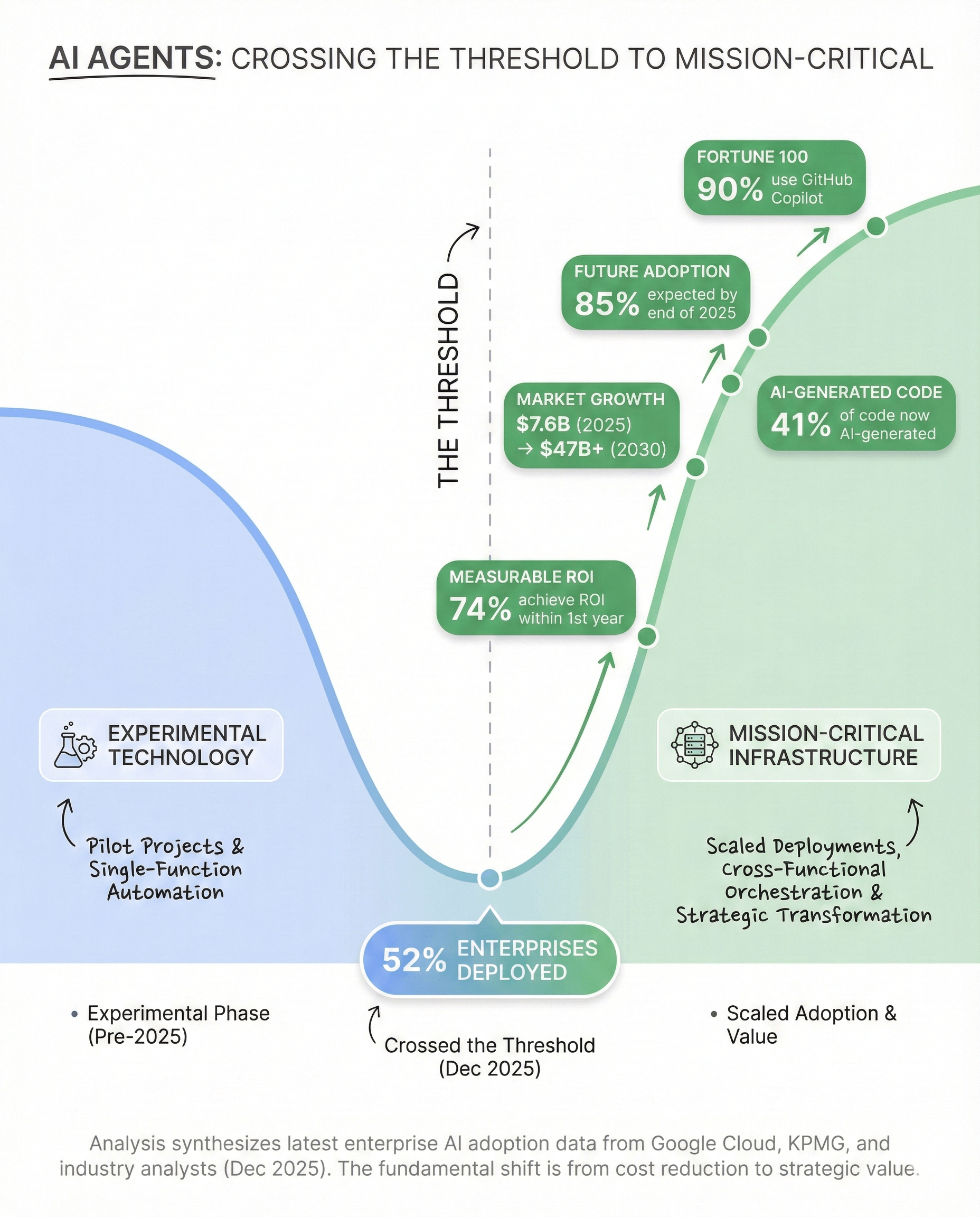
EXECUTIVE SUMMARY
The Bottom Line: AI agents have crossed the threshold from experimental technology to mission-critical infrastructure. New research from Google Cloud, KPMG, and industry analysts reveals that 52% of enterprises have deployed AI agents in production, with 74% achieving measurable ROI within the first year. The organizations capturing the most value aren't just automating tasks—they're fundamentally redesigning how work gets done.
This analysis synthesizes the latest enterprise AI adoption data from December 2025, providing actionable insights for technical leaders, business strategists, and decision-makers navigating the AI agent landscape. The findings signal a fundamental shift: from pilot projects to scaled deployments, from single-function automation to cross-functional orchestration, and from cost reduction to strategic transformation.
Key Numbers at a Glance: 52% of enterprises have deployed AI agents • 74% achieve ROI within first year • 85% of enterprises expected to implement by end of 2025 • $7.6B market in 2025 → $47B+ by 2030 • 41% of code now AI-generated • 90% of Fortune 100 use GitHub Copilot
PART I: THE CURRENT STATE OF ENTERPRISE AI AGENTS
What Are AI Agents in 2026?
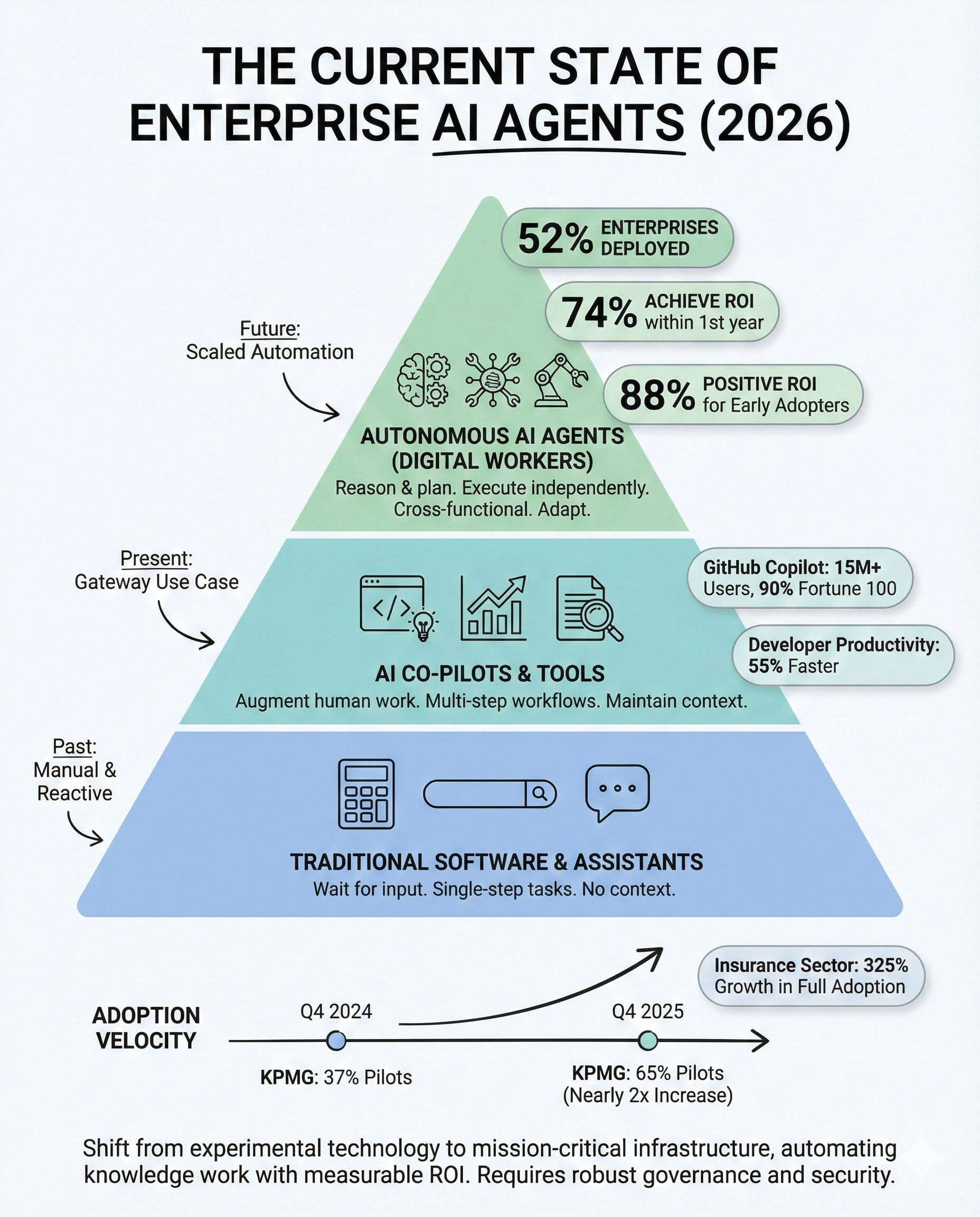
AI agents represent a fundamental evolution beyond traditional software and basic AI assistants. Unlike conventional applications that wait for human input, agents reason through problems, make decisions, and take action autonomously. They handle everything from multi-step coding workflows to cross-functional business processes spanning multiple teams and systems.
For Business Users: AI agents are software systems that complete complex tasks independently—digital workers who research, analyze, execute, and verify their own work without constant human supervision.
For Technical Users: Autonomous systems built on foundation models capable of planning and executing multi-step workflows. They differ from basic LLM applications through their ability to use tools, maintain context across sessions, and adapt based on real-world feedback.
For Decision Makers: Infrastructure that automates knowledge work at scale. The shift requires enterprise-grade security, compliance frameworks, and robust governance—but delivers measurable ROI within the first year for 74% of deploying organizations.
Adoption Velocity: The Numbers
The pace of enterprise AI agent adoption has accelerated dramatically through 2025. According to Google Cloud's September 2025 ROI study surveying 3,466 senior leaders across 24 countries:
- 52% of executives report their organizations have deployed AI agents in production
- 13% are "agentic AI early adopters" dedicating 50%+ of AI budget to agents with deep operational integration
- 88% of early adopters report positive ROI on at least one use case (vs. 74% average)
- 77% of executives report increased AI spending as technology costs fall
KPMG's Q1 2025 AI Pulse Survey of 130 C-suite leaders at $1B+ organizations found that 65% have progressed from experimentation to fully-fledged pilot programs—up from 37% the previous quarter. InsuranceNewsNet's 2025 analysis revealed the fastest adoption curve in any regulated sector: insurers moved from 8% full AI adoption in 2024 to 34% in 2025, a 325% increase.
AI Coding Agents: The Gateway Use Case
AI coding assistance has become the proving ground for enterprise AI adoption. GitHub Copilot now has over 15 million users—a 400% increase in one year—with 90% of Fortune 100 companies using the tool. The data on productivity impact is now substantial:
| Metric | Finding |
|---|---|
| Code written by AI | 46% average (up to 61% for Java) |
| Developer productivity increase | 55% faster coding in controlled studies |
| Developer satisfaction increase | 75% higher than non-users |
| Suggestion acceptance rate | ~30% of suggestions accepted |
| Time to realize full productivity gains | 11 weeks (Microsoft research) |
Critical Context: While productivity gains are real, GitClear's 2025 analysis of 211 million changed lines from Google, Microsoft, Meta, and enterprise codebases found concerning trends: code duplication increased 4x, and short-term code churn is rising. This suggests a need for strong code review practices alongside AI adoption.
PART II: ENTERPRISE AI AGENTS IN PRODUCTION
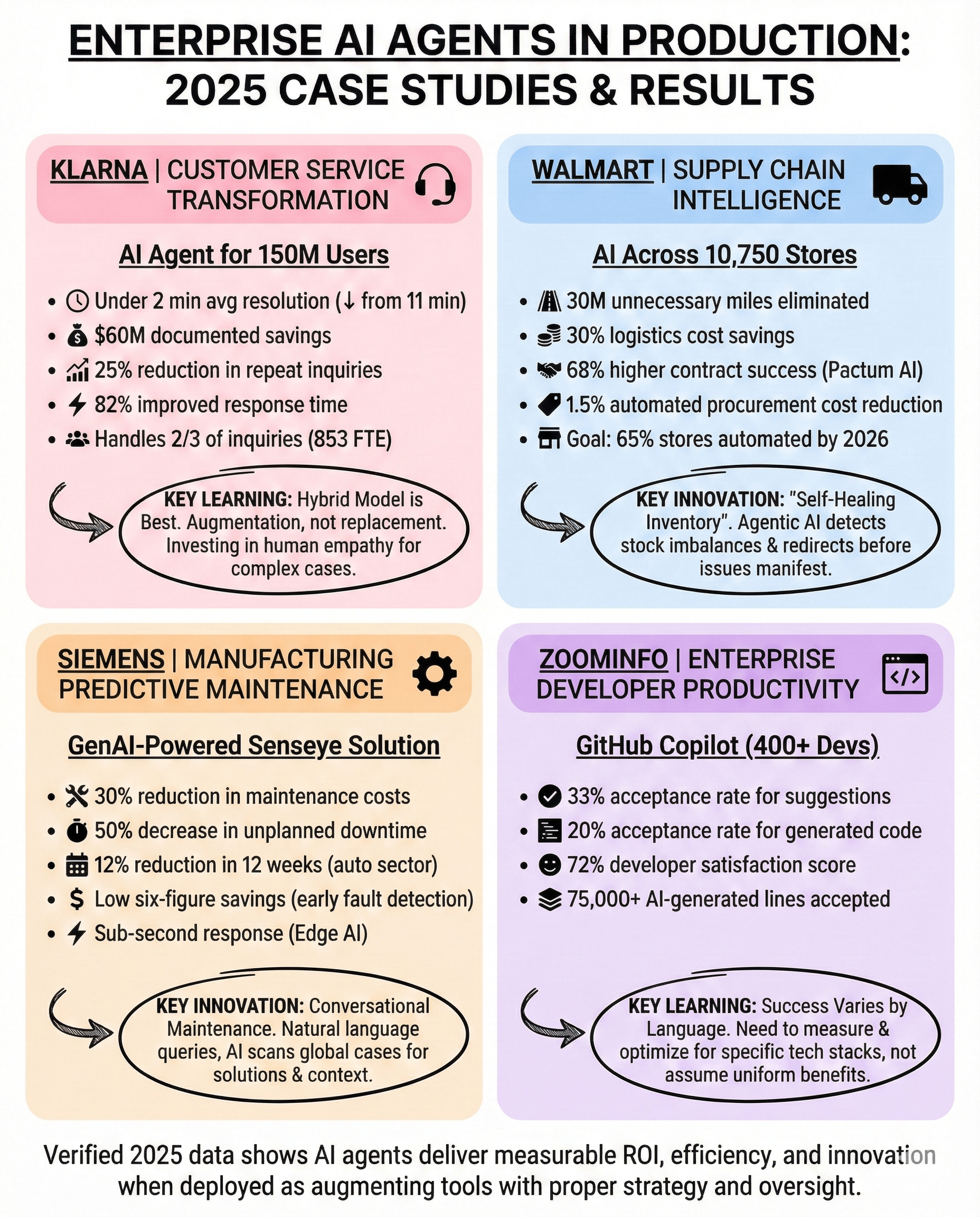
The most compelling evidence for AI agent value comes from production deployments. Here are verified case studies from 2025 with documented results:
Case Study 1: Klarna—Customer Service Transformation
Context: Swedish fintech Klarna deployed an OpenAI-powered customer service agent to handle its 150 million global users across 23 markets.
Results (Q3 2025):
- AI agent handles two-thirds of all customer inquiries (equivalent to 853 FTE)
- Average resolution time: under 2 minutes (down from 11 minutes)
- 25% reduction in repeat inquiries
- $60 million in documented savings
- Response time improved by 82%
Key Learning: In May 2025, Klarna's CEO acknowledged the company had "gone too far" with AI-only service, and announced a hybrid model ensuring customers always have access to human agents. This pivot demonstrates that AI agents work best as augmentation, not replacement. The company now uses AI for routine queries while investing in human empathy for complex cases.
Case Study 2: Walmart—Supply Chain Intelligence
Context: Walmart operates over 10,750 stores worldwide with $681 billion in FY2025 revenue. The company has deployed AI and automation across its entire supply chain.
Results:
- 30 million unnecessary driving miles eliminated through ML-powered route optimization
- 30% logistics cost savings
- 68% higher contract success rates using Pactum AI for supplier negotiations
- 1.5% cost reduction through automated procurement
- Goal: 65% of stores automated by 2026
Key Innovation: Walmart's "self-healing inventory" system uses agentic AI to detect stock imbalances and automatically redirect products before issues manifest in stores. Associates can ask natural language questions like "What items were shorted in these stores?" and receive instant insights with recommended next steps.
Case Study 3: Siemens—Manufacturing Predictive Maintenance
Context: Siemens deployed its Senseye Predictive Maintenance solution with generative AI capabilities across manufacturing clients including Sachsenmilch (one of Europe's most modern dairy facilities) and BlueScope (Australian steel manufacturer).
Results:
- 30% reduction in maintenance costs reported by production lines
- 50% decrease in unplanned downtime
- 12% reduction in unplanned downtime within 12 weeks of deployment (automotive sector)
- Low six-figure savings from single early fault detection at Sachsenmilch
- Edge AI enables sub-second response times for safety-critical applications
Key Innovation: Siemens' generative AI functionality makes predictive maintenance conversational. Maintenance teams can query the system in natural language, and the AI scans and groups cases across multiple languages, finding similar past cases and their solutions to provide context for current issues.
Case Study 4: ZoomInfo—Enterprise Developer Productivity
Context: ZoomInfo, a leading GTM Intelligence Platform, deployed GitHub Copilot across 400+ developers with a systematic four-phase evaluation approach.
Results (January 2025):
- 33% acceptance rate for AI suggestions
- 20% acceptance rate for generated lines of code
- 72% developer satisfaction score
- 75,000+ lines of AI-generated code accepted during study period
Key Learning: Success varies by programming language. The study found significant performance variations across different languages, emphasizing the need for teams to measure and optimize for their specific tech stack rather than assuming uniform benefits.
PART III: ROI REALITY CHECK AND MARKET OUTLOOK
Documented ROI Across Use Cases
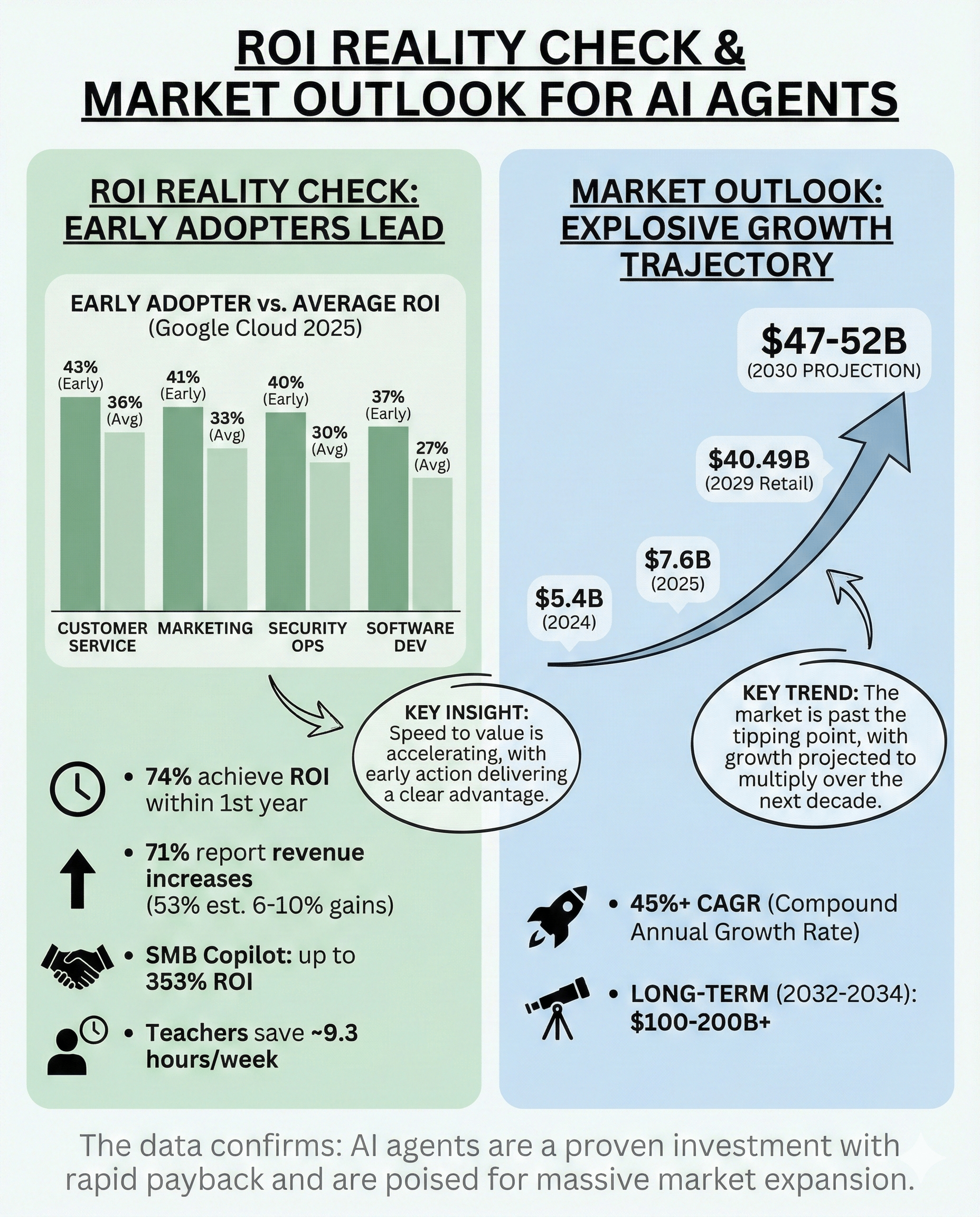
Google Cloud's 2025 ROI study provides the most comprehensive view of AI agent returns by function. Early adopters consistently outperform average organizations:
| Use Case | Early Adopter ROI | Average ROI |
|---|---|---|
| Customer Service & Experience | 43% | 36% |
| Marketing Effectiveness | 41% | 33% |
| Security Operations | 40% | 30% |
| Software Development | 37% | 27% |
Additional ROI Data Points:
- 74% of executives achieve ROI within the first year (Google Cloud)
- 71% of organizations with ROI report revenue increases, with 53% estimating 6-10% gains
- Microsoft Copilot for SMBs: up to 353% ROI
- Teachers using Copilot save approximately 9.3 hours per week
- 62% of companies expect 100%+ ROI from AI agent deployments
Market Size and Growth Trajectory
The AI agents market is experiencing explosive growth:
| Timeframe | Market Size |
|---|---|
| 2024 | $5.4 billion |
| 2025 | $7.6 billion |
| 2029 (AI retail market) | $40.49 billion |
| 2030 Projection | $47-52 billion (45%+ CAGR) |
| 2032-2034 Long-term | $100-200 billion+ |
PART IV: STRATEGIC IMPLEMENTATION FRAMEWORK
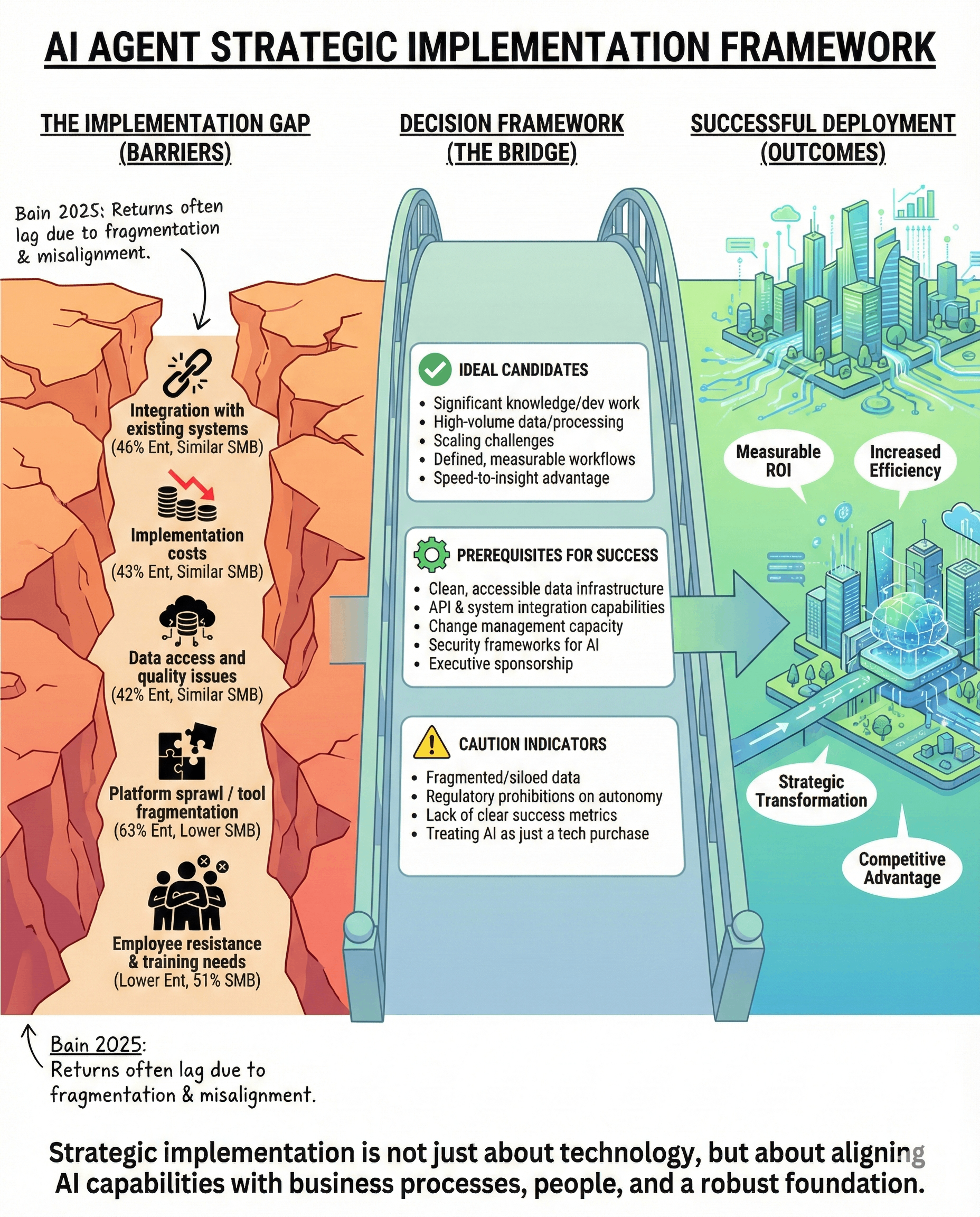
Common Implementation Barriers
Bain's 2025 Technology Report provides important nuance: while AI investment is up, returns often lag expectations. The gap stems from fragmented workflows, insufficient integration, and misalignment between AI capabilities and business processes. Top barriers by organization size:
| Barrier | Enterprise | SMB |
|---|---|---|
| Integration with existing systems | 46% | Similar |
| Implementation costs | 43% | Similar |
| Data access and quality issues | 42% | Similar |
| Platform sprawl / tool fragmentation | 63% | Lower |
| Employee resistance & training needs | Lower | 51% |
Decision Framework: Should You Deploy AI Agents?
Ideal Candidates:
- Organizations with significant knowledge work or software development functions
- High-volume data, document, or customer interaction processing
- Scaling challenges that cannot be solved by hiring alone
- Clearly defined, documentable, and measurable workflows
- Competitive markets where speed-to-insight creates advantage
Prerequisites for Success:
- Data infrastructure: Clean, accessible data across systems
- Integration capabilities: APIs and connectivity to core systems
- Change management capacity: Ability to retrain and realign teams
- Security posture: Frameworks for handling sensitive data with AI
- Executive sponsorship: Leadership committed to systematic deployment
Caution Indicators:
- Fragmented or siloed data that cannot be surfaced to AI systems
- Regulatory constraints prohibiting autonomous decision-making
- Lack of clear success metrics for AI deployments
- Organizations treating AI as a technology purchase rather than transformation
PART V: STRATEGIC RECOMMENDATIONS FOR 2026
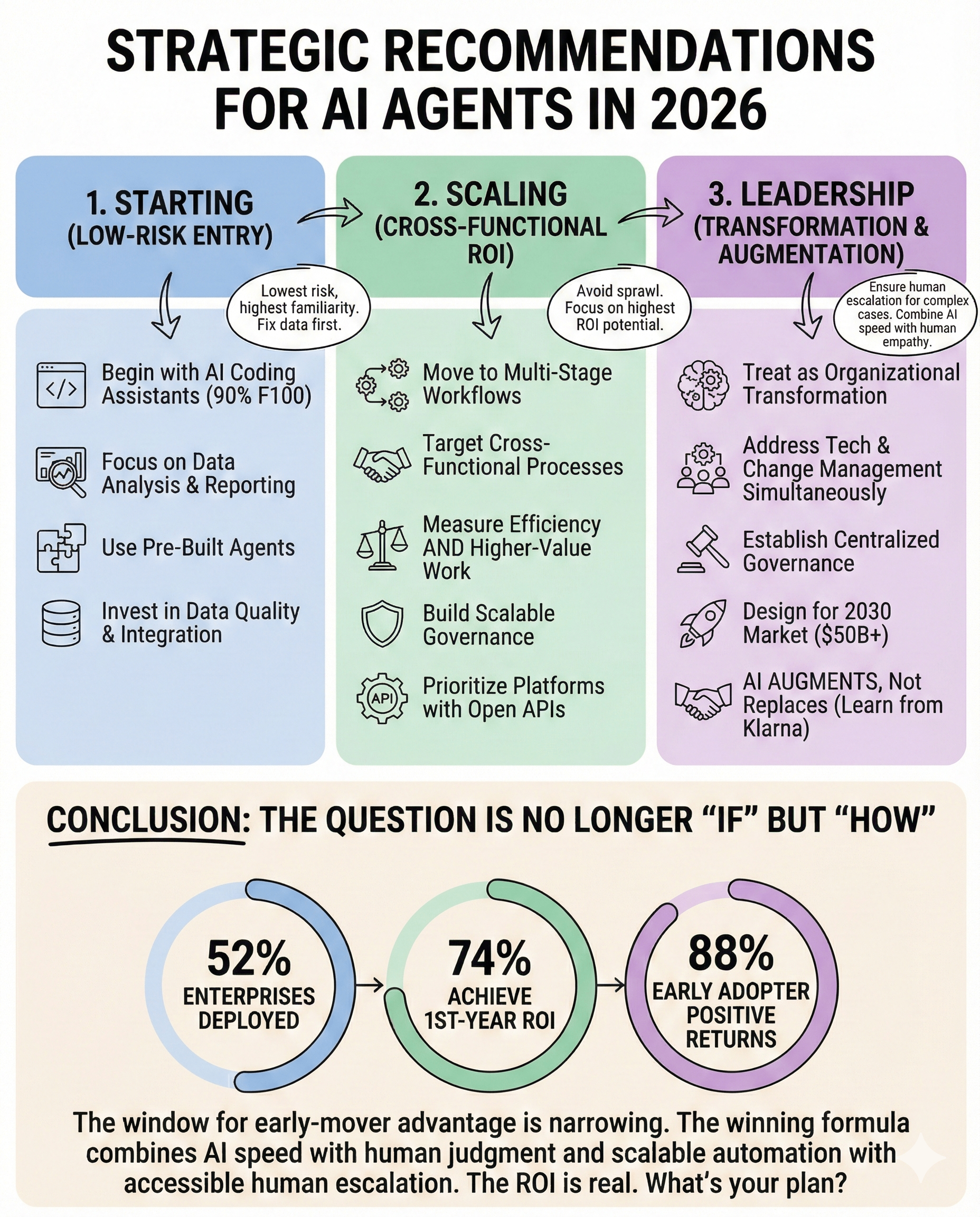
For Organizations Just Starting
Begin with AI coding assistants. 90% of Fortune 100 adoption proves the value proposition. This is the lowest-risk, highest-familiarity entry point with well-documented productivity gains.
Focus on data analysis and reporting as a cross-functional proving ground. These use cases have clear metrics and benefit multiple stakeholders.
Use pre-built agents for initial deployments. Build custom only where differentiation creates meaningful competitive advantage.
Invest in data quality and integration infrastructure before scaling. This is the most common barrier to ROI.
For Organizations Scaling
- Move from single-task to multi-stage workflows
- Target cross-functional processes for highest ROI potential
- Measure both efficiency gains AND whether employees are working on higher-value problems
- Build governance frameworks that can scale with deployment
- Prioritize platforms with native integrations and open APIs to avoid sprawl
For Enterprise Leaders
- Treat AI agent deployment as organizational transformation, not technology implementation
- Address both technical integration and change management simultaneously
- Establish centralized governance while enabling distributed experimentation
- Design for the 2030 market ($50B+) while capturing 2026 opportunities
- Learn from Klarna: AI augments, not replaces. Ensure human escalation paths for complex cases
CONCLUSION: THE QUESTION IS NO LONGER "IF" BUT "HOW"
The data is unambiguous: AI agents have crossed the threshold from experimental technology to production infrastructure. With 52% of enterprises already deployed, 74% achieving first-year ROI, and 88% of early adopters seeing positive returns, the question facing leaders is no longer whether to adopt but how to scale strategically.
The organizations capturing the most value aren't just deploying agents—they're using them to fundamentally redesign how work gets done. They're measuring success not just in efficiency gains but in whether their people are working on progressively higher-leverage problems. And they're building the infrastructure and expertise that will let them capture disproportionate value as the technology matures.
The critical insight from 2025's deployments—particularly Klarna's pivot—is that AI agents work best as augmentation, not replacement. The winning formula combines AI speed with human empathy, automated efficiency with human judgment, and scalable automation with accessible human escalation.
The window for early-mover advantage is narrowing. The data is in. The ROI is real. The question is: what's your plan?
SOURCES & METHODOLOGY
Primary Research Sources:
- Google Cloud ROI of AI Study (September 2025) — 3,466 senior leaders, 24 countries
- KPMG Q1 2025 AI Pulse Survey — 130 C-suite leaders, $1B+ organizations
- Bain 2025 Technology Report and Executive AI Survey
- GitClear 2025 AI Code Quality Research — 211 million changed lines
- GitHub Copilot Enterprise Data (October 2025)
- ZoomInfo Copilot Case Study (January 2025) — 400+ developers
- Klarna Earnings Reports (Q1-Q3 2025)
- Walmart Supply Chain Technology Updates (2025)
- Siemens Senseye Predictive Maintenance Case Studies (2025)
- InsuranceNewsNet 2025 Industry Analysis
Supplementary Market Data:
- Grand View Research — AI Agents Market Size and Share Report
- McKinsey — The State of AI (November 2025)
- Deloitte Analytics Institute — Predictive Maintenance ROI Studies
- Microsoft Research — Copilot Impact Studies (2024-2025)
- Gartner — Enterprise AI Forecasts 2026
No comments yet — be the first to add to the discussion. Comments appear after they’re reviewed.
Want more insights?
Subscribe to get the latest articles delivered straight to your inbox.